Somi Conveyor Beltings Ltd FY26: The ₹17 Crore Revenue Mirage and the 221-Day Working Capital Trap
Section 1 — At a Glance
Somi Conveyor Beltings Ltd reported standalone revenue of ₹100.74 crore for the full year ended March 31, 2026, marking a minor flatline from the ₹101.24 crore recorded in FY25. Net profit for the fiscal year mirrored this architectural inertia, dipping slightly to ₹5.03 crore from ₹5.49 crore in the previous year. While headline annual indicators hint at a steady industrial ship cruising on an even keel, the underlying quarterly metrics expose significant operational volatility. Revenue for the final quarter of FY26 plunged sharply by 28.8% year-over-year to ₹17.29 crore, down from ₹24.29 crore in Q4 FY25, while fourth-quarter net profit dropped 34.4% to ₹0.59 crore.
Investor attention remains intensely anchored to the company’s robust order execution pipelines, headlined by major infrastructure contract wins including a ₹48.65 crore allocation from NLC India and recurring supply mandates from public undertakings. However, structural financial vulnerabilities continue to test the endurance of long-term capital. The business remains severely burdened by its structural working capital velocity, ending the year with a punishing cash conversion cycle of 221 days, driven by massive inventory retention periods. The divergence between structural accounting profits and free cash flow generation signals that capital efficiency is still deeply subordinate to manufacturing cycle lead times.
Section 2 — Introduction
Somi Conveyor Beltings Ltd entered the public markets as a specialized player tailored to the heavy engineering, extraction, and material handling lifelines of core infrastructure. Based out of Jodhpur, Rajasthan, the enterprise designs and fabricates heavy-duty rubber and steel-reinforced transport solutions. This is an environment where capital expansion cycles dictate survival, and where balance sheets are explicitly built to withstand the long payment delays common to core-sector public enterprises.
The company’s primary corporate orientation involves providing critical utility components to high-wear heavy industrial frameworks. Over the past few years, management has focused on optimizing internal debt levels and capturing supply agreements across key core infrastructure portfolios. However, navigating the volatile purchasing cadences of state utilities and thermal power stations demands substantial working capital endurance.
Section 3 — Business Model: WTF Do They Even Do?
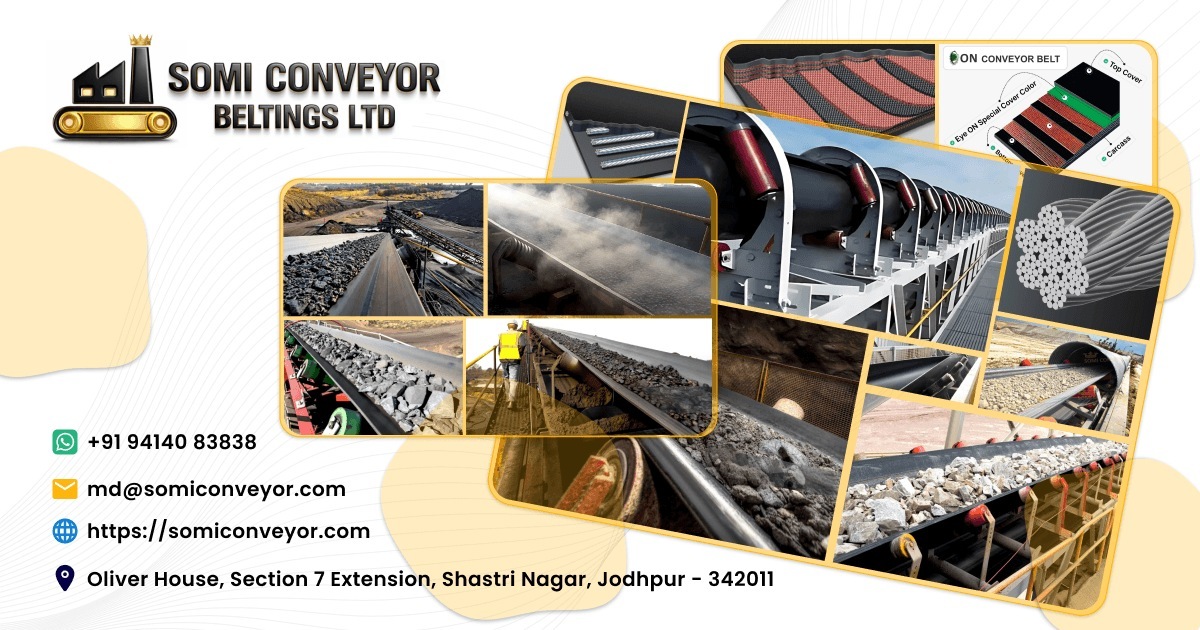
Somi Conveyor Beltings manufactures the heavy-duty industrial belts that transport millions of tons of coal, rock, cement, and hot steel across continuous processing yards. If an industrial plant involves blasting, crushing, or burning raw materials, this company provides the moving floor that prevents the entire assembly line from grinding to a dead halt. Their portfolio reads like an industrial survival kit, spanning heat-resistant, fire-retardant, oil-resistant, and bullet-proof aramid fabrics alongside high-tensile steel cord belts engineered to haul heavy matter across miles of rugged mining terrain.
The financial reality of this model is heavily tied to the budgeting whims of state power boards, national mining conglomerates, and infrastructure titans like JSW, Tata, and UltraTech. They operate two manufacturing plants in Jodhpur with an installed capacity of 12 lakh meters per annum. While selling thousands of meters of vulcanized rubber to state corporations guarantees industrial relevance, it also guarantees a life of chasing government accountants for overdue invoices.