Vibhor Steel Tubes FY26: The 156,000 MTPA Odisha Gamble and the Cost of Heavy Metal Dreams
Section 1 — At a Glance
The structural steel tube industry in India has long rewarded sheer volume over subtlety, and Vibhor Steel Tubes Limited’s full-year FY26 performance is a masterclass in the operational friction that occurs when a microcap fabricator attempts to scale into a multi-regional infrastructure player. Headline numbers present a stark divergence between top-line expansion and bottom-line preservation. Revenue for the full year reached ₹1,149.35 crore, staging a recovery from the ₹996.38 crore reported in FY25, primarily driven by the commercialization and initial volume ramp of the company’s new Unit III facility in Sundergarh, Odisha.
However, this volume-led recovery came at an immense tactical cost. While operating profit (EBITDA) recovered to ₹46.40 crore from the cyclical low of ₹38.48 crore in FY25, net profit (PAT) contracted for the second consecutive year, landing at ₹8.79 crore compared to ₹11.77 crore in FY25 and ₹17.72 crore in FY24.
The primary culprit is not a failure of demand, but the structural weight of the company’s capital expenditure program. The commissioning of the ₹119.83 crore Odisha plant has dramatically altered the income statement through structural inflation of fixed expenses. Annual depreciation surged to ₹17.00 crore, while finance costs escalated to ₹16.00 crore as bank loan facilities were enhanced to ₹370 crore to support capital deployment and working capital requirements. This operational asset-heavy transition has temporarily depressed return ratios, with Return on Capital Employed (ROCE) flattening at 11.80% and Return on Equity (ROE) dropping to a restrictive 4.46%. Investors are left balancing the promise of a higher-margin product mix against the immediate reality of an earnings profile encumbered by heavy fixed-charge coverage.
True corporate growth is rarely a linear expansion; it is an awkward mutation where asset additions outpace cash generation until utilization catches up with capacity.
Section 2 — Introduction
Vibhor Steel Tubes Limited (VSTL), established in 2003, operates in the intensely competitive and structurally low-margin segment of Electric Resistance Welded (ERW) black pipes, hot-dipped galvanized (GI) pipes, and hollow structural sections. For over two decades, the company’s business model has been structurally tethered to its long-standing relationship with Jindal Pipes Limited (JPL), manufacturing and processing pipes sold under the “Jindal Star” brand.
While this arrangement historically insulated VSTL from market-development costs and provided baseline asset utilization, it left the company vulnerable to severe customer concentration and structurally capped margins. The current fiscal year marks the defining inflection point in VSTL’s corporate history. Management is attempting a deliberate pivot away from commodity pipe processing toward high-value infrastructure fabrications—specifically highway crash barriers, transmission line towers, and specialized octagonal monopoles. The success of this transition rests entirely on the execution of its newly commissioned manufacturing hubs, particularly the massive 156,000 MTPA plant in Odisha, which repositions the company from a regional job-worker into an independent infrastructure vendor.
Section 3 — Business Model: WTF Do They Even Do?
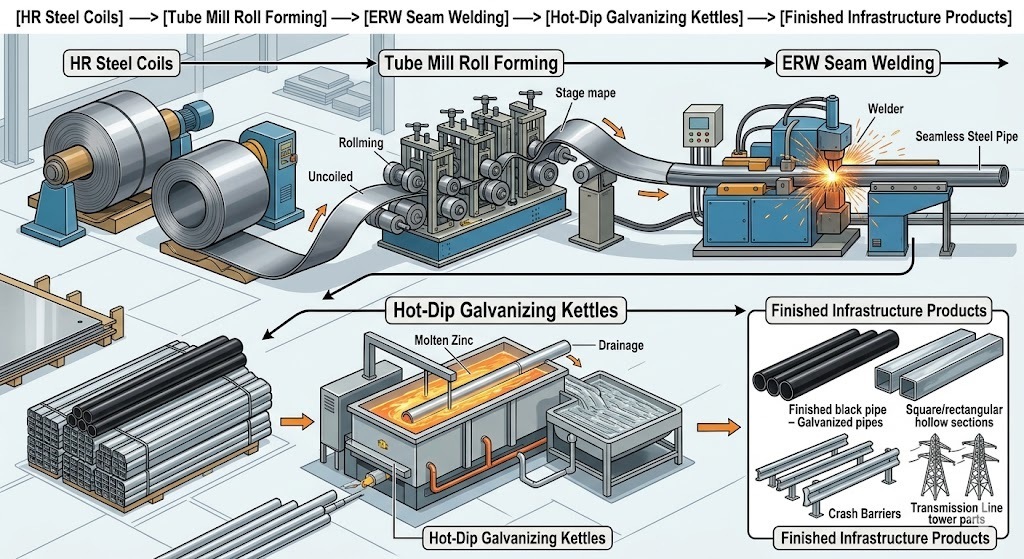
To understand Vibhor Steel Tubes, one must look past the complex metallurgy terminology and realize they are essentially an industrial tailor for infrastructure projects. They buy Hot Rolled (HR) steel coils from primary producers, roll them into round, square, or rectangular shapes, weld the seams, and frequently dip them into giant vats of molten zinc to stop them from rusting.
Historically, 90% of this output was standard galvanized iron (GI) pipes handed over directly to Jindal Pipes Ltd to be sold under their brand name. It is a stable, low-drama relationship that guarantees the company can sell at least 1,00,000 metric tonnes of pipe a year, but it possesses the financial excitement of a fixed deposit.
The new business architecture is an open attempt to break out of this margin prison. VSTL is realigning its product mix to a target of 75% GI pipes and 25% “Others” by FY28. These “Others” are where the real margin drama lives. Instead of selling simple water transport tubes, the company has begun fabricating heavy mild-steel highway crash barriers, massive steel lattices for power transmission line towers, and large-diameter monopoles designed to support high-voltage electrical lines (up to 765 kV). These products do not just sit in dirt; they require rigorous state-by-state department certifications and empanelments, turning regulatory approval into the ultimate operational gateway before a single rupee of high-margin revenue can be recognized.
Section 4 — Financials Overview
Figures are consolidated, in ₹ crore.
Quarterly Performance Trend
Metric
Latest Quarter (Mar 2026)
YoY Change (%)
QoQ Change (%)
Revenue
335.13
+16.24%
+11.15%
EBITDA
15.34
+26.15%
+72.36%
PAT
2.57
-42.12%
+54.82%
Reported EPS (₹)
1.36
-47.29%
+54.55%
The top-line velocity observed in Q4 FY26 indicates that the underlying volume engine has finally caught fire, with revenue expanding 16.24% year-over-year to ₹335.13 crore. This acceleration was fueled directly by the commercial output of the Odisha unit, which began contributing to shipments. EBITDA margins expanded sequentially to 4.59%, reflecting localized logistics advantages and raw material sourcing efficiencies close to eastern India’s primary iron markets.
What is Management Promising in the Coming Quarters?