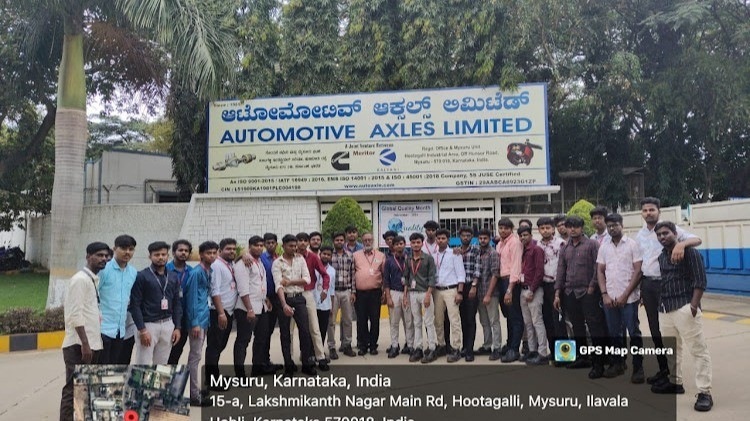
Automotive Axles Q4 FY26: A 24% Operating Margin Illusion or Structural Masterstroke?
Section 1 — At a Glance
Automotive Axles Ltd closed fiscal year 2026 with a powerful final quarter, clocking revenue from operations of ₹664.30 crore and a net profit of ₹53.89 crore. This pushed full-year sales to ₹2,177.73 crore , registering a modest top-line growth of 4.8% over the previous year. The headliner for the investor community, however, remains the structural transformation of the business model executed on April 1, 2025, which migrated the company from an indirect related-party distributor model to a direct-to-OEM fulfillment architecture. While the top-line recovery from a cyclical dip in FY25 appears steady, investor attention is fiercely split between spectacular absolute quarterly volumes and structural cost adjustments.
On one hand, the street is tracking the seamless absorption of a 4.0% to 4.5% technical fee payable to its joint-venture partner, Meritor HVS , alongside an escalating employee expense profile that rose to 7.3% of annual revenues. On the other hand, the corporate balance sheet has entered an era of pristine capitalization, holding cash and bank balances of ₹258.91 crore and nearly erasing financial leverage with total borrowings down to a negligible ₹14.06 crore. Cyclical auto-component plays often disguise structural cost inefficiencies during peak macro demand conditions. As the commercial vehicle replacement cycle flattens out, the real test of this direct-to-customer architecture will be its margin resilience when utilization trends lower. The primary intrigue moving forward lies in the company’s capability to weaponize its newly deployed capital expenditure to capture high-margin export components and outpace the domestic platform migration from multi-axle trucks to single-axle tractor-trailers.
Section 2 — Introduction
Automotive Axles Ltd stands as an established industrial benchmark within the domestic commercial vehicle ecosystem. Formed in 1981 as a 50-50 joint venture philosophy between the Kalyani Group and Meritor Inc., USA , the corporate entity operates as a premier designer and manufacturer of rear drive axles, steer axles, and braking systems for light, medium, and heavy commercial vehicles.
The structural landscape of the company changed dramatically following global parent alignments, bringing it under the technological umbrella of Cummins Inc.. The reason this business commands intense analytical scrutiny today is the termination of its legacy related-party transaction pipeline. Shareholders previously rejected restrictive commercial terms with sister entity Meritor HVS (India) Ltd , forcing a wholesale operational restructuring. Effective April 2025, the company took direct ownership of its customer relationships, transitioning from a sub-contracted manufacturing unit to a front-line engineering partner. This article analyzes the audited financial reality of this structural overhaul against the backdrop of an auto industry balancing peak domestic volumes against an unpredictable global export market.
Section 3 — Business Model: WTF Do They Even Do?
To the uninitiated investor, Automotive Axles simply bends heavy steel. In reality, it runs a highly precise, technologically intensive engineering shop that dominates the driveline architecture of Indian heavy transport. The business is the largest independent axle manufacturer and the second-largest commercial brake producer across the Indian subcontinent. Its product line spans massive rear drive axles, front steer axles, off-highway specialty drivelines, and foundational drum and disc brake systems.
The operational blueprint relies heavily on customer wallet share, with a historical anchor client relationship where Ashok Leyland commands 50% to 60% of the aggregate revenue mix. The rest is balanced across tier-1 OEMs including Tata Motors, Daimler India, Mahindra & Mahindra, and Volvo Eicher. Structurally, the product mix has evolved toward diversification: rear drive axles accounted for 57% of FY25 revenue compared to 70% in FY17, while brakes and auxiliary parts scaled up to 22% and 21% respectively. The corporate apparatus operates through three strategic manufacturing hubs situated at Mysore, Jamshedpur, and Rudrapur , having systematically decommissioned its unviable Hosur facility in early 2025 to optimize asset utilization.
Section 4 — Financials Overview
Figures are consolidated, in ₹ crore.
Performance Tracker
Metric
Latest Quarter (Mar 2026)
YoY (Mar 2025)
QoQ (Dec 2025)
Revenue
664.30
559.64
562.29
EBITDA / Operating Profit
77.02
62.63
63.88
PAT
53.89
45.93
38.81
EPS (₹)
35.66
30.39
25.68
The financial trajectory reflects a massive surge in absolute volume execution during the final quarter of the fiscal year. Revenue from operations escalated by 18.7% on a year-on-year basis, driven by a frenetic pace of domestic fleet acquisition prior to year-end adjustments. Operating profit metrics matched the pace, jumping to ₹77.02 crore.
The operating profit margins held firm at 11.6%, proving that the company successfully insulated its earnings core against