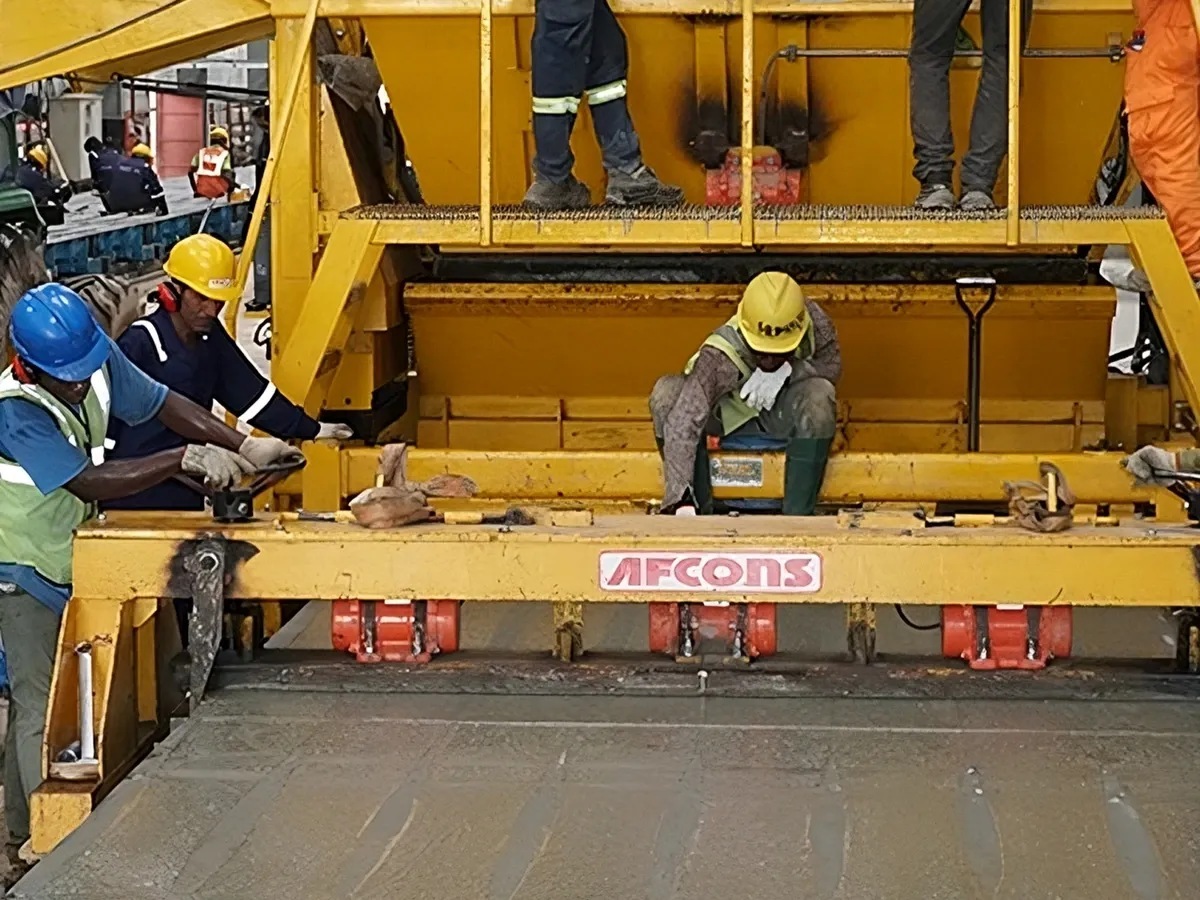
Afcons Infrastructure Ltd experienced a significant reversal in the final quarter of the financial year ended March 31, 2026, recording a net loss of ₹88.40 crore. This quarterly deficit disrupted a consistent sequence of positive earnings maintained since 2010. Total income for the full year contracted by 5.4% to ₹12,322 crore, down from ₹13,023 crore in the preceding fiscal year, as a combination of domestic payment elongations and international supply chain pressures curbed physical progress across key construction sites. Annual earnings before interest, tax, depreciation, and amortization (EBITDA) dropped 13.4% to ₹1,439 crore, compressing the full-year operational margin to 11.7%.
The sudden deceleration has highlighted the structural volatility inherent in heavy infrastructure execution. While the company’s entry into the public markets in late 2024 initially focused attention on its technical capabilities—such as constructing India’s first undersea rail tunnel—current market assessment centers on cash generation metrics and working capital efficiency. Operating cash flow deteriorated further to negative ₹127.49 crore for FY26, highlighting that accounting profits do not necessarily equal liquid capital. Management characterizes this downturn as a temporary operational anomaly. However, high debt levels, escalating finance costs, and the absolute suspension of the final dividend payout present a more complex near-term outlook for public shareholders.
Section 2 — Introduction
Afcons Infrastructure Ltd occupies a unique and visible position within the domestic civil engineering landscape. Established originally in 1959 as a European-Indian partnership, the company underwent a ownership transition in 2000 when it was acquired by the Sterling Investment Corporation, anchoring it as the flagship infrastructure arm of the Shapoorji Pallonji Group. Over six decades, the firm has transitioned from specialized foundation works into a diversified engineering, procurement, and construction (EPC) contractor handling mega-projects across multiple continents.
This deep dive is necessitated by a material divergence between the company’s multi-year order book value and its actual cash realization. For an enterprise that recently completed its initial public offering (IPO) in November 2024 to clean up its balance sheet and fund equipment acquisitions, the immediate post-listing performance has tested investor patience. This analysis sets aside historical prestige to evaluate the immediate financial realities: the structural breakdown of its operating margins, the geographic distribution of its project stress, and the ultimate destination of its cash flow.
Section 3 — Business Model: WTF Do They Even Do?
At its core, Afcons functions as a high-end execution engine for engineering tasks that normal construction firms cannot handle. They do not build standard residential towers; instead, they specialize in complex infrastructure split across five distinct verticals. Urban Infrastructure represents the largest business driver at 48% of historical revenue, featuring heavy elevated corridors, underground metro rail networks, and specialized bridges. Hydro and Underground construction follows at 27.75%, involving deep rock tunneling, barrages, and irrigation networks. The remainder of the business is distributed among Surface Transport, marine jetties, and specialized offshore oil and gas process platforms.
Revenue Bifurcation by Vertical: Urban Infrastructure (48%) Hydro & Underground (27.75%) Surface Transport (9.75%) Marine and Industrial (8.5%) Oil & Gas (6%)
The underlying business logic is structurally high-risk. The firm signs large-scale EPC contracts where the average project cycle spans three to five years. While domestic public contracts carry built-in statutory price escalation formulas to protect against commodity volatility, their international operations operate largely under rigid, fixed-price frameworks. Consequently, any delay in design alignment, localized labor availability, or international shipping logistics immediately burns through the budgeted contingency margins, turning a premium asset into a cash-consuming liability.
Section 4 — Financials Overview
Figures are consolidated, in ₹ crore.
Quarterly Results Trend Table
Metric
Mar 2026
Dec 2025
Mar 2025
YoY (%)
QoQ (%)
Revenue from Operations
2,613.84
2,975.77
3,223.27
-18.91%
-12.16%
EBITDA / Operating Profit
42.92
410.28
293.63
-85.38%
-89.54%
Net Profit (PAT)
-88.40
97.09
110.93
-179.69%
-191.05%
Reported EPS (₹)
-2.40
2.64
3.02
-179.47%
-190.91%
Did Management Walk the Talk?
During the presentation of their mid-year and third-quarter financial results, management expressed high structural confidence regarding a traditional fourth-quarter execution ramp-up. In heavy construction, the final quarter typically drives 15% to 20% higher seasonal volume due to fiscal year-end clearings. The actual performance directly contradicted this guidance, with March 2026 revenue falling to a multi-quarter low of ₹2,613.84 crore.
Management conceded that payments elongated rapidly across state and central government projects. Rather than utilizing limited corporate cash to aggressively execute work on credit, the company chose to enforce internal exposure caps,