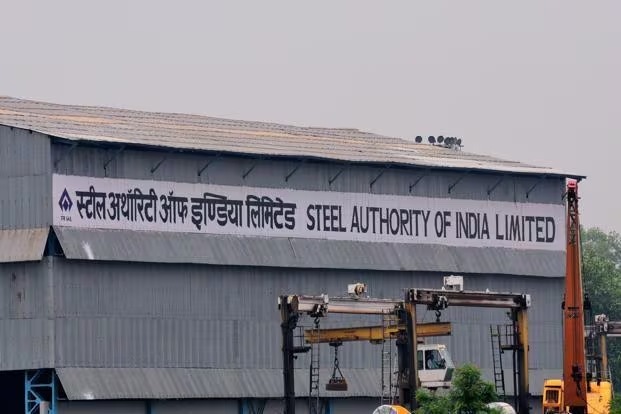
SAIL Q4 FY26: The Beast Under the Bhabhabha Iron-Ore Hill Ramps Up Capital Spending
Section 1 — At a Glance
The numbers out of New Delhi’s corporate steel palace confirm that Steel Authority of India Ltd (SAIL) is operating at full mechanical intensity, even as it prepares for a massive multi-year capital deployment cycle. Headline revenue from operations hit ₹110,811 crore for FY26, up 8.13% year-on-year, driven by record standalone sales volumes of 19.93 million tonnes. Operating profit (EBITDA) followed suit, expanding to ₹12,000 crore, while consolidated profit after tax (PAT) jumped 42.2% to ₹3,373 crore.
FY26 Headline Metrics
Value / Growth
Revenue from Operations
₹110,811 crore (+8.13% YoY)
Operating Profit (EBITDA)
₹12,000 crore (+12.11% YoY)
Consolidated Net Profit
₹3,373 crore (+42.20% YoY)
Standalone Sales Volume
19.93 million tonnes (+11.35% YoY)
Investor focus is sharply concentrated on the massive inventory liquidation that unlocked working capital in the latter half of the fiscal year, coupled with a substantial balance sheet deleveraging of ₹8,150 crore in borrowings. However, structural headwinds loom heavily on the horizon. The domestic steel pricing environment remains vulnerable to global price corrections and trade dumping, while raw material cost inflation—specifically coking coal procurement—threatens to squeeze sequential margins.
Furthermore, a significant retrospective mining tax liability estimated at ₹2,687 crore following the Supreme Court’s landmark ruling continues to cast a long regulatory shadow over future cash flows. When volume expansions are driven primarily by drawing down accumulated stockpiles rather than stepping up nominal capacity, the structural sustainability of near-term earnings growth remains highly dependent on macro conditions. The stage is set for a capital expenditure transformation that will either redefine the state-owned steel giant or test its leverage limits.
Section 2 — Introduction
State-owned corporate monoliths are rarely praised for structural agility, yet Steel Authority of India Ltd is currently demanding the market’s undivided attention. Holding a prized central “Maharatna” status, the Government of India maintains a tight 65% majority ownership stake in this industrial titan. SAIL operates five massive integrated steel production facilities and three specialized steel plants, heavily concentrated across the raw material belts of eastern and central India.
The publication of these financial results marks a critical inflection point for the company. After years of post-pandemic debt reduction and balance sheet consolidation, management has greenlit a phase-wise capital expenditure master plan to scale crude steel capacity from approximately 21 million tonnes per annum (MTPA) to a staggering 35 MTPA by FY32.
With a total targeted capital outlay of approximately ₹1,00,000 crore, this massive program is set to step up aggressively starting in FY27. This analysis tears through the numbers to separate the sustainable structural turnarounds from cyclical inventory windfalls, providing investors with an unvarnished assessment of SAIL’s true valuation floor before the massive infrastructure spend begins.
Section 3 — Business Model: WTF Do They Even Do?
SAIL is a vertically integrated heavy manufacturing entity that extracts iron ore from its domestic captive mines to produce a vast portfolio of carbon and specialty steel products. Its output is broadly divided into flat steel products (hot-rolled plates, coils, sheets, and cold-rolled variants), long steel products (bars, rods, and structural items for heavy infrastructure), and semi-finished steel blocks.
Product Category
Share % (FY24 Allocation)
HR Plates / Coils / Sheets
27%
Bars & Rods
22%
PM Plates
14%
Others
12%
Structurals
9%
Semis
8%
Railway Products
8%
The company serves as the foundational steel supplier to the state, maintaining an absolute monopoly on the supply of heavy steel tracks to Indian Railways, delivering 11.50 lakh tonnes of specialized rails in FY24 alone. While the domestic market consumes a massive 98% of its total sales volume, the business model is inherently highly capital-intensive and bound to the volatile cycles of infrastructure development and global commodity pricing.
Section 4 — Financials Overview
Figures are consolidated, in ₹ crore.
Performance Comparison Table
Metric
Latest Quarter (Q4 FY26)
YoY Change (%)
QoQ Change (%)
Revenue from Operations
30,813
+5.11%
+12.57%
EBITDA / Operating Profit
4,409
+26.58%
+92.19%
Profit After Tax (PAT)
1,835
+62.96%
+390.64%
Earnings Per Share (₹)
4.44
+62.63%
+387.91%
Did Management Walk the Talk?
A close evaluation of management’s past guidance shows a highly disciplined focus on operational efficiency and aggressive working capital optimization. During the fiscal year, management successfully executed a massive inventory reduction of close to 1 million tonnes (comprising 0.4 MT of saleable steel and 0.5 MT of in-process inventory), allowing the company to significantly reduce borrowings by ₹8,150 crore.
Furthermore, the blended cost of debt fell sharply from 7.3% to 6.2%. Operationally, raw material efficiency gains contributed a positive swing of ₹429 crore to the EBITDA bridge, offsetting a ₹272 crore hit from rising coking coal input costs through a significantly reduced coke rate, increased oxygen enrichment, and higher pulverized coal injection (PCI).
What is Management Promising in the Coming Quarters?
Looking ahead to FY27, management is targeting an ambitious sales volume of approximately 22 million tonnes (excluding external trading volumes from RINL). To achieve this, crude steel production is projected to hit 22.5 MT, deliberately pushing operations past the nominal “nameplate” capacity of 21 MT. Management noted:
“Theoretical calculations do not hold good… by giving better enablers and raw materials, we can easily go beyond 100% capacity utilization.”
However, near-term headwinds are intensifying. Blended coking coal costs are guided to rise by approximately ₹2,000 per tonne in Q1 FY27 (moving from a Q4 average of ₹19,500/t to ₹21,500/t), creating an estimated cash cost of production (COP) impact of ₹1,400 to ₹1,500 per tonne. While a sequential increase in net sales realizations (NSR) of nearly ₹4,000 per tonne in April and May provides an initial buffer, management openly acknowledges that the upcoming monsoon-heavy