PDS Ltd Q4 FY26: The Asset-Light Illusion Meets a ₹1,264 Crore Debt Reality
Section 1 — At a Glance
PDS Ltd concluded FY26 with a topline performance that managed a mild expansion, reaching ₹13,110.08 crore, up 4% year-on-year. However, the real story lies beneath the headline revenue. The group’s net profit witnessed a stark contraction of 28.8% to land at ₹111.69 crore for the full fiscal year , down from ₹156.89 crore in FY25, exposing severe operating pressure and a shifting business mix.
While management successfully trumpet a massive decompression in net working capital days from 17 days down to just 4 days, alongside a monumental operating cash flow generation of ₹780.85 crore, investors are closely parsing the structural integrity of this cash. Much of the liquidity extraction was achieved by aggressively running down trade receivables by over ₹213 crore and letting trade payables expand.
The market’s concern is clear: gross margins remain stable at 20.6%, but true operating leverage is evaporating under the weight of surging employee costs—which rose to ₹1,317.17 crore —and an interest expense burden of ₹146.48 crore. Despite pitching itself as a nimble, asset-light global sourcing platform, the balance sheet continues to carry a heavy debt load with gross borrowings ticking up to ₹1,264 crore.
Volatility in customer segments can quickly transform a lean sourcing agent into a high-overhead corporate rescue operation. The stock market has reacted with clear skepticism, pulling the year-end share price down to ₹261.65 from last year’s ₹436. The core question remains whether the newly integrated manufacturing assets can rescue the bottom line or if they will simply dilute returns further.
Section 2 — Introduction
PDS Ltd finds itself at a critical strategic junction in May 2026. Long known as a global garment trading house and sourcing platform, the company has spent the last several quarters trying to re-engineer its identity. By positioning itself across design-led sourcing, brand management, and direct manufacturing, PDS attempts to capture multiple slices of the global apparel value chain.
The publication of the FY26 audited results brings needed clarity to these efforts. With 144 subsidiaries, 5 associates, and 4 joint ventures, the corporate map is highly complex. Recent restructuring moves—such as transitioning corporate management with a new CFO appointment effective April 2026 and scaling down underperforming licensed brands—indicate a corporate structure undergoing a forced diet.
This deep dive exists to unpack the structural divergence between PDS’s reported operating efficiency and its actual cash position.
Section 3 — Business Model: WTF Do They Even Do?
To the uninitiated, PDS looks like a massive garment manufacturer. In reality, it acts primarily as a global matchmaker with legal liabilities. The business runs on a “federation” model of distinct business verticals, splitting its identity into Sourcing (~93% of 9M revenue) and Manufacturing (~7% of 9M revenue).Based on PDS Ltd’s operational architecture and the financial breakdown provided in the performance update, here is the structured comparison between its two core business segments:
Business Segment Matrix: Sourcing vs. Manufacturing
Strategic Pillar
Sourcing Services
Owned Manufacturing
Revenue Contribution
~93% of operations (9MFY26)
~7% of operations (9MFY26)
FY26 Revenue
₹12,399 Cr ($1,404 Mn)
₹1,034 Cr ($117 Mn)
FY26 EBIT
₹266 Cr ($30 Mn)
₹57 Cr ($6 Mn)
EBIT Margin
2.1% (Includes other income)
5.5% (Includes other income)
Gross Capital Employed
₹1,525 Cr ($161 Mn) — 51% of Group Total
₹943 Cr ($99 Mn) — 31% of Group Total
Segment ROCE
18% (Based on gross capital employed)
6% (Based on gross capital employed)
Operating Model
Asset-Light Platform • Acts as an outsourced sourcing arm (SaaS) . • Takes minimal inventory or credit risk. • Leverages 600+ third-party compliant factories.
Asset-Heavy Operations • Direct manufacturer with high fixed overhead. • 5 owned facilities across Bangladesh (2), Sri Lanka (2), and India (1).
Key Assets & Scale
• 90+ global offices across 22+ countries. • 250+ in-house designers managing fast-fashion concept feeds.
SaaS Scale-up: Chasing large-scale, high-margin, asset-light sourcing mandates in North America ($1bn pipeline under pitch).
Platform Integration: Moving away from running independent factory P&Ls to a unified, higher-margin showcase ecosystem.
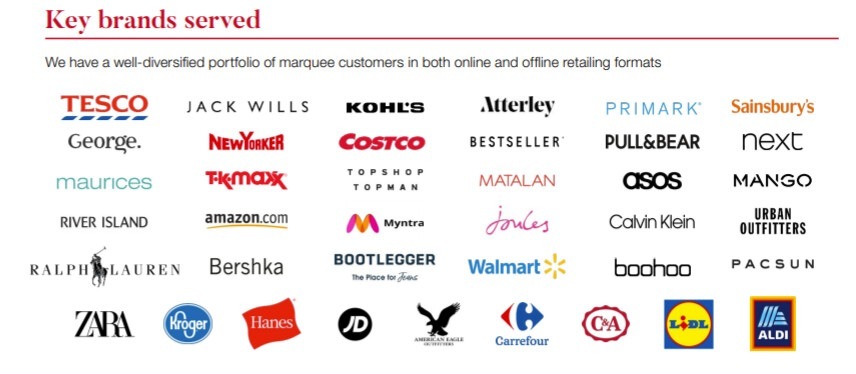
The sourcing arm takes design concepts to retail giants like Walmart and Primark, then offloads the physical production to over 600 third-party compliant factories. This keeps the core business model relatively asset-light.
However, the manufacturing segment, while small in revenue share, consumes a disproportionate amount of capital. With the recent acquisition of a 55% stake in Knit Gallery, PDS now owns a massive fixed-overhead capacity capable of churning out over 40 million pieces annually in India alone. It is a dual identity: a capital-light service provider on one side, and a traditional factory master on the other.