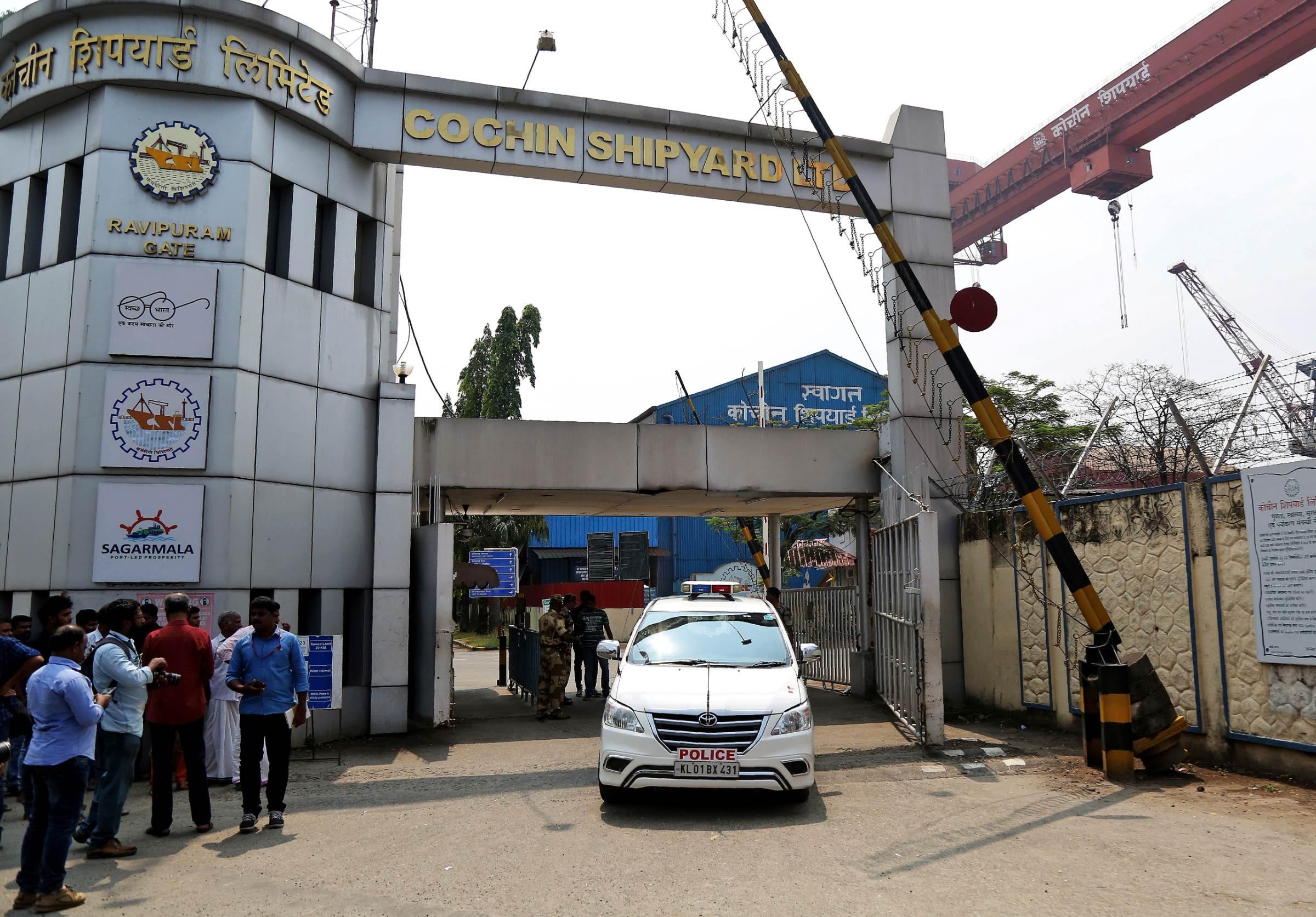
Cochin Shipyard Limited has taken investors on a wild ride, displaying a massive order book of ₹20,342 crore and a sharp expansion in capacity, yet structural financial pain points are emerging beneath the surface. For the full year ended March 31, 2026, consolidated revenue from operations edged up to ₹5,021.87 crore, compared to ₹4,819.96 crore in the previous year. However, a major divergence has appeared between reported accounting profitability and actual cash reality. While net profit for the year stands at ₹716.74 crore, the company suffered a severe operating cash outflow of ₹1,234.00 crore. This represents a complete structural breakdown from the negative ₹297.00 crore recorded in FY25, highlighting a deep cash drain into working capital.
The shipyard completed major capital expansions, including the ₹1,799 crore New Dry Dock and the ₹970 crore International Ship Repair Facility (ISRF). Both facilities became fully operational to handle larger defense and commercial vessels. Yet, this massive capital deployment has coincided with a sharp increase in short-term financial liabilities. Short-term borrowings skyrocketed from ₹45.99 crore in FY25 to ₹1,075.84 crore by March 31, 2026, to bridge the growing working capital gap.
Furthermore, execution delays in critical non-defense contracts have locked up capital. A key example is the customized passenger vessel project for the Andaman & Nicobar Administration, where delivery was halted due to reallocation requests. This project alone accounts for accumulated liquidated damages of ₹215.70 crore. Additionally, the company faces severe corporate governance pressure. Regulatory bodies imposed multiple financial penalties for non-compliance regarding the composition of its board of directors. With the stock trading at a high Price-to-Earnings (P/E) ratio of 55.2 despite declining annual profits, the financial gaps require closer scrutiny.
2. Introduction
Cochin Shipyard Limited (CSL) occupies a strategic position in India’s defense and commercial maritime infrastructure. Established in 1972, the state-owned enterprise has evolved from building simple bulk carriers into a complex engineering hub capable of delivering frontline naval assets, including India’s first indigenous aircraft carrier, INS Vikrant. Operating under the administrative control of the Ministry of Ports, Shipping and Waterways, the company benefits from sovereign backing, with the Government of India holding a 67.92% equity stake.
Beyond large-scale domestic naval construction, the company has established a presence in international export markets, delivering over 45 vessels to clients across Norway, the Netherlands, Germany, and the United States. Its operational core is split between long-cycle shipbuilding projects and high-margin ship repair services, run from its primary facilities in Kochi and regional repair centers across Mumbai, Kolkata, and the Andaman & Nicobar Islands.
The structural financial profile has changed significantly following the commissioning of its dual expansion projects. While these investments position the company to capture larger naval tenders and high-tonnage commercial refits, they have altered the company’s asset-liability mix and immediate cash-generation profile.
3. Business Model – WTF Do They Even Do?
The mechanics of running a massive shipyard are simple: you build floating fortresses over several years, or you patch up battered commercial tankers within a few weeks. Cochin Shipyard splits its operations into these two distinct areas.
 [Cochin Shipyard Operations]
|
-----------------------------------------------
| |
[Shipbuilding Segment] [Ship Repair Segment]
- 58% of 9M FY26 Revenue - 35% of 9M FY26 Revenue
- Long-cycle, heavy capital - Short-cycle, higher margin
- Government & Navy heavy (63.41%) - Commercial & Defense refits
The Shipbuilding division brings in the bulk of top-line revenue, accounting for 58% of operations in the first nine months of FY26. This division manages long-term, multi-year contracts for naval frigates, research vessels, and commercial transport ships. While these projects build a large order book, they require massive working capital. Materials must be procured, blocks fabricated, and sub-contractors managed long before milestone payments are unlocked.
The Ship Repair division contributes 35% of revenue but acts as the primary driver of immediate cash and higher margins. It focuses on the maintenance, upgrade, and life extension of commercial vessels, oil rigs, and active naval fleets. Unlike shipbuilding, repairs offer faster turnaround times and prompt billing cycles. The final 7% of the business comes from marine engineering training and specialized strategic consulting.
Is the business model dependent on government spending? With government and defense contracts making up 63.41% of the unexecuted order book, the company’s financial health is tied closely to the budgeting and procurement timelines of the Indian Navy and coastal authorities.
4. Financials Overview
The financial performance for the quarter ended March 31, 2026, shows a recovery in revenue but a decline in full-year net profitability. Total revenue from operations for Q4 FY26 reached ₹1,484.28 crore, representing an 11.5% sequential growth over Q3 FY26, though down 15.6% compared to the ₹1,757.65 crore reported in Q4 FY25.
Operating profit for the quarter came in at ₹309.68 crore, supported by lower other expenses and adjustments in provisions for anticipated losses. However, full-year consolidated profit after tax dipped to ₹716.74 crore in FY26 from ₹827.33 crore in FY25, impacted by a sharp increase in finance costs, which rose to ₹92.38 crore due to higher short-term debt servicing.