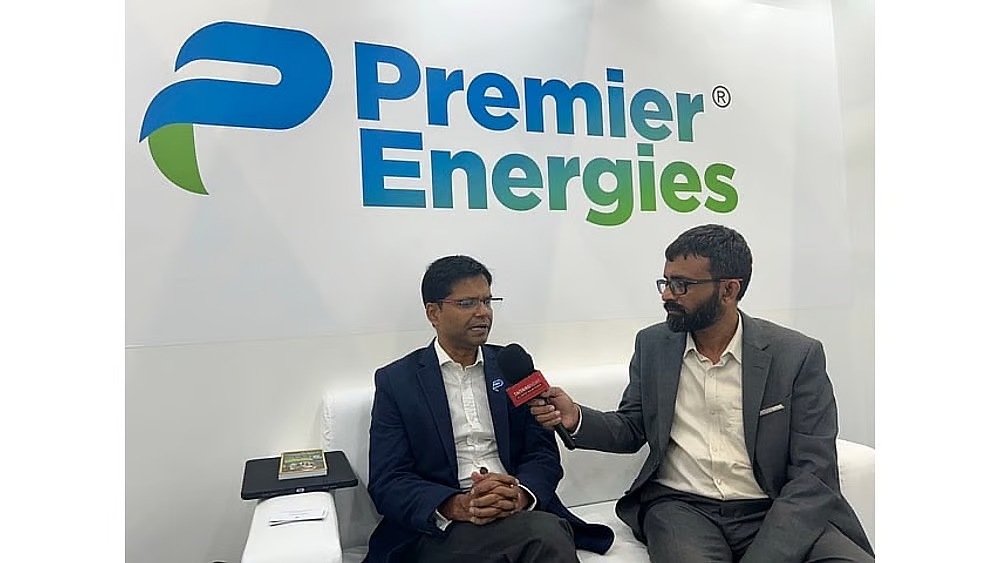
Premier Energies Ltd Q4 FY26: Staggering ₹7,824 Crore Sales Face The Realities of a Deep Negative Free Cash Flow
1. At a Glance
The domestic clean energy landscape is shifting rapidly, and within India, the scramble for manufacturing dominance has turned into an expensive arms race. Premier Energies Ltd has emerged as a focal point of this transition, capturing substantial market interest by scaling its consolidated operations to a massive ₹7,824 crore in revenue for the full financial year ended March 31, 2026. Yet, behind the dazzling growth of a company whose quarterly revenue crossed ₹2,230 crore in Q4 FY26 lies a capital-hungry machine traversing deep integration hazards. The entire solar ecosystem is currently riding high on government incentives, basic customs duties, and aggressive capacity targets, making short-term performance metrics appear artificially flawless.
Beneath the operational euphoria, serious structural friction points are building up. The company’s total borrowings have expanded aggressively to ₹3,707 crore by March 2026, marking a heavy debt-fueled expansion phase that leaves little room for execution delays. Furthermore, the underlying business is wrestling with acute revenue concentration, where a handful of clients dictate the order book’s fate, and sudden shifts in input costs—most notably a massive surge in silver consumption pricing—threaten margin stability. While the top-line numbers project an image of an unstoppable clean-tech titan, the real story lies in whether the cash generation can outrun a staggering multi-billion rupee capital expenditure program before global macro shifts turn today’s solar boom into tomorrow’s capacity glut.
2. Introduction
Premier Energies Ltd has long evolved past its quiet beginnings in April 1995. Today, it operates as a sprawling, vertically integrated solar cell and solar module manufacturing heavyweight based out of Hyderabad, Telangana. The public market recently gave it a massive capital cushion via a ₹1,290 crore IPO fresh capital raise, but the stock market has already priced the business as if it will power the entire subcontinent by next Tuesday. With a current market capitalization hovering at ₹44,987 crore, the company finds itself under the microscopic lens of public scrutiny.
The modern corporate thesis for solar requires staggering scale. Premier has rapidly scaled its capacities across five owned manufacturing facilities in Hyderabad, moving fiercely away from old polycrystalline technology to high-efficiency Tunnel Oxide Passivated Contact (TOPCon) platforms. But executing multi-gigawatt plants while juggling raw material supply lines requires flawless operational choreography. When a company expands its total balance sheet size to over ₹10,845 crore in a matter of years, the primary risk transitions from market demand to sheer engineering and commissioning discipline.
3. Business Model – WTF Do They Even Do?
To understand Premier Energies, imagine a giant industrial kitchen that buys highly sensitive raw silicon sheets (wafers), bakes them into sophisticated energy-trapping wafers (solar cells), and then stitches those cells together into the large blue glass panels (modules) you see on utility solar farms and commercial roofs. They also execute engineering, procurement, and construction (EPC) projects, operate as independent power producers, and provide operations and maintenance (O&M) services to make sure those panels do not just sit there gathering dust.
The underlying catch? They rely heavily on the domestic content requirement (DCR) market. Government-aided schemes mandate that solar installations under central programs must use cells and modules made right here at home. Because India is chronically short on domestic cell capacity, Premier enjoys a beautiful, protected premium. However, the upstream raw materials—the actual wafers—are still 100% imported, meaning the business model is effectively a sophisticated, high-margin processing arbitrage wrapped inside a patriotic regulatory blanket.
4. Financials Overview
The financial results declared for March 2026 are explicitly published as Quarterly Results. In line with strict annualization rules for a closing fiscal quarter, the full-year reported numbers provide the ultimate reality check without requiring trailing quarter multipliers.
Key Performance Metrics
The financial performance across key operational horizons highlights sharp structural scaling:
Metric (₹ Crores)
Latest Quarter (Q4 FY26)
Same Quarter Last Year (YoY Q4 FY25)
Previous Quarter (QoQ Q3 FY26)
Full Year (FY26)
Revenue
2,230.30
1,620.84
1,936.19
7,824.37
EBITDA
674.84
528.45
593.20
2,377.21
PAT
456.84
277.81
391.62
1,509.69
EPS (₹)
10.08
6.16
8.65
33.33
The numbers show robust sequential and year-over-year growth. Operating profit margins have stabilized at a lucrative 30.4% for the full year, driven by strong realizations on domestic cells. When looking at older corporate targets, management has successfully walked the talk regarding the rapid stabilization of their 1.2 GW TOPCon cell line, which achieved ~80% utilization within months of its mid-2025 launch. How long can a company maintain 30%+ operating margins in a commoditized manufacturing sector before global supply chains correct?
5. Valuation Discussion – Fair Value Range Only
To evaluate Premier Energies without falling into speculative market hype, we look closely at three distinct valuation methodologies based on the audited FY26 financial data.