Allied Blenders & Distillers Ltd Q4 FY26: The Premiumization Cocktail: Inside ABDL’s ₹1,000 Cr Capital Quest, Tax Drama, and the Brandy Gamble
1. At a Glance
Allied Blenders & Distillers Limited (ABDL) is serving a heavy, complex cocktail of structural growth mixed with unexpected fiscal legalities. The headline performance figures for FY26 show a business trying to alter its DNA, scaling its consolidated operations to a historic revenue high of ₹3,923 crore while wrestling with volatile profit performance.
The biggest surprise catching investors’ attention is a sharp correction in the consolidated profit after tax for the fourth quarter, which plunged 48.0% year-on-year to ₹37.62 crore. This volatile performance stems from an intense, behind-the-scenes fiscal drama. A decade-long income tax search and assessment operation, which originally raised a massive tax demand, was scaled down during the quarter via an order under Section 250 of the Income-tax Act. This forced the company to absorb a definitive prior-period tax expense and related interest impact of ₹45.45 crore straight into its current profit and loss statement.
Simultaneously, the board has approved a substantial ₹1,000 crore capital raising program right alongside an aggressive 270% final dividend recommendation of ₹5.40 per equity share. This simultaneous move to payout substantial cash while requesting fresh institutional funding raises immediate, fascinating questions about internal capital allocation priorities.
Meanwhile, the operational side of the balance sheet continues to experience stress, with an elongated working capital layout characterized by a large trade receivables cycle of 168 days, driven heavily by payment deferrals from the Telangana state distribution system. Can ABDL complete its premiumization playbook before its capital structure requires major refinancing? Let us find out.
2. Introduction
Allied Blenders & Distillers Limited, incorporated in its modern corporate structure in 2008 but with operational roots tracking back to 1988, occupies a significant footprint within the Indian Made Foreign Liquor (IMFL) industry. The company operates a comprehensive, pan-India manufacturing, bottling, and retail distribution infrastructure that spans across more than 30 states and Union Territories, reaching an expansive network of over 79,000 retail endpoints.
Historically known as a high-volume, lower-margin supplier dominated by its mass-market volume driver, Officer’s Choice Whisky, the company has recently embarked on an aggressive, multi-year corporate transformation strategy. Following its initial public offering in July 2024, which injected net proceeds of ₹975.9 crore to clear high-cost historical debt and unfreeze statutory bottlenecks, management has pivoted directly toward an aggressive premiumization path.
This strategy relies on expanding its Prestige & Above (P&A) product pipeline, led by the fast-growing Iconiq White brand, alongside structural backward integration projects designed to capture margin efficiencies from raw material manufacturing to in-house packaging.
3. Business Model – WTF Do They Even Do?
To explain it clearly for a smart but lazy investor: ABDL functions as an industrial distiller and brand aggregator that converts agricultural raw materials into high-margin liquid lifestyle choices. The company makes money by processing grains into Extra Neutral Alcohol (ENA), blending it into multi-tier spirits, bottling the final product, and navigating India’s complex, state-by-state regulatory excise systems to capture consumer spending on alcohol.
The portfolio is split into three main segments:
Mass Premium: Home to the iconic Officer’s Choice Whisky. This segment is a high-volume, low-margin cash engine that commands a 35% market share in its specific mass category but offers limited pricing power.
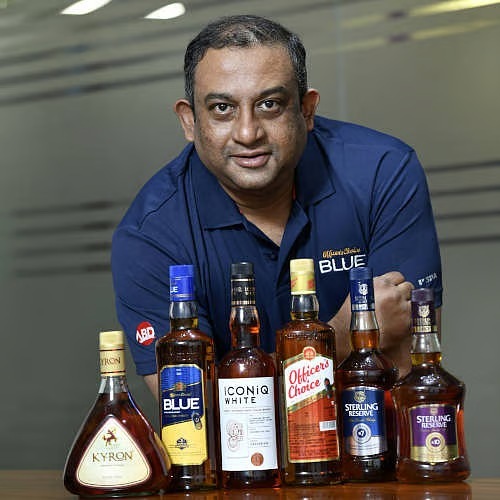
Prestige & Above (P&A): Featuring brands like Officer’s Choice Blue, Sterling Reserve B7, and the fast-growing Iconiq White. This is where corporate profitability resides, pulling in higher net realizations per case.
Premium & Luxury: Managed via its specialized subsidiary, ABD Maestro Private Limited, which focuses on top-tier single malts, gins, and imported vodka portfolios.
The core challenge of this business model is structural optimization. Historically, ABDL operated an asset-light but margin-thin model, relying on third-party franchise bottling plants and external ENA procurement. This left its gross margins exposed to volatile commodity cycles in grain and ENA markets.
The company is currently executing a structural shift, investing ₹525 crore in capital expenditure to transform into a vertically integrated manufacturer that controls its own core distillation and packaging lines.
4. Financials Overview
The operational performance reveals a business successfully driving top-line growth, even as bottom-line metrics reflect a prior-period tax settlement.
Consolidated Quarterly Performance
All financial values are in ₹ crore, except EPS.
Metric
Latest Quarter (Q4 FY26)
Same Quarter Last Year (Q4 FY25)
YoY Change (%)
Previous Quarter (Q3 FY25)
QoQ Change (%)
Revenue from Operations
₹1,006.89
₹921.00
+9.37%
₹974.00
+3.38%
EBITDA
₹136.00
₹112.00
+21.43%
₹117.00
+16.24%
Profit After Tax (PAT)
₹37.62
₹72.43
-48.05%
₹56.00
-32.82%
Annualised EPS (₹)
₹5.84
₹5.18
+12.74%
₹9.52
-38.66%
Recalculated P/E (x)
91.10x
102.70x
-11.30%
55.88x
+63.03%
The top-line expanded 9.37% year-on-year to ₹1,006.89 crore for the quarter, sustained by strong structural traction within the Prestige & Above volume pipeline, which expanded 20.5% year-on-year to 4.4 million cases. EBITDA outpaced revenue growth, increasing 21.43% to ₹136 crore, while quarterly EBITDA margins expanded to 13.51%. This margin expansion was driven by a strong raw material pricing environment and initial operational savings from its newly commissioned Telangana PET bottle packaging line.