RBZ Jewellers Ltd Q4 FY26: The Illusion of Sparkling Margins vs. The Reality of Negative Free Cash Flows
1. At a Glance
Gold has long been a foundational symbol of wealth, but looking closely at the financial books of those who shape it reveals that true financial strength requires more than a shiny exterior. RBZ Jewellers Ltd has successfully captured public attention by highlighting its record-breaking numbers. The headline figures look remarkable: operational revenue for FY26 climbed to ₹6,365 million (₹636.5 crore), up from ₹5,301 million in FY25, while its PAT reached ₹548 million, showing a robust 41.2% growth.
However, beneath the surface of these expanding revenue figures lies a far more complex corporate narrative. A deeper look at the core financials reveals critical structural risks that require careful scrutiny:
The Cash Flow Deficit: While the income statement shows a strong net profit of ₹548 million for FY26, the cash flow statement tells a very different story, revealing a negative cash flow from operations of -₹732.5 million.
The Burden of Working Capital: The business model demands significant inventory buildup, causing inventory assets to surge to ₹33,567.5 million, which continues to lock up crucial liquidity.
Escalating Leverage: Short-term borrowings have risen substantially from ₹8,653.8 million in FY25 to ₹11,842.7 million in FY26, highlighting a heavy reliance on debt to support day-to-day operations.
Can a regional retail business sustain long-term growth when its cash from operations remains deep in negative territory? While the top-line numbers shine brightly, a rigorous analysis of the balance sheet and cash flows suggests that investors should look beyond the initial glitter.
2. Introduction
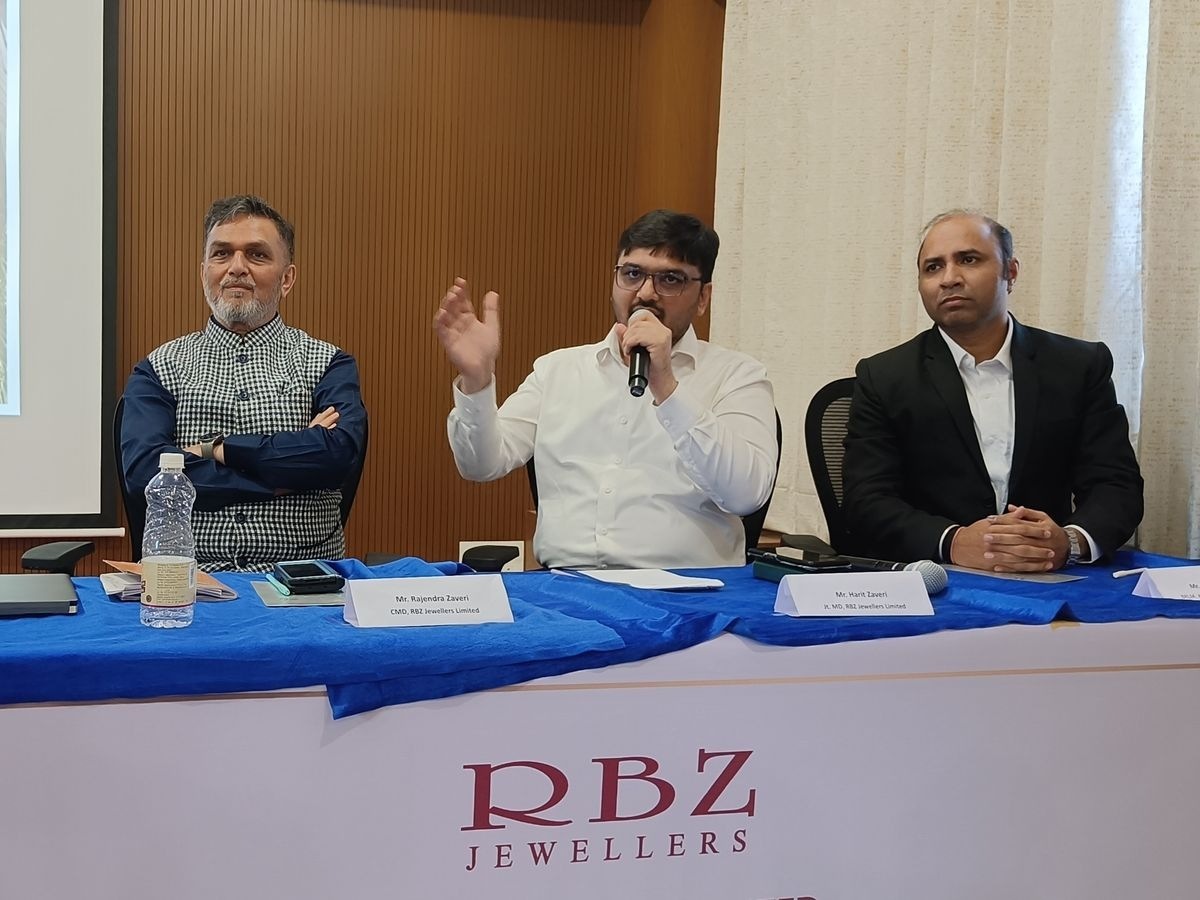
RBZ Jewellers Ltd, established in 2008 by the promoter duo of Rajendrakumar and Harit Zaveri, operates a distinct dual business model. It functions as both an organized B2B manufacturer supplying antique gold bridal jewellery to major national brands, and as a regional retailer through its massive flagship boutique, Harit Zaveri Jewellers, located in the high-end Satellite area of Ahmedabad.
The company completed its public listing on December 21, 2023, raising ₹1,000 million to expand its market footprint. Since listing, it has navigated a volatile gold price environment, using automated manufacturing technology like 3D printing and laser casting to drive production efficiency. However, as it transitions into a broader retail player across Gujarat, it faces a tough balancing act: sustaining high accounting margins while trying to resolve its ongoing working capital constraints.
3. Business Model – WTF Do They Even Do?
The core business model relies on a hybrid structure divided into three distinct segments: Wholesale (B2B), Retail (B2C), and Job Work operations.
The wholesale arm supplies customized antique gold jewellery to over 190 retailers across 72 cities. This channel provides volume scale and establishes partnerships with major national chains like Titan, Malabar Gold, and Senco Gold.
The retail segment (B2C) operates through its large 11,667 sq. ft. showroom in Ahmedabad. This storefront targets high-margin bridal and occasion wear, which accounts for 65% of its sales mix, while daily wear makes up the remaining 35%.
The third segment, job work, delivers the highest percentage margins because corporate clients supply the raw gold themselves. RBZ simply charges a manufacturing or “making” fee, avoiding any inventory price risk on the metal. While job work represents only a fraction of total revenues, it plays a vital role in optimizing plant capacity.
4. Financials Overview
The latest official financial filings show that RBZ reported its final audited financial statements under a standard quarterly framework.
Quarterly Financial Performance Comparison
All figures are presented in original reporting units: ₹ Lakhs (₹100 Lakhs = ₹1 Crore).
Particulars
Q4 FY26 (Ended 31-Mar-2026)
Q4 FY25 (Ended 31-Mar-2025)
YoY Change (%)
Q3 FY26 (Ended 31-Dec-2025)
QoQ Change (%)
Revenue from Operations
18,948.36
13,729.20
+37.95%
22,633.02
-16.28%
EBITDA
2,119.78
1,450.18
+46.17%
2,949.00
-28.12%
PAT
1,167.96
856.91
+36.30%
1,743.01
-32.99%
Basic & Diluted EPS (₹)
2.92
2.14
+36.45%
4.36
-33.03%
Financial Wisdom: Net profit can be an accounting fiction, but cash flow is cold reality. Always verify if reported earnings are actually backed by cash collections.
The quarterly data reveals notable patterns. While year-on-year metrics show solid growth, the sequential (QoQ) metrics indicate a noticeable slowdown. Q4 FY26 revenue dropped 16.28% compared to Q3 FY26, and PAT declined by nearly a third. Management explained that Q3 typically benefits from peak wedding season sales, whereas Q4 faces a normal post-holiday moderation.
Evaluating the annual tracking reveals how management executed its strategy against past commitments. In early FY26, management projected a conservative revenue target of around ₹7,000 million, which was later