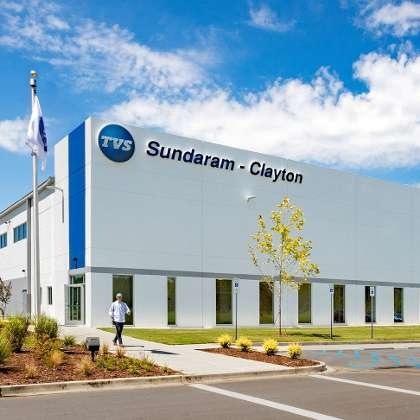
Sundaram Clayton Ltd Mar 2026 Consolidated Results: Balancing Act of Asset Sales and Red Ink Across the Atlantic
1. At a Glance
An old lineage in corporate India offers no immunity against the harsh, grinding realities of global operational execution. Sundaram Clayton Ltd, a prominent manufacturer of engineered aluminum die-casting components backed by the reputable TVS group, is currently walking a tightrope.
On one side, investors are watching the domestic business benefit from an automated manufacturing setup and massive asset monetizations. On the other side, an expensive, bleeding operational footprint in the United States continues to drain capital.
The headline numbers tell a story of structural changes and heavy non-operating injections. For the full year ended March 31, 2026, the company reported a consolidated Net Profit of ₹52 crore. While this looks like an improvement compared to the devastating net loss of ₹112 crore in March 2025, a deeper look reveals this profitability is built on a fragile foundation.
Consolidated Revenue: ▼ 10.3% (₹2,026 Cr vs ₹2,259 Cr)
Reported Net Profit: ▲ Turnaround to ₹52 Cr (Driven by ₹536 Cr Other Income)
Operating Profit: ▲ ₹106 Cr vs ₹71 Cr
The underlying core tells a completely different story. The consolidated earnings include a massive other income of ₹536 crore, primarily driven by a ₹521.16 crore exceptional gain from selling a 16.33-acre land parcel at its erstwhile Padi unit in Chennai for ₹560.67 crores.
Without this massive property sale, the consolidated entity would be deeply deep in the red. The reason? The company’s wholly owned foreign subsidiary, Sundaram Holdings USA Inc (SHUI), operating out of Delaware, has been reporting operational losses for the past 4 to 5 fiscal years.
In the current fiscal year alone, the domestic parent had to invest ₹361.08 crore into subsidiaries to fund operational losses, capital expenditure, and debt refinancing obligations across the Atlantic.
The core question hanging over this auto-component player is simple: Can the automated domestic operations and land sales fix the structural issues of its American expansion before the cash from real estate runs out?
2. Introduction
Sundaram Clayton Ltd was incorporated in 1962, born out of a joint venture between the TVS group and the UK-based Clayton Dewandre Holdings Ltd. For decades, it operated as an industrial anchor for the group’s automotive component ambitions.
However, the corporate structure investors see today is radically different from the historical entity. In August 2023, the company underwent an elaborate corporate restructuring. The aluminum die-casting business was demerged into a separate entity, which eventually took over the name Sundaram Clayton Ltd.
Meanwhile, the original entity was renamed TVS Holdings Limited, which retained the highly valuable equity stakes in TVS Motor Company Limited and Emerald Haven Realty Limited.
This left the current Sundaram Clayton as a pure-play automotive casting operator, stripped of its liquid treasury shields. To make matters more complex, the company decided to clean its plate further in March 2025 by divesting its entire low-margin two-wheeler casting business at the Hosur plant to Sandhar Ascast Private Ltd for ₹163 crore.
The strategy was intentional: exit the low-margin, high-volume two-wheeler segment and focus heavily on high-value passenger vehicle (PV) and commercial vehicle (CV) casting architectures, which command superior margins.
This structural shift explains the apparent drop in consolidated revenues from ₹2,259 crore in FY25 to ₹2,026 crore in FY26. The business is structurally shrinking its revenue base to focus on higher margins.
The domestic plants have relocated machinery from the old Padi unit to a modern, highly automated facility at Thervoy Kandigai (TK) outside Chennai, aiming for an efficient standalone operational state. Yet, the consolidated entity remains anchored to its international operations, forcing corporate detective work to focus on why the American markets are refusing to cooperate.
3. Business Model – WTF Do They Even Do?
To put it simply: Sundaram Clayton takes raw aluminum, melts it down, and forces it under immense pressure into highly complex, engineered molds to create lightweight structural components for heavy trucks, passenger cars, and engines.
If you look inside the engine bay or chassis of a heavy commercial vehicle or a modern SUV, you are likely looking at the type of aluminum die-castings SCL manufactures.
The company’s target market is split across two distinct economic engines. Domestically, it caters to top-tier commercial and passenger vehicle OEMs, including Hyundai Motor India, Tata Motors, and major component aggregators like the Cummins group, the Volvo group, the Daimler group, and the ZF group.
In the domestic market, SCL is a premium supplier, even winning the “Supplier of the Year” quality award from Hyundai Motor Group in the current fiscal year.
The second engine is the export market, which brings in roughly 44% of total revenues, heavily weighted toward the North American Class 8 heavy truck market.
This business model is highly cyclical. When global freight volumes are high and logistics companies are buying fleet trucks, SCL makes good money. When fleet capital expenditure in the US slows down, SCL’s expensive machinery sits idle, eating away at cash flow through fixed depreciation and interest costs.
Worse, as an OEM supplier, the company faces intense pricing pressure. While it can pass on volatile raw aluminum ingot costs through contract clauses, it has limited flexibility to pass on rising internal conversion costs, such as spiking electricity bills, structural freight rates, and cross-border tariffs.
4. Financials Overview
Let us look at the financial results for the quarter and full year ended March 31, 2026. Following the official announcement format, the latest financial disclosures represent Quarterly Results, requiring a standard annualization of the latest quarter’s standalone figures while keeping a close eye on the consolidated reality.
Core Comparison Table (Consolidated Figures in ₹ Crores)
Metric
Latest Quarter (Mar ’26)
Same Quarter Last Year (Mar ’25)
YoY Change (%)
Previous Quarter (Dec ’25)
QoQ Change (%)
Sales
₹518.11
₹586.92
-11.72%
₹501.11
+3.39%
EBITDA
₹91.90
₹89.80
+2.34%
₹39.00
+135.64%
PAT
₹426.41
₹143.55
+197.05%
₹-51.92
Turnaround
EPS (₹)
₹193.42
₹68.03
+184.31%
₹-23.55
Turnaround
Standalone vs Consolidated Performance (FY 2025-26 Full Year)
Financial Metric
Standalone Full Year (FY26)
Consolidated Full Year (FY26)
The Subsidiary Gap (Value Destructed)
Revenue
₹1,808.90 Cr
₹2,025.61 Cr
+₹216.71 Cr (US Sales Added)
EBITDA
₹330.30 Cr
₹106.00 Cr
-₹224.30 Cr (US Losses Drag)
Net Profit (PAT)
₹552.23 Cr
₹52.00 Cr
-₹500.23 Cr (The Black Hole)
Financial Commentary
The numbers show a clear divergence between standalone strength and consolidated weakness. On a standalone domestic level, the management successfully delivered on its operational automation promise.
Full-year standalone EBITDA stepped up to ₹330.3 crore, achieving a healthy 18.3% margin. This shows clear execution in shifting operations to the automated Thervoy Kandigai plant and dropping the low-margin two-wheeler business.
However, when you look at the consolidated numbers, the impact of the US subsidiary is striking. The entry of Sundaram Holdings USA Inc wipes out ₹224.3 crore of hard-earned domestic operating profit, crushing the