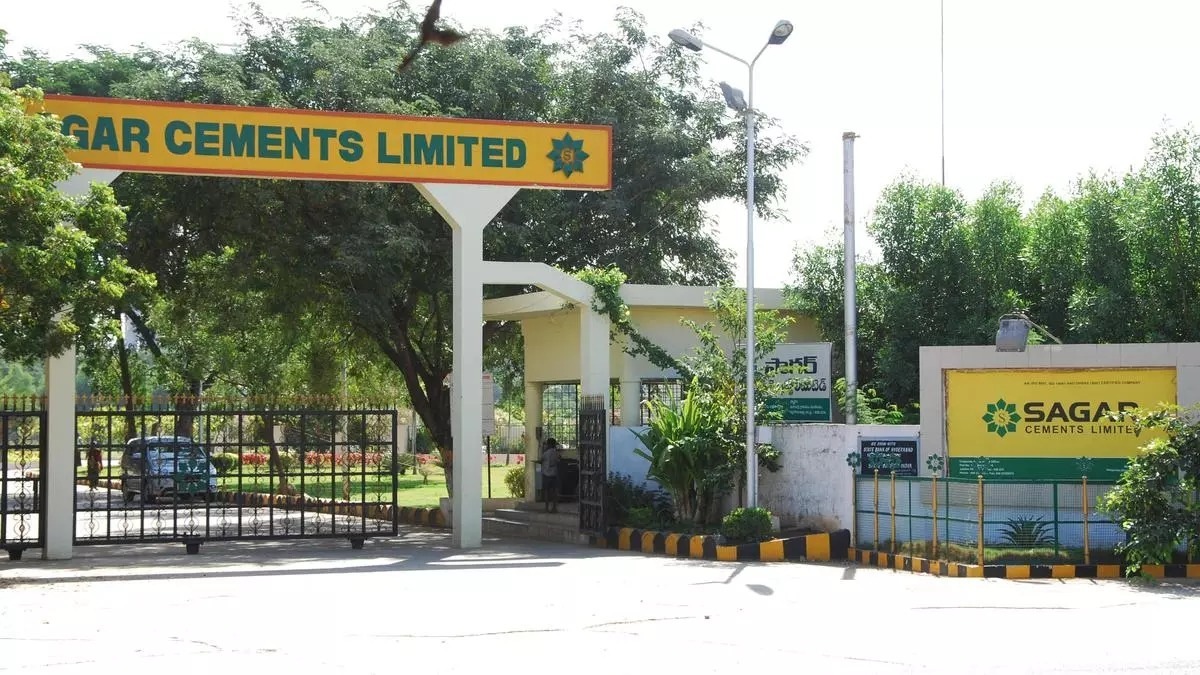
Sagar Cements Q4 FY26: The Dangerous Math of 1.01 Debt-to-Equity and Pledged Shares Meets Credit Downgrades
1. At a Glance
Sagar Cements is flying directly into a financial storm. While investors focus heavily on the headlines showing a 20% jump in quarterly revenue to ₹787 crore and a massive 297% variance in quarterly profits, a deep analytical dive into the underlying financial architecture reveals severe systemic stress. The company is wrestling with a crushing debt load of ₹1,708 crore, leaving it with a highly precarious Debt-to-Equity ratio of 1.01.
Compounding this leverage crisis, the promoter group has encumbered 30.0% of its entire equity holding, with critical filings showing that a single promoter has pledged up to 80.8% of their specific shares to secure non-convertible debentures.
The balance sheet is facing real-world consequences from this prolonged capital strain. Credit rating agencies have recently stepped in, stripping Sagar Cements of its investment-grade pride by downgrading its bank loans and debentures to ‘IND BBB+’ with a Negative Outlook. This reflects a significant reduction in the company’s liquidity cushion and a sharp erosion of its interest coverage ratio, which sits at an alarming 0.38.
The structural operational inefficiencies are hard to ignore. Consolidated capacity utilization remains weak at a mere 60%, dragged down heavily by the underperforming Dachepalli plant operating at 39% capacity and the Jajpur grinding unit at 40%.
Consolidated Borrowings vs. Total Net Worth (FY26)
[==================== ₹1,708 cr Borrowings ====================]
[================== ₹1,693 cr Total Net Worth ==================]
Financially, the company remains highly volatile, posting an overall net loss of ₹11.1 crore for the full financial year. With contingent liabilities Looming large at a staggering ₹1,152 crore, the margin for error has completely vanished. The company is caught in a high-stakes race against time, attempting to complete a capital-heavy, ₹900 crore multi-year capacity expansion program across FY26 and FY27 while its core engine struggles to generate adequate positive operational cash flow.
2. Introduction
Sagar Cements operates as a regional cement manufacturing company with structural footholds primarily across Southern India, alongside expanding footprints in Central and Eastern markets. With four decades of operating history, the enterprise manages a total consolidated cement capacity of 10.50 million tonnes per annum (MTPA) across an interconnected network of plants. These locations include Mattampally (3.0 MTPA), Dachepalli (2.25 MTPA), Bayyavaram (1.5 MTPA), Jajpur (1.5 MTPA), Gudipadu (1.25 MTPA), and Indore (1.0 MTPA).
The capital allocation decisions of the past few years have shaped the current state of its financial statements. The aggressive, debt-fueled inorganic acquisition of Andhra Cements Limited in March 2023 for ₹9.2 billion—encompassing purchase prices, restart capital expenditures, and working capital requirements—pushed the group’s balance sheet capacity to its absolute limits.
This rapid build-up of assets occurred right as the broader cement industry faced a severe pricing downturn, creating a misalignment between debt obligations and operating cash flows. The primary tension now centers on whether the company can successfully execute a operational turnaround before its heavy interest obligations exhaust its remaining liquidity.
3. Business Model – WTF Do They Even Do?
At its core, the business model revolves around transforming limestone reserves into heavy construction commodities. The revenue mix is highly concentrated, with the manufacturing and sale of cement driving 89% of top-line performance, complemented by an 11% operational contribution from power generation segments.
The commodity distribution strategy is evenly split across market channels, with 49% allocated to trade sales and 51% directed toward non-trade channels. The product catalog consists of Ordinary Portland Cement (OPC), which accounts for 51% of total volumes, alongside Portland Pozzolana Cement (PPC) at 30%, Portland Slag Cement (PSC) at 9%, and small volumes of composite and ground granulated blast-furnace slag variants.
The central operational risk of this business model is its exposure to geographic price volatility and rigid production costs. Cement is a dense, costly commodity to transport, binding the company’s profitability to a 253-kilometer average lead distance across its southern regional core.
Because non-trade volumes face continuous competitive bidding from infrastructure projects, margins are entirely dependent on minimizing kiln thermal energy costs and electrical consumption. When regional demand softens, fixed costs—such as large employee overheads and plant depreciation—quickly impact the bottom line, leaving the company vulnerable to market downcycles.
How long can an infrastructure-linked commodity business sustain multi-year expansions when its underlying plant utilization can barely cross the 60% mark?
4. Financials Overview
A detailed review of Sagar Cements’ audited financial results shows an operational recovery in the final quarter of the fiscal year, though this must be viewed against weak overall numbers for the full year.
Consolidated Financial Performance Comparison
(Figures in ₹ Crores)
Metric
Latest Quarter (Q4 FY26)
Same Quarter Last Year (YoY)
Previous Quarter (QoQ)
Revenue
786.96
658.04
590.54
EBITDA
81.54
36.82
37.67
PAT
100.05
-73.05
-64.10
Reported EPS (₹)
6.70
-5.41
-4.41
Annualized EPS (₹)
26.80
-21.64
-17.64
Financial and Management Analysis
The audited numbers reveal a real-time shift in performance. Sagar Cements delivered an impressive turnaround in Q4 FY26, with revenue expanding 20% YoY to ₹786.96 crore. Operating EBITDA doubled to ₹81.54 crore, driven by a recovery in operating EBITDA per tonne to ₹445, up from ₹254 in the preceding sequential quarter.
The significant Net Profit of ₹100.05 crore in Q4 FY26 was driven by a major corporate tax adjustment. The group opted into the lower tax structure under Section 115BAA of the Income-tax Act, 1961, which required a complete remeasurement of its deferred tax assets and liabilities.
Specifically, management recognized deferred tax assets on carried-forward business losses and unabsorbed depreciation at Andhra Cements Limited. This accounting adjustment provided a significant non-cash boost to PAT, helping offset a full-year pre-tax loss of ₹123.06 crore and bringing the final full-year consolidated net loss to just ₹0.73 crore (reported as an annualized EPS of ₹-0.85).
An evaluation of past management guidance reveals mixed execution results. During earlier investor calls, the management group committed to structuring its ongoing capital expenditures to match internal cash generation, aiming to bring net leverage below 3.5x by FY26.
However, weak regional pricing and flattish sales volumes over the past year disrupted these plans, pushing debt reduction out by at least another fiscal year. On a positive note, the operational team successfully delivered on its technical targets by commissioning the new 6-stage preheater at the Dachepalli plant in October 2025, which increased clinker capacity to 2.31 MTPA and helped reduce structural production costs.
5. Valuation Discussion
To build a complete valuation perspective for Sagar Cements, we must analyze the stock using its current market metrics: a close price of ₹181, a total outstanding equity base of 13.07 crore shares, an enterprise value (EV) of ₹4,054 crore, and a full-year reported EPS of ₹-0.85.
Price-to-Earnings (P/E) Method
The company’s full-year earnings remain negative at ₹-0.85 per share, making a trailing P/E valuation metric uninformative. However, if we evaluate the normalized mid-cycle earnings potential of the company—assuming it can hit its guided FY27 volume target of 7.0