At a Glance
The Indian IT landscape is currently witnessing a high-stakes evolution, and LTM Ltd (the newly rebranded identity of LTIMindtree) is positioning itself right at the epicenter. If you’ve been watching the stock’s recent performance—a 32.5% slide over the last six months—you might be tempted to look away. But the numbers under the hood tell a story of a company aggressively re-engineering its DNA while the market remains fixated on short-term macro jitters.
LTM closed the financial year 2026 with a massive statement of intent: a revenue of ₹42,308 crore and an order inflow of $6.6 billion. The most staggering figure? A 300% increase in large deal wins, including six $100 million-plus monsters. This isn’t a company just “maintaining” its position; this is a Tier-1 aspirant using its “BlueVerse” AI ecosystem to eat the lunch of legacy players who are still stuck in the “delivery pyramid” era.
However, it’s not all sunshine and code. The company is facing a noticeable contraction in its top BFSI accounts, with one large account productivity program acting as a significant headwind. Management has bluntly admitted to a “slightly more decline” in Q4 as they accelerated productivity benefits to “bottom out” the issue. While they expect a growth trajectory from Q1 FY27, they’ve warned that the climb back up won’t be as fast as the fall.
Furthermore, the balance sheet shows a spike in Total Liabilities reaching ₹37,148 crore, largely driven by a massive jump in “Other Liabilities.” Investors are essentially betting on whether LTM’s pivot to “Business Creativity” and “Agentic AI” can outpace the margin pressures of wage hikes and the slow ramp-up of hardware-heavy deals like the ₹3,000 crore CBDT project.
Introduction
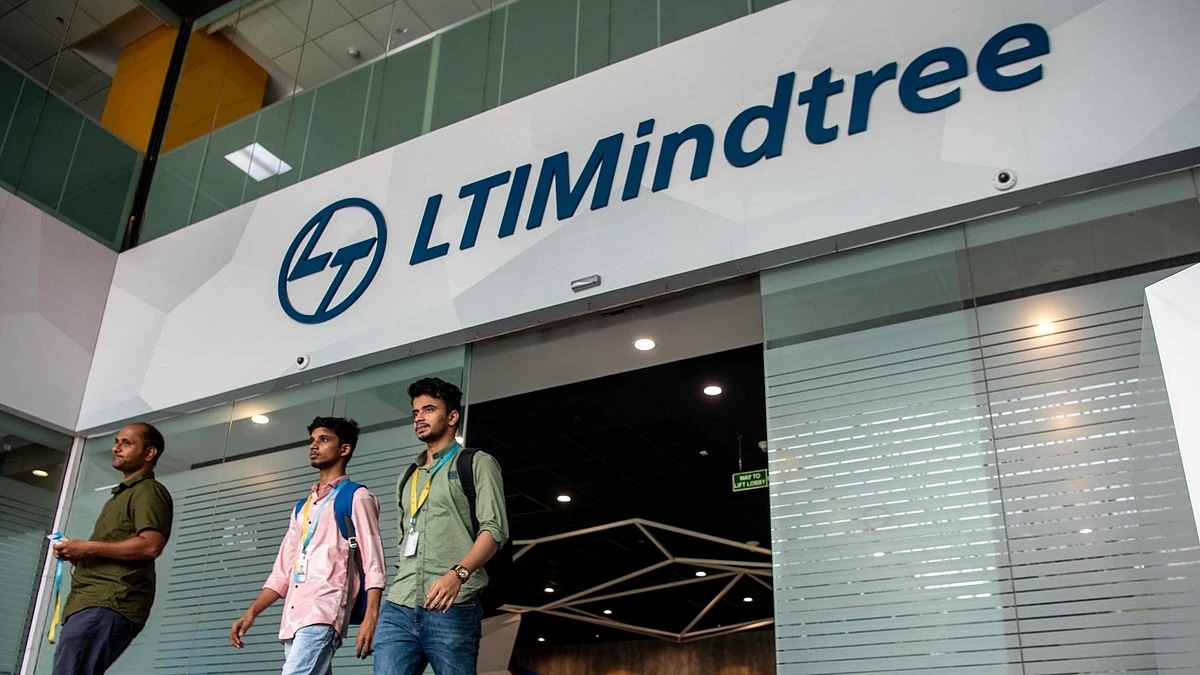
LTM Ltd, headquartered in Mumbai, is no longer just a subsidiary of the engineering giant Larsen & Toubro; it has become the group’s high-tech spearhead. Serving over 700 clients across 40 countries, the company offers a sprawling range of digital solutions from cloud acceleration to AI-driven cyber defense.
The company recently underwent a strategic rebranding to “LTM” to signal its shift from a traditional IT service provider to a “Business Creativity Partner.” This isn’t just marketing fluff; it represents a fundamental change in how they bid for contracts. They are moving away from the commodity “intelligence” of AI models—which they argue will be available to everyone—to focus on deep domain expertise.
The geographical mix remains heavily skewed toward North America (72.3%), making the company sensitive to the regulatory whims and economic temperature of the United States. However, with an attrition rate that has cooled to 13.3% and a utilization rate of 85.7%, the internal engine appears to be humming despite the external stock price volatility.
Is the market being too harsh on a company that just hit an all-time high cash balance of $1.63 billion? Or are the structural shifts in the BFSI segment a sign of deeper rot? Let’s dig into the mechanics of the business.
Business Model – WTF Do They Even Do?
Think of LTM as the “Special Ops” unit for enterprise transformation. They don’t just write code; they reimagine how a business functions using a tech-first lens. Their revenue is split across five key verticals:
- BFSI (33%): Their biggest breadwinner but currently their biggest headache. This segment covers everything from core banking systems to insurance claim automation.
- Manufacturing & Resources (20.7%): This is where they help factories get “smart.”
- Technology, Media & Communications (23.7%): Cloud acceleration and digital media workflows.
- Consumer Business (15.6%): Retail and F&B transformation.
- Healthcare & Public Services (7%): Includes massive government contracts like the CBDT tax analytics project.
The “Secret Sauce” they are currently selling is BlueVerse. This is an AI ecosystem containing over 300 industry-specific AI agents. Instead of a client hiring 500 people to manage a contact center, LTM offers “Agentic AI” to do the heavy lifting.
They are effectively trying to kill the old “linear growth” model (more revenue = more people) and replace it with a platform-led model. This is why they are shifting from a “delivery pyramid” to a “skill-based role-driven workforce.” It’s a bold move that risks alienating legacy staff but is essential for surviving the AI era.
Question for the readers: Do you think AI will eventually replace the need for traditional IT outsourcing, or will it just create a new type of high-value consulting work?
Financials Overview
The financial performance of LTM in Q4 FY26 reflects a company “performing while transforming.” While revenue continues to scale, margins are feeling the heat of internal investments and wage cycles.
Quarterly Performance Comparison (Consolidated)
| Metrics (₹ Cr) | Latest Qtr (Mar ’26) | Same Qtr Last Yr (YoY) | Previous Qtr (QoQ) |
| Revenue | 11,291.7 | 9,771.7 | 10,781.0 |
| EBITDA | 1,973.0 | 1,596.2 | 2,002.7 |
| PAT | 1,387.3 | 1,128.6 | 959.6 |
| EPS (₹) | 46.96 | 38.10 | 32.74 |
Annualised EPS Calculation:
Since these are Q4 (March) results, we use the full-year reported EPS without annualisation.
FY26 Reported EPS: ₹169.25
Calculated P/E Ratio:
Current Price: ₹3,970
EPS (FY26): ₹169.25
P/E = 23.45x
Author’s Note: Management has certainly walked the talk regarding cost optimization via their “Fit4Future” program, which supported a 90 bps YoY expansion in FY26 EBIT margins. However, the Q4 EBIT margin dipped to 15.1% due to wage hikes and productivity commitments. They delivered on the “large deals” promise but are now facing the “digestion phase” where these deals take time to reflect in the bottom line.
Valuation Discussion – Fair Value Range
To understand if LTM is a bargain or a trap, we look at three different lenses.
1. P/E Method
LTM’s current P/E of ~23x is slightly above its industry median of 20.1x but significantly lower than high-flyers like Persistent Systems (38x). If we apply a “quality-tech” multiple range of 20x to 25x to the FY26 EPS of ₹169.25, we get:
- Lower Bound: 169.25 \times 20 = ₹3,385
- Upper Bound: 169.25 \times 25 = ₹4,231
2. EV/EBITDA Method
With an Enterprise Value of ₹117,253 Cr and FY26 EBITDA of ₹7,555 Cr, the EV/EBITDA stands at 15.5x. Historical averages for mid-to-large cap IT companies in growth phases typically range between 14x and 18x.
3. DCF (Discounted Cash Flow)
LTM generated a Free Cash Flow (FCF) of ₹3,890 Cr in FY26. Assuming a conservative 8% growth rate for the next 5 years (matching their 3-year sales CAGR) and a terminal growth rate of 4%, with a discount rate (WACC) of 11%, the intrinsic value gravitates toward the ₹3,700 – ₹4,100 range.
Fair Value Range Summary:
₹3,400 — ₹4,200
This fair value range is for educational purposes only and is not investment advice.
What’s Cooking – News, Triggers, Drama
The biggest news isn’t just the name change; it’s the ₹3,000 crore CBDT “Insight 2.0” project. LTM is essentially building the “Big Brother” of tax analytics for India. This 7-year mandate uses AI to detect tax evasion in real-time. It’s a massive prestige win, but it comes with a catch: it’s hardware-heavy, meaning the “ramp-up” of profits will be slower than a pure software deal.
Then there’s the $100 million deal with a European MedTech firm and another $100 million win with a US chemical manufacturer. LTM is winning the “Renewals War.” CEO Venu Lambu recently noted that most of their large deal wins were actually renewals they snatched away from competitors.
On the “Drama” side, the company saw the resignation of Whole-time Director Nachiket Deshpande in late 2025, and Vipul Chandra was recently elevated to the board as CFO. Changing the guard while rebranding the ship is a bold move—let’s see if the new crew can keep the margins steady.
Question for the readers: Do you think the rebranding to “LTM” will help them win more global deals, or was the “Mindtree” brand too valuable to drop?
Balance Sheet
LTM’s balance sheet is looking a bit “heavy” lately. While assets are growing, the liability side is seeing some interesting movements.
| Metrics (₹ Cr) | Mar 2024 | Mar 2025 | Mar 2026 (Latest) |
| Total Assets | 27,544 | 30,598 | 37,148 |
| Net Worth | 20,018 | 22,699 | 24,025 |
| Borrowings | 2,071 | 2,187 | 2,310 |
| Other Liabilities | 5,456 | 5,712 | 10,814 |
| Total Liabilities | 27,544 | 30,598 | 37,148 |
- Cash is King: Cash and investments hit an “all-time high” of ₹15,445 crore ($1.63bn). They are basically a bank that also happens to do IT.
- The Liability Leap: “Other Liabilities” nearly doubled in a year. While some of this is the impact of the new Labour Code (an exceptional item of ₹528 Cr), it’s a massive jump that warrants a closer look.
- Asset Rich: Fixed assets and investments are scaling, but capital work-in-progress (CWIP) jumped to ₹1,022 Cr, suggesting a lot of internal building is still underway.
Cash Flow – Sab Number Game Hai
Cash is where the truth resides. LTM’s cash flow statement shows they are exceptionally good at turning “paper profits” into actual bank balances.
| Metrics (₹ Cr) | Mar 2024 | Mar 2025 | Mar 2026 |
| Operating Cash Flow (CFO) | 5,670 | 4,546 | 4,799 |
| Investing Cash Flow | (271) | (3,918) | (1,604) |
| Financing Cash Flow | (2,269) | (2,574) | (2,926) |
Where is the money? The CFO/Operating Profit ratio stands at a healthy 88%. They generated ₹4,799 Cr from operations and promptly used a large chunk of it (₹2,926 Cr) to reward shareholders via dividends and pay off lease liabilities.
Where did it go? They are aggressively buying investments (₹41,493 Cr worth of purchases vs ₹40,050 Cr of sales) to park their massive cash pile. They are essentially running a mini-hedge fund alongside their IT business.
Ratios – Sexy or Stressy?
The ratios tell the story of a high-efficiency machine that is perhaps running a bit hot.
| Ratio | Value | Commentary |
| ROE | 23.1% | Down from historical 27%, but still “Premium” territory. |
| ROCE | 29.6% | Very efficient capital deployment; double the cost of capital. |
| P/E | 21.8 | Fairly valued compared to the “Big Three” (TCS/Infy). |
| Debt to Equity | 0.10 | Virtually debt-free. The “borrowings” are mostly lease obligations. |
| PAT Margin | 11.8% | A bit “stressy.” Competitive pressures are keeping margins lean. |
Author’s Take: The reduction in working capital requirements (from 33.8 days to 26.4 days) is a “sexy” hidden win. It shows they are getting paid faster and managing their cycle better than before.
P&L Breakdown – Show Me the Money
Let’s look at the three-year trajectory. Is the growth real, or is it just inflation?
| Metrics (₹ Cr) | Mar 2024 | Mar 2025 | Mar 2026 |
| Revenue | 35,517 | 38,008 | 42,308 |
| EBITDA | 6,387 | 6,495 | 7,555 |
| PAT | 4,585 | 4,602 | 4,983 |
Stand-up Comedy Commentary:
If the P&L was a person, they’d be that overachiever who got a 12% raise but spent it all on a fancy “LTM” rebrand and AI courses. Revenue is up ₹6,800 Cr over two years, but PAT only climbed by ₹400 Cr. It’s like running a marathon and realizing you only moved three inches closer to the finish line because the headwind (wage hikes) was that strong.
Peer Comparison
LTM is currently playing in the “Big League,” but it’s the smallest player in that room.
| Company | Revenue (Qtr Cr) | PAT (Qtr Cr) | P/E |
| TCS | 70,698 | 13,784 | 15.6 |
| Infosys | 46,402 | 18,509 | 15.1 |
| HCL Tech | 33,981 | 4,490 | 17.7 |
| LTM | 11,292 | 1,387 | 21.8 |
Sarcastic Notes: TCS is the giant that doesn’t even notice LTM exists. Infosys is busy printing money with a massive 20.8% profit variance. Meanwhile, LTM is the “Premium” kid in the corner with a 21.8 P/E, trying to convince everyone that its “AI-first” approach makes it worth the higher multiple. Persistent Systems (P/E 38) is laughing at everyone from its valuation cloud.
Miscellaneous – Shareholding and Promoters
Shareholding Pattern (Mar 2026):
- Promoters: 68.52% (Larsen & Toubro Ltd holds the lion’s share).
- FIIs: 6.63% (Foreign investors have been slowly trimming their stake from 8.2%).
- DIIs: 16.90% (Domestic institutions, led by LIC with a 9.8% stake, are buying what the foreigners are selling).
- Public: 7.82% (Retail investors are slowly losing heart, down from 10.7%).
Promoter Roast: Larsen & Toubro is like the strict parent who demands excellence but provides the best “domain expertise” lunchbox. With a 68.5% stake, they aren’t going anywhere. However, the slow drip-feed of FII selling suggests that global funds are waiting for the BFSI segment to actually “bottom out” before coming back to the party.
Corporate Governance – Angels or Devils?
LTM enjoys the “AAA” rating from CRISIL, which is the gold standard in India. The board is composed of 50% independent directors, and the recent appointment of Vipul Chandra as CFO brings a steady hand from the L&T Treasury.
However, keep an eye on the “Exceptional Items.” The company took a hit of ₹528 crore due to the new Labour Code. While it’s a “one-time” expense, the fact that they reassessed and reversed ₹62 crore of it in Q4 shows that even the auditors are still figuring out the final bill. No pledges, no major red flags—just the usual corporate restructuring drama.
Question for the readers: Does the L&T brand give you more confidence in a stock, or do you prefer independent “pure-play” IT firms?
Industry Roast and Macro Context
The Indian IT sector currently feels like a high-end restaurant where the customers (US/Europe) are only ordering appetizers because they’re afraid of the bill (Recession/Inflation).
While everyone is screaming “AI,” the reality is that most clients are still just trying to move their data to the cloud without it blowing up. LTM’s roast? They are betting the house on “Agentic AI” while their biggest vertical (BFSI) is basically in a defensive crouch.
The sector is facing “seasonal furloughs” and “wage hike” pressures, yet they all act like AI will magically fix the margins. Spoiler: AI requires massive R&D spend and expensive hardware (like those NVIDIA chips for the CBDT project). It’s an expensive game of musical chairs.
EduInvesting Verdict
LTM is a company in the middle of a high-speed engine swap while driving at 100 mph. The rebrand to LTM, the pivot to BlueVerse, and the focus on Business Creativity are necessary moves to avoid becoming a commodity code-shop.
The $6.6 billion order inflow provides massive visibility, but the declining BFSI revenue and shrinking top-client contribution (Top 5 fell from 28% to 22%) are real risks. They are diversifying, but the new growth engines (Manufacturing/Consumer) need to ramp up fast to cover the holes in the banking bucket.
SWOT Analysis
- Strengths: Backing of L&T Group; $1.63bn cash pile; 300% jump in large deals.
- Weaknesses: High geographical concentration (72% USA); structural decline in key BFSI accounts.
- Opportunities: ₹3,000 Cr CBDT project; AI transformation as a high-margin consulting lead.
- Threats: Macro-economic slowdown in the US; intense competition from legacy Tier-1 players (TCS/Accenture).
LTM is clearly playing the long game with their “Lakshya’31” framework, aiming to double revenue in five years. Whether they can “Outcreate” the competition or just “Outspend” them remains the multi-billion dollar question.
Disclaimer: This analysis is for educational purposes only. The fair value ranges and financial interpretations do not constitute buy/sell recommendations. Please consult with a SEBI-registered financial advisor before making any investment decisions.