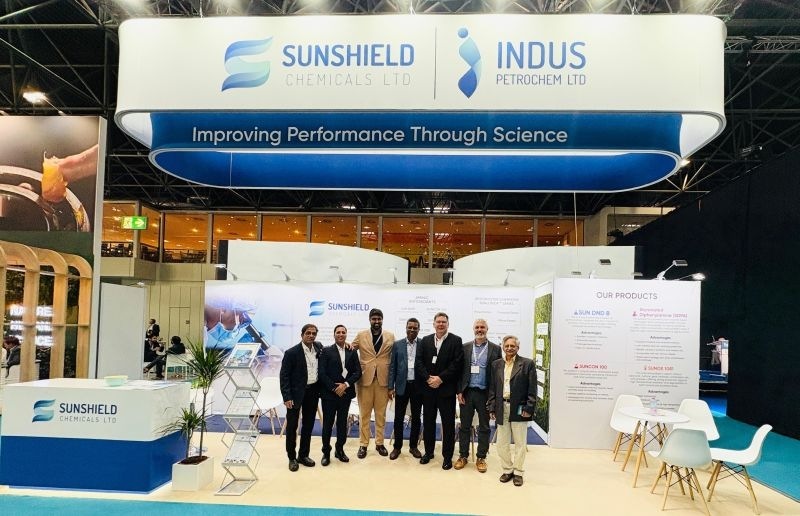
The specialty chemicals sector often feels like a high-stakes laboratory where the smallest titration of debt or capacity can change the entire reaction. For Sunshield Chemicals Ltd, the fiscal year 2026 wasn’t just another period of manufacturing; it was a total structural overhaul. While the broader industry struggled with Chinese oversupply and pricing pressure, Sunshield decided to rewrite its balance sheet, raising ₹129.90 crore through a rights issue to effectively wipe out its term debt.
1. At a Glance
Specialty chemical companies usually grow by piling on debt to build massive plants, hoping the demand follows. Sunshield Chemicals is playing a different, bolder game. The headline numbers are enough to make any auditor look twice: a 103% year-on-year profit growth (TTM) and a complete transformation into an almost debt-free entity.
In a world where interest rates have been a thorn in the side of mid-cap companies, Sunshield’s finance costs plummeted from ₹2.35 crore in March 2025 to a mere ₹0.06 crore in March 2026. This isn’t just a minor improvement; it’s a surgical removal of interest burden.
However, the “detective” in us must look at the shadows. While the bottom line is screaming success, the Operating Profit Margin (OPM) has seen a volatile journey. It dipped to 8% in the middle of the year before recovering to 15% in the final quarter. This volatility reveals the company’s vulnerability to raw material price swings and its ongoing battle with aggressive Chinese suppliers.
The geographical shift is also telling. Domestic revenue surged to 83% in FY25, up from 65% just two years prior. This suggests a strategic retreat or perhaps a loss of competitiveness in international markets like the Americas and Europe, where exports once held a much larger share.
The most intriguing part? The market has noticed. The stock is trading at a P/E of 28.2, nearly in line with the industry median, despite the massive deleveraging. Investors are clearly weighing the “clean” balance sheet against the “dirty” reality of global chemical demand.
Will the newly expanded capacity of 25,231 MTPA find enough buyers to justify the modernization, or will Sunshield find itself with a pristine balance sheet but idle reactors?
2. Introduction
Sunshield Chemicals Ltd, incorporated in 1986, is no newcomer to the Indian chemical landscape. For decades, it has operated from its hub in Raigad, Maharashtra, producing a niche portfolio that sounds like a chemistry textbook: THEIC, Ethoxylates, Antioxidants, and specialty elastomers.
These products find their way into everything from the wire enamels that insulate your electronics to the stabilizers in your PVC pipes and the antioxidants in your car’s lubricants. They aren’t selling household brands; they are selling the “secret sauce” that makes other products work.
The company underwent a pivotal change in 2021 when Indus Petrochem Limited took the reins, acquiring a 62.36% stake. Since then, the focus has shifted toward capacity expansion and operational efficiency.
The latest results for the quarter and year ended March 31, 2026, represent a “victory lap” for the management’s financial strategy. By utilizing a rights issue to clear debt, they have effectively insulated the company from the volatility of the credit markets. But as any seasoned investor knows, a debt-free company is only as good as its ability to generate cash from its core operations.
3. Business Model – WTF Do They Even Do?
Think of Sunshield as the high-end boutique of the chemical world. They don’t make millions of tons of basic stuff; they make specific molecules that high-profile clients like Asian Paints, Godrej Industries, and Lubrizol desperately need to keep their own products from falling apart.
Their business is split into several key buckets:
- THEIC: Used for heat and PVC stabilizers. If your plastic pipes don’t melt in the sun, you might thank THEIC.
- Ethoxylates & Propoxylates: These are the workhorses. They act as dispersing agents in paper, emulsifiers in dyes, and ingredients in agro-insecticides.
- Antioxidants: Used in plastic and rubber processing.
- HQEE: A specialty chain extender for polyurethanes.
The model is essentially “Technical Chemistry for Hire.” By serving diverse industries like Metal Treatment, Agrochemicals, and Personal Care, they try to ensure that if one sector (like Textiles) is crying, another (like Agrochemicals) is smiling.
However, let’s be real: this is a tough neighborhood. They are net exporters but are increasingly relying on the Indian domestic market. They import raw materials from China and Malaysia, meaning they are constantly playing a game of “Currency and Commodity Roulette.”
4. Financials Overview
The latest numbers show a company that has successfully converted its revenue growth into a massive PAT (Profit After Tax) jump, thanks largely to the removal of the debt anchor.
Quarterly and Annual Performance Comparison
(Figures in ₹ Crore)
| Metric | Mar 2026 (Latest Qtr) | Mar 2025 (YoY Qtr) | Dec 2025 (QoQ) | FY 2026 (Full Year) |
| Revenue | 109.67 | 110.31 | 94.96 | 440.91 |
| EBITDA | 16.90 | 12.45 | 10.01 | 55.29 |
| PAT | 10.66 | 5.74 | 4.89 | 29.60 |
| EPS (₹) | 12.12 | 7.76 | 5.83 | 33.66 |
Annualised EPS: Since March is the final quarter, we use the full-year EPS of ₹33.66.
Witty Commentary:
Management actually walked the talk. After talking about capacity expansion and debottlenecking throughout FY25, the volume jump is finally hitting the P&L. They managed to grow the bottom line significantly even when top-line growth was relatively flat on a YoY quarterly basis. How? By firing their bankers. Interest costs are now negligible.
Question for the reader: Do you prefer a company that grows by taking massive risks with debt, or one that asks its shareholders for cash to clean the slate?
5. Valuation Discussion – Fair Value Range
Let’s break down the math. Is Sunshield a bargain or a trap?
Method 1: P/E Ratio
- Current EPS: ₹33.66
- 5-Year Average PE: ~18x to 22x (Conservative)
- Current PE: 28.2x
- Calculation: $33.66 \times 20 = 673.20$
Method 2: EV/EBITDA
- EBITDA (FY26): ₹55.29 Cr
- Market Cap: ₹835 Cr (Debt is zero, so EV is roughly Market Cap minus Cash)
- Adjusted EV: ₹821 Cr
- Current EV/EBITDA: $821 / 55.29 = 14.8x$
- Industry Average: 15x to 18x
- Target Calculation: $55.29 \times 16 = 884.64$
Method 3: DCF (Discounted Cash Flow)
- Free Cash Flow (FCF): Volatile due to capex, but CFO is strong at ₹48 Cr.
- Growth Rate: 15% (Conservative)
- Terminal Value: 2%
- WACC: 12%
- Estimated Range: ₹850 – ₹1,050
Fair Value Range: ₹780 — ₹1,150
Disclaimer: This fair value range is for educational purposes only and is not investment advice.
6. What’s Cooking – News, Triggers, Drama
The biggest “drama” was the Rights Issue in late 2025. Sunshield asked for ₹129.90 crore, offering shares at ₹901 each. The fact that the market price is currently hovering around ₹950 shows that the “rights” weren’t exactly a gift, but a necessary capital infusion.
Then there’s the regulatory slap. The company was penalized ₹4.9 Crore in late 2024. While they’ve cleared the debt since then, it’s a reminder that specialty chemicals involve navigating a minefield of regulations.
The modernization of the Ethoxylates facility and the debottlenecking of the THEIC unit are the real catalysts. Management claims they now have a capacity of 25,231 MTPA. If they fill this capacity, the fixed-cost absorption will be legendary.
7. Balance Sheet
The balance sheet is the star of the show. It went from a “heavily leveraged” patient to a “marathon runner” in twelve months.
(Figures in ₹ Crore)
| Row | Mar 2026 (Consolidated) | Mar 2025 (Consolidated) | Mar 2024 (Consolidated) |
| Total Assets | 305 | 304 | 229 |
| Net Worth | 252 | 96 | 82 |
| Borrowings | 0 | 100 | 85 |
| Other Liabilities | 53 | 108 | 61 |
| Total Liabilities | 305 | 304 | 229 |
- Borrowings went to zero. It’s like watching a magic trick, except the rabbit was ₹129 Crore of shareholder money.
- The Net Worth skyrocketed, proving that “Equity is the new Black.”
- Total assets remained stable, but the quality of the “funding” for those assets is now much safer.
8. Cash Flow – Sab Number Game Hai
(Figures in ₹ Crore)
| Category | Mar 2026 | Mar 2025 | Mar 2024 |
| Operating Cash Flow | 10 | 48 | 42 |
| Investing Cash Flow | -20 | -50 | -40 |
| Financing Cash Flow | 134 | 2 | -11 |
Analysis:
The company is a cash-generating machine at the operating level, but it’s spending it as fast as it makes it. The ₹50 Cr and ₹20 Cr spent on fixed assets over the last two years show they are betting big on their own future. The financing cash flow spike of ₹134 Cr is the rights issue money flowing in.
Question: If the company stops spending on new plants, what will they do with all that extra cash? Dividends or more drama?
9. Ratios – Sexy or Stressy?
| Ratio | Value | Verdict |
| ROE | 17.0% | Decent, but was 21% before. Dilution from rights issue hurts this. |
| ROCE | 19.9% | Strong. This shows the business itself is healthy. |
| P/E | 28.2 | Fair. Not a bargain, but not absurd. |
| PAT Margin | 6.71% | A bit thin. Needs to cross 10% to be “sexy.” |
| Debt to Equity | 0.00 | Absolute perfection. Auditor’s dream. |
Sunshield is currently in the “stable” zone. The high ROCE suggests they are efficient at using capital; they just need to protect their margins from the Chinese pricing onslaught.
10. P&L Breakdown – Show Me the Money
(Figures in ₹ Crore)
| Year | Revenue | EBITDA | PAT |
| Mar 2026 | 441 | 55 | 30 |
| Mar 2025 | 366 | 34 | 15 |
| Mar 2024 | 283 | 40 | 19 |
Commentary:
Revenue is climbing like a determined hiker, but EBITDA had a weird slip in 2025 before bouncing back. It’s a classic “V-shaped” recovery. 2025 was the year of “expansion pain,” and 2026 is the year of “expansion gain.”
11. Peer Comparison
| Company | Revenue (Cr) | PAT (Cr) | P/E |
| Pidilite Inds. | 12,358 | 1,758 | 61.4 |
| BASF India | 13,876 | 605 | 43.6 |
| Aarti Industries | 6,205 | 412 | 41.2 |
| Sunshield Chem. | 441 | 30 | 28.2 |
Sarcastic Note:
Sunshield is the “tiny tot” in this group of giants. While Pidilite is busy owning every carpenter’s shop in India, Sunshield is happy sitting in its corner with a 28 P/E. It’s the cheapest in the lot, but that’s because it doesn’t have the “brand” moat of its peers. It’s a pure B2B play.
12. Miscellaneous – Shareholding and Promoters
Promoter Holding: 66.53% (Up from 62.36%—they are putting their money where their mouth is).
The Promoters:
Indus Petrochem Limited runs the show. Managing Director Jeet Malhotra is at the helm. These guys aren’t just “investors”; they are industry veterans who seem to have a personal vendetta against debt.
The Roast:
The promoters finally realized that paying interest to banks is less fun than owning more of their own company. They boosted their stake during the rights issue. It’s like buying more of your own cake because you realized the neighbors actually like the taste.
13. Corporate Governance – Angels or Devils?
Sunshield has been around since 1986, which is an eternity in the Indian stock market. They have an unmodified audit opinion, which is auditor-speak for “we didn’t find any bodies buried in the basement.”
However, the ₹4.9 Crore penalty in 2024 is a small smudge on the record. The board is also shuffling chairs, with independent directors being reappointed for 5-year terms.
They also recently constituted a CSR Committee. While it’s a regulatory requirement, it’s always funny to see chemical companies talk about “social responsibility” while handling thousands of tons of ethoxylates. At least they are playing by the book.
14. Industry Roast and Macro Context
The specialty chemical industry in India currently feels like a boxing match where India is trying to land a punch, but China keeps hitting below the belt with “predatory pricing.”
Every company’s annual report mentions the same thing: “Chinese oversupply.” It’s the industry’s version of “the dog ate my homework.” However, with the “China Plus One” strategy still alive, Indian players are expanding capacity like there’s no tomorrow.
The macro context is simple: if global demand for paints, cars, and detergents stays high, Sunshield wins. If China continues to dump chemicals at cost price, Sunshield—and the rest of the Indian chemical sector—will keep crying about their margins.
15. EduInvesting Verdict
Sunshield Chemicals Ltd is a fascinating case of financial engineering meeting industrial expansion. They have successfully de-risked the company from a “solvency” perspective. There is zero debt. None. That is a massive tailwind in an uncertain economy.
The Past: They survived the 2021 takeover and the 2024-25 margin squeeze.
The Future: They have the capacity (25k+ MTPA). They have the clients (Asian Paints, etc.). Now, they just need the demand.
SWOT Analysis
- Strengths: Zero debt, high ROCE, experienced promoter backing (Indus Petrochem).
- Weaknesses: Thin PAT margins, heavy reliance on domestic demand, vulnerability to raw material imports.
- Opportunities: Operating leverage from newly expanded capacity, “China Plus One” tailwinds.
- Threats: Aggressive pricing from Chinese competitors, forex volatility, regulatory fines.
Sunshield isn’t a “get rich quick” scheme. It’s a “watch the capacity utilization” story. If they can fill those reactors without sacrificing margins, the 103% profit growth we saw this year might just be the first chapter.
Final Question: If you were the CEO and had ₹130 Crore in the bank, would you have paid off the debt, or would you have built a second plant?
Disclaimer: This fair value range and analysis are for educational purposes only and are not investment advice.