TRF Ltd Q4 FY26: Revenue Down 28% YoY, PAT Reverses into Loss; Is the Tata Support Enough?
TRF Ltd is currently a company of contradictions. On one hand, it carries the prestigious Tata lineage, a badge of corporate royalty that usually grants an automatic premium. On the other hand, its financial statements read like a cautionary tale of a legacy business struggling to find its footing in a modern industrial landscape. The latest numbers for the quarter ended March 31, 2026, show a business that is shrinking in size and bleeding at the bottom line.
Revenue from operations plummeted to ₹19.39 crore this quarter, a stark contrast to the ₹27.11 crore recorded in the same period last year. This is not just a minor dip; it is a 28.5% year-on-year (YoY) contraction. Even more concerning is the Net Profit, which swung from a positive ₹3.52 crore in March 2025 to a Net Loss of ₹6.91 crore in March 2026. This reflects a staggering 296% decline in profitability.
The market cap stands at a modest ₹266 crore, yet the stock trades at a Price-to-Earnings (P/E) of 38.4, which is higher than the industry median of 32.7. This suggests that investors are still pricing in a “Tata recovery” or perhaps the eventual merger into Tata Steel, rather than the cold, hard reality of current operations. With a Debt-to-Equity of 1.54 and Interest Coverage of 1.47, the financial cushions are thin.
Metric
Latest Qtr (Mar ’26)
Same Qtr LY (Mar ’25)
YoY Change (%)
Sales
₹19.39 Cr
₹27.11 Cr
-28.5%
Net Profit
₹-6.91 Cr
₹3.52 Cr
-296.3%
OPM %
-32.23%
22.98%
-5521 bps
The operational efficiency has taken a massive hit, with Operating Profit Margin (OPM) crashing into negative territory at -32.23%. For a company that once boasted margins above 40% in late 2023, this is a dramatic fall from grace. The legacy of “turnkey projects” seems to be coming with legacy-sized headaches.
Is this just a temporary transition phase as the company pivots toward serving only Tata Steel, or is the core business model fundamentally broken? The numbers suggest that while the debt has been reshuffled thanks to parent support, the operational engine is misfiring.
Introduction
TRF Ltd, established in 1962, was once a powerhouse in the material handling space. It built the veins and arteries of India’s infrastructure—conveyors, crushers, and screens for power plants and steel mills. However, the last decade has been an uphill battle. The company has moved from being an aggressive external contractor to a captive service provider for its parent, Tata Steel Limited.
The current state of TRF is defined by its relationship with Tata Steel. The parent company holds a 34.11% stake and has been the ultimate “Lender of Last Resort,” infusing capital through preference shares to pay off external debts. In FY23 alone, the company repaid external borrowings of ₹164 crore using funds provided by Tata Steel.
Despite this “get out of jail free” card on the debt front, the top line is vanishing. Sales growth over the last five years is a negative 5.69%, and the latest TTM (Trailing Twelve Months) sales growth is an even worse -30%. The strategy has shifted toward “Life Cycle Services” and “Equipment Manufacturing” primarily for the Tata ecosystem.
The company’s presence in Jamshedpur gives it a front-row seat to Tata Steel’s expansion, but it also makes TRF a “one-trick pony.” While this reduces the risk of payment defaults (since the client is the parent), it limits the growth potential to whatever crumbs the parent decides to drop. The proposed Scheme of Amalgamation with Tata Steel remains the ultimate endgame, where TRF will eventually cease to exist as a separate entity.
Business Model – WTF Do They Even Do?
TRF Ltd is essentially the “Maintenance and Repair Guy” for big industrial machines, with a special focus on the Tata family. They operate two main divisions: Product and Project.
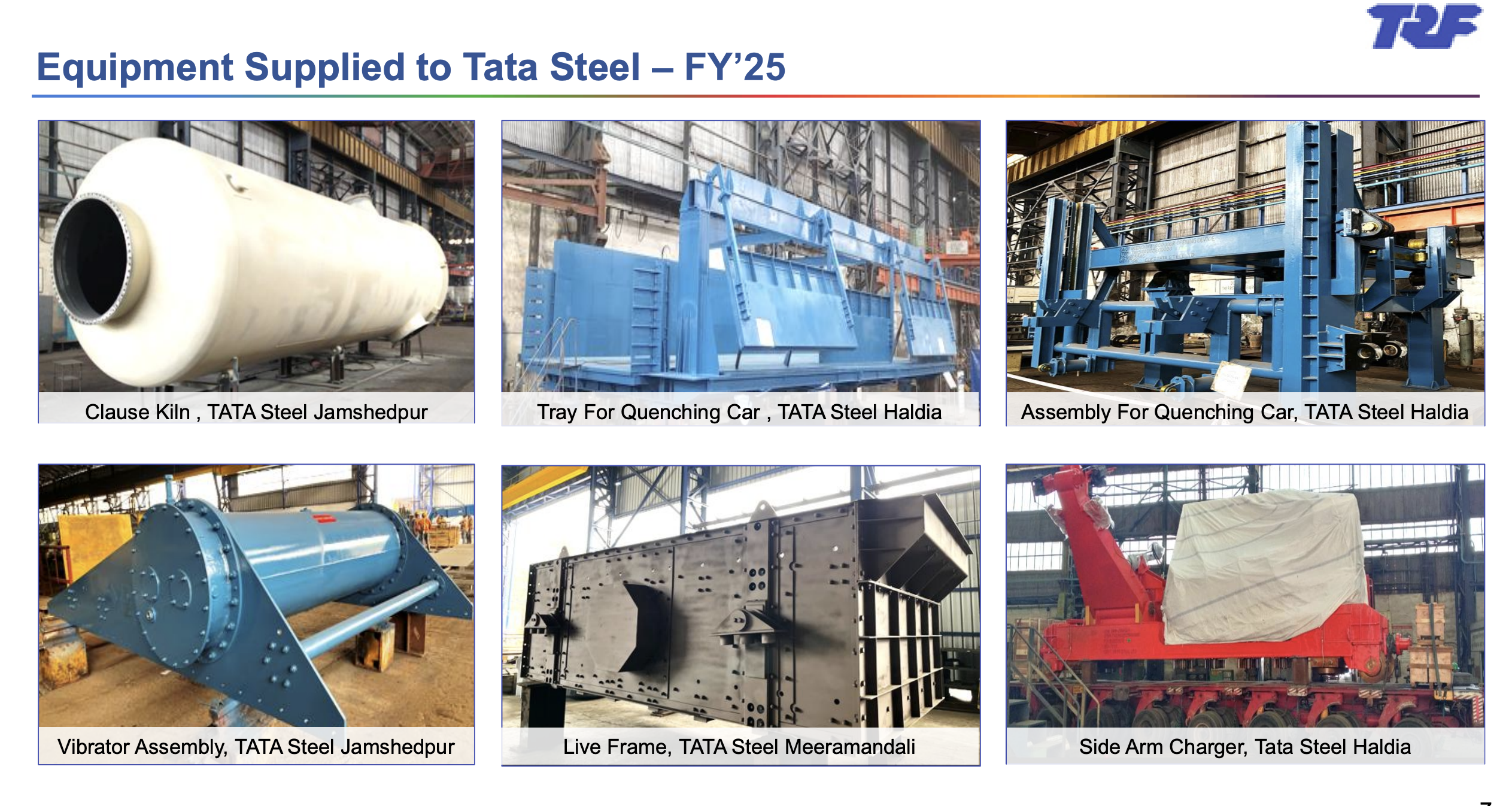
The Product Division manufactures the heavy-duty gear: crushers that turn big rocks into small ones, screens that sort them, and conveyors that move them. These aren’t your household gadgets; we are talking about 2,386 metric tons of finished goods produced in FY25. They even started making EOT cranes—a first for them—specifically for Tata Steel.
The Project Division is where things get messy. This is the EPC (Engineering, Procurement, and Construction) arm. They take on “turnkey” projects, meaning they design and build entire material handling systems. Historically, they did this for external clients like NTPC and