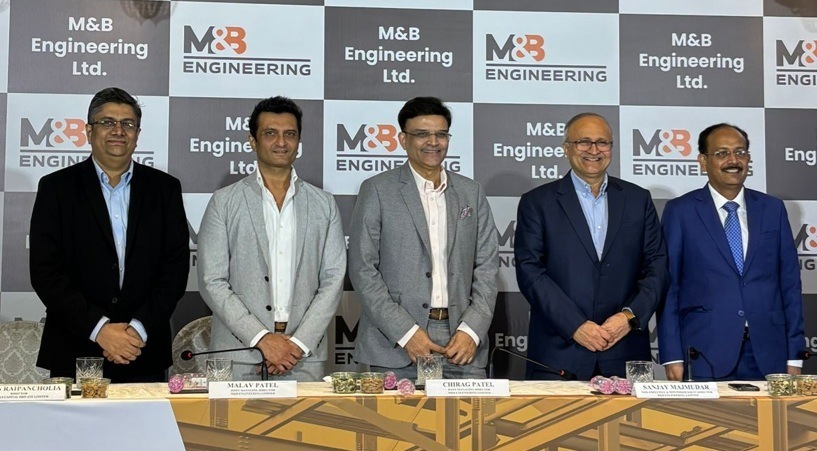
The construction landscape in India is no longer just about brick and mortar. It is about speed, precision, and steel. M & B Engineering Ltd (MBEL) has just capped off a massive fiscal year, proving that the shift toward Pre-Engineered Buildings (PEBs) is not just a trend—it’s a structural pivot in the industrial economy. With a record-breaking consolidated revenue of ₹1,260 crore for FY26, the company is screaming for attention in a sector that was once considered slow and “boring.”
1. At a Glance
The numbers coming out of MBEL are designed to turn heads, but beneath the surface of the 27% YoY revenue growth, there are fascinating dynamics at play. We are looking at a company that has successfully scaled its Phenix (PEB) and Proflex (Roofing) divisions to hit a combined order book of ₹1,083 crore. This isn’t just about domestic warehouses anymore; MBEL is aggressively hunting in the North American markets, securing a single massive export order worth ₹212 crore during the year.
However, high growth usually comes with high stakes. The company’s Gross Current Asset (GCA) days stand at a staggering 222 days. In plain English: their money is tied up in inventory and receivables for more than seven months. While they claim this is a hedge against volatile steel prices, it puts immense pressure on liquidity. Furthermore, while the Sanand facility is running “chock-a-block” at 75%+ utilization, the Cheyyar facility in Tamil Nadu is lagging significantly at ~23% to 50%.
Investors are watching a balancing act: Can MBEL ramp up its Southern capacity fast enough to justify the capital expenditure, or will the logistical nightmare of shipping steel across India eat into their margins? The 11.2% OPM suggests that while they are winning orders, they aren’t exactly operating in a high-margin vacuum. Competition from unorganized players remains a persistent thorn.
2. Introduction
M & B Engineering Ltd is an Ahmedabad-based powerhouse that has survived and thrived since 1981. It doesn’t just “build” things; it designs, engineers, and manufactures the skeletal remains of modern India. From the massive textile plants in Madhya Pradesh (2,85,000 sq. m.) to e-commerce warehouses in Gujarat, MBEL provides the Pre-Engineered Buildings (PEBs) that allow industries to go live in months rather than years.
The company operates through two distinct lenses:
- Phenix Division: The heavy lifters. This division handles structural steel, T-beams, and complex engineering for power plants, bridges, and factories.
- Proflex Division: The roofing specialists. They use mobile manufacturing units to create self-supported steel roofing that requires no intermediate supports—a godsend for large-scale industrial sheds.
With the recent ₹650 crore IPO in August 2025, the company has cleared its term loans and is now sitting on a war chest for expansion. But as the “detective” in this story, one must ask: is the aggressive expansion into North America a strategic masterstroke or a desperate search for margins that the domestic market refuses to give?
3. Business Model – WTF Do They Even Do?
If you see a giant warehouse or a factory being erected with pre-fabricated steel columns like a giant Lego set, that’s a PEB. MBEL’s Phenix division is the brain behind these. They take a client’s requirement, design it on software like TEKLA or STAAD PRO, manufacture it in Sanand or Cheyyar, and then ship it to the site for “erection.”
Then there is Proflex. Imagine a machine on wheels that goes to a construction site, takes flat steel coils, and spits out curved, self-supporting roofing panels. No trusses, no purlins, no bird nuisance. It’s elegant, but let’s be real—it’s a niche business that accounted for about 22.65% of revenue in FY25.
The core of their “moat”—if we can call it that—is the AISC (American Institute of Steel Construction) and CWB (Canadian Welding Bureau) certifications. These are the golden tickets that allow them to export to North America. Without these, they’d just be another local steel fabricator fighting over a few rupees of margin in Gujarat.
4. Financials Overview
The latest results show a company that is growing its topline, but the bottom line is feeling the heat of global competition and “tariff absorption.”
Key Performance Indicators (Consolidated)
| Particulars | Q4 FY26 (Latest) | Q4 FY25 (YoY) | Q3 FY26 (QoQ) |
| Revenue | ₹364 Cr | ₹314 Cr | ₹352 Cr |
| EBITDA | ₹43 Cr | ₹44 Cr | ₹44 Cr |
| PAT | ₹27 Cr | ₹29 Cr | ₹25 Cr |
| EPS (Quarterly) | ₹4.72 | ₹5.70 | ₹4.46 |
Financial Wisdom: Revenue is vanity, profit is sanity, but cash is reality. While revenue grew 16% YoY this quarter, PAT actually dropped by 5.3%. Management admits they are “absorbing” tariffs in the US to stay competitive. In short, they are buying market share at the expense of current margins.
Management Walk the Talk: In the Feb 2026 ConCall, management guided for ₹1,250 Cr revenue and ~12.75% EBITDA margins. They hit the revenue target (₹1,260 Cr) but the EBITDA margin for the full year came in slightly lower at 12.48%. They are close, but not quite “walking the talk” on margin expansion yet.
5. Valuation Discussion – Fair Value Range Only
To find the fair value of MBEL, we must look at where it stands relative to its growth and its heavy capital requirements.
Method 1: P/E Approach
The current P/E is 18.3. Given the industry median of 18.2, MBEL is trading exactly at par with its peers. However, with a PEG Ratio of 0.44, the market might be underestimating its growth potential.
- Annualized EPS (FY26): ₹16.21
- Target P/E Range: 16x – 20x
- Value: ₹259 – ₹324
Method 2: EV to EBITDA
- FY26 EBITDA: ₹157 Cr
- Enterprise Value: ₹1,516 Cr
- EV/EBITDA: 9.64x
- Peer Average: ~10.5x
- Value: ₹285 – ₹330
Method 3: DCF (Discounted Cash Flow)
Assuming a 12% discount rate and a 5% terminal growth, accounting for the heavy working capital drag and recent IPO infusion:
- Value: ₹270 – ₹310
Fair Value Range: ₹265 — ₹320
This fair value range is for educational purposes only and is not investment advice.
6. What’s Cooking – News, Triggers, Drama
The big drama here is the US-India tariff war. While some tariffs were reduced recently, management pointed out that the 50% sectoral tariff on steel remains intact. MBEL is literally paying a 50% “entry fee” to play in the US market.
On the bright side, they bagged a ₹71.95 crore domestic order in April 2026. They are also chasing the Railway RUB (Road Under Bridge) opportunity. With 11,000 RUBs planned in India, and MBEL’s Proflex roofing being a perfect fit, this could be the catalyst that finally utilizes the Cheyyar plant.
Is the market ignoring the potential “Railway Boom” for this stock?
7. Balance Sheet
The balance sheet has undergone a massive makeover post-IPO. The debt-to-equity ratio has crashed from 0.61 to a very comfortable 0.13.
| Rows | Mar 2026 (Consolidated) | Mar 2025 (Consolidated) | Mar 2024 (Consolidated) |
| Total Assets | ₹1,161 Cr | ₹849 Cr | ₹633 Cr |
| Net Worth | ₹657 Cr | ₹307 Cr | ₹233 Cr |
| Borrowings | ₹84 Cr | ₹191 Cr | ₹205 Cr |
| Other Liabilities | ₹420 Cr | ₹352 Cr | ₹195 Cr |
| Total Liabilities | ₹1,161 Cr | ₹849 Cr | ₹633 Cr |
- The company used the IPO to kill its debt, which is great, but now they have a lot of equity to service.
- “Other Liabilities” are rising faster than a PEB structure—mostly customer advances and trade payables.
- They are sitting on ₹180 Cr of fixed assets, mostly in Gujarat and Tamil Nadu.
8. Cash Flow – Sab Number Game Hai
This is where the “Auditor” in me starts to sweat. Look at the Cash from Operating Activity for Mar 2026.
| Particulars | Mar 2026 | Mar 2025 | Mar 2024 |
| Operating Cash Flow | -₹31 Cr | ₹33 Cr | ₹5 Cr |
| Investing Cash Flow | -₹39 Cr | -₹34 Cr | -₹62 Cr |
| Financing Cash Flow | ₹136 Cr | -₹45 Cr | ₹32 Cr |
MBEL generated zero net cash from its operations this year; in fact, it was negative. The entire show is being run by the ₹136 Cr inflow from the IPO and financing. They are pouring money into capacity (Investing) but the operations aren’t spitting back cash yet because it’s all stuck in Inventory (₹349 Cr) and Receivables (₹239 Cr).
9. Ratios – Sexy or Stressy?
The ratios tell a story of high operational efficiency but poor cash management.
| Ratio | Value | Commentary |
| ROE | 19.4% | Respectable, but down from 22.5% earlier. |
| ROCE | 23.0% | Strong, showing they use their capital well. |
| P/E | 18.3 | Fairly valued for a 20% grower. |
| Net Margin | 7.4% | Thin. One wrong move in steel prices and this vanishes. |
| Debt to Equity | 0.13 | Clean as a whistle. |
Financial Wisdom: A high ROCE with negative operating cash flow is like a Ferrari with a tiny fuel tank. It looks fast, but you’ll be stopping for “equity refills” (IPOs/QIPs) more often than you’d like.
10. P&L Breakdown – Show Me the Money
| Particulars | Mar 2026 | Mar 2025 | Mar 2024 |
| Revenue | ₹1,260 Cr | ₹989 Cr | ₹795 Cr |
| EBITDA | ₹142 Cr | ₹127 Cr | ₹80 Cr |
| PAT | ₹93 Cr | ₹77 Cr | ₹51 Cr |
The company has more than doubled its PAT in three years. That’s the good news. The bad news? Other income (interest on IPO funds) contributed ₹15.67 Cr to the PBT. Without that “free money,” the growth would look a lot more modest.
11. Peer Comparison
| Name | Revenue (Qtr) | PAT (Qtr) | P/E |
| Larsen & Toubro | ₹82,762 Cr | ₹6,133 Cr | 31.3 |
| NBCC | ₹3,022 Cr | ₹197 Cr | 38.5 |
| M & B Engineering | ₹364 Cr | ₹27 Cr | 18.3 |
MBEL is a tiny fish in a massive pond. While L&T trades at a premium P/E of 31, MBEL is sitting at 18. Why? Because L&T has a balance sheet that can withstand a decade of bad weather, whereas MBEL is still sensitive to the price of a steel coil in China.
12. Miscellaneous – Shareholding and Promoters
The Promoters hold 70.54%, which is a sign of skin in the game. The Patel family runs the show.
- Girishbhai Patel & Chirag Patel are the heavyweights here.
- Institutions (FII/DII) hold about 12.5%, including big names like Abu Dhabi Investment Authority and Abakkus.
- Public holding is increasing, now at 16.88%.
The Roast: The promoters have set up a web of trusts and LLPs (MGM11, MGM5, etc.). While legal, it makes the shareholding look like a messy family dinner seating chart.
13. Corporate Governance – Angels or Devils?
The auditors haven’t flagged anything major yet, but the Monitoring Agency Report for IPO proceeds was just submitted. So far, the money is being spent where they said it would: ₹130 Cr into capacity and ₹58 Cr to pay debt.
However, the company’s Sanand facility is the only one with export certifications. This creates a “single point of failure” risk. If something goes wrong in Sanand, the export business—the high-value part of the story—grinds to a halt.
14. Industry Roast and Macro Context
The PEB industry is currently the “cool kid” in construction. Everyone from Adani to Tata wants steel buildings because concrete is “too slow.” But let’s be honest: this is a commodity business disguised as engineering. Entry barriers are low for small sheds, and the big boys only win on “complexity.”
If the US decides to hike steel tariffs further, or if the Indian government stops its infrastructure spending spree, these PEB companies will be left with a lot of expensive iron and no one to buy it.
Will the shift from concrete to steel happen fast enough to save the lagging Cheyyar plant?
15. EduInvesting Verdict
M & B Engineering is at a crossroads. It has successfully used the public’s money to clean its balance sheet and is now aggressively betting on the “American Dream.”
The Bull Case:
- Operating Leverage: If the Cheyyar plant utilization goes from 23% to 70%, margins will explode.
- Export Moat: The AISC/CWB certifications are hard to get and provide a defensive wall.
- Railway Opportunity: A massive TAM in the Indian Railways.
The Bear Case:
- Working Capital Trap: GCA days of 222 are unsustainable. One bad credit cycle and they are in trouble.
- Tariff Absorption: If they keep absorbing 50% tariffs, the export “growth” is just busywork with no profit.
SWOT Analysis
- Strengths: Zero net debt, niche certifications, strong domestic repeat clientele.
- Weaknesses: High working capital, low capacity utilization in the South.
- Opportunities: North American infrastructure bill, Indian Railway modernization.
- Threats: Steel price volatility, increased domestic competition, global trade wars.
MBEL is a play on the “Faster India” theme. It’s built for speed, but the financial engine needs to produce more cash and less “inventory” to truly become a market leader.