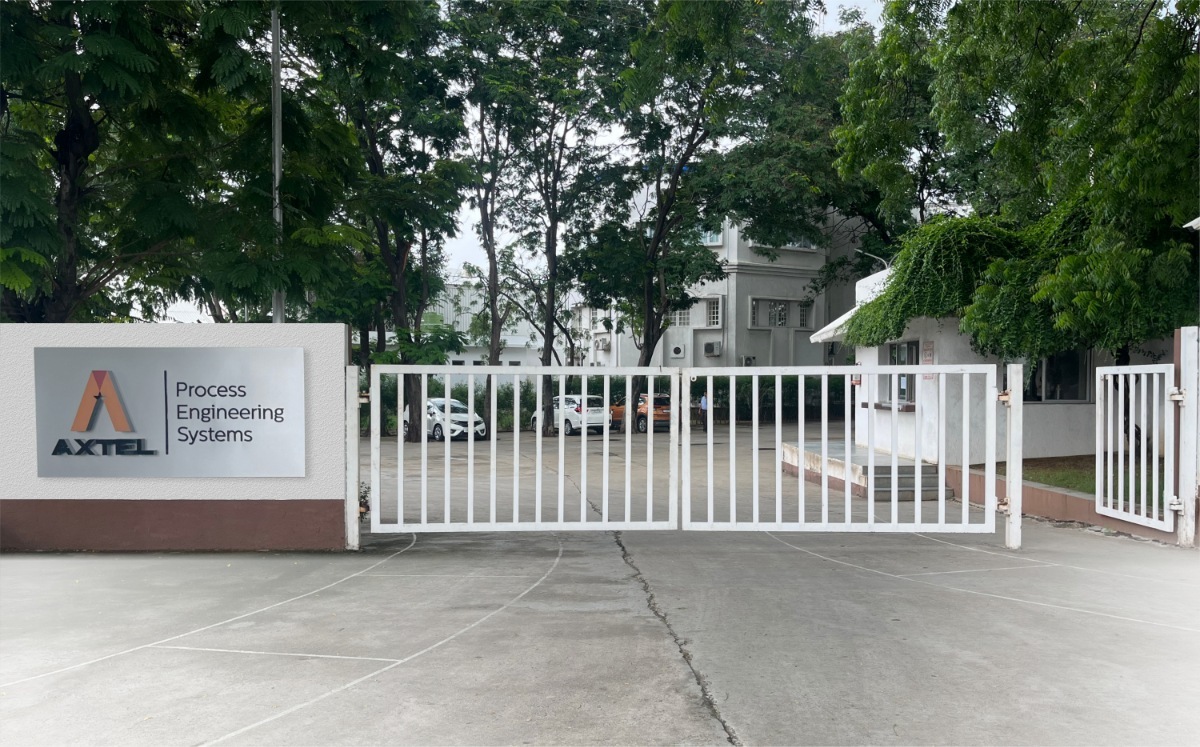
1. At a Glance
Axtel Industries is a company that operates in a niche yet vital segment of the industrial landscape: manufacturing custom-designed food processing plants and machinery. While the name might not be a household one, its client list certainly is. We are talking about the heavyweights—Nestle, Pepsico, Unilever, and Mondelez. If you’ve eaten a processed snack or a chocolate bar in India recently, there is a high probability that an Axtel machine played a part in its journey from raw ingredient to finished product.
However, do not let the blue-chip clientele blind you to the inherent risks. Axtel is a classic example of a “lumpy” business. Its revenue is tied directly to the capital expenditure (capex) cycles of food giants. When Pepsico decides to build a new plant, Axtel wins big. When the industry enters a consolidation phase, the order book can look stagnant.
In FY25, the company saw a significant drop in Total Operating Income (TOI), falling to ₹180 crore from ₹224 crore in FY24. This was not due to a loss of competitiveness, but rather a temporary slowdown in execution and industry-wide capex moderation. But here is the kicker: in the latest Q4 FY26 results, sales have surged back to ₹71 crore, nearly doubling from the ₹38 crore reported in the same quarter last year.
The company is virtually debt-free, which is a rare feat for an engineering firm. It sits on a pile of cash, yet it faces the constant struggle of elongated working capital cycles. In FY25, the operating cycle stretched to 127 days. Inventory remains high because custom machines aren’t built overnight. It’s a game of patience, high margins, and waiting for the next big order.
As we look at the numbers for the full year ending March 2026, the company is showing a recovery in its top line, reaching ₹224 crore again. But the real story lies in the margins. The operating profit margin (OPM) which dipped to 13% in FY25 has bounced back to 18% in FY26.
Is this a sign of a sustainable turnaround, or just the peak of another volatile cycle? The company recently expanded its manufacturing facility at Halol, increasing its capacity from 1.50 lakh sq. ft. to 2 lakh sq. ft. This indicates management’s confidence in future demand, but it also increases the fixed cost base. If the orders don’t flow in, that extra floor space becomes an expensive liability.
2. Introduction
Axtel Industries Limited (AIL) was incorporated in 1991. For over three decades, it has carved out a space as an Original Equipment Manufacturer (OEM) specifically for the food industry. They don’t just sell “machines”; they sell “systems.” Whether it’s size reduction, mixing, sieving, or steam sterilization, they provide end-to-end process engineering.
The company’s headquarters and sole manufacturing unit are located in Halol, Gujarat. This centralization allows for tight control over quality but creates a single point of failure risk. Their strategic partnerships with global players like Wenger Inc. (USA) for extrusion systems and AnuTec GmbH (Switzerland) for powder handling give them a technological edge that local competitors often lack.
What makes Axtel unique is its focus on customization. Almost every project is a “one-off.” While this allows for premium pricing and healthy EBITDA margins (historically between 12% and 20%), it prevents the company from achieving mass-production efficiencies. Each order requires intense engineering hours and specific raw material procurement.
The shareholding pattern is remarkably stable. Promoters have held a steady 49.95% stake for years. Interestingly, the public holding is quite concentrated, with some large individual names and a small but growing presence of institutional investors like PGIM India Equity Growth Opportunities Fund.
Despite being a small-cap company with a market capitalization of roughly ₹806 crore, Axtel maintains a high level of transparency and financial discipline. Their credit ratings were recently reaffirmed at CARE A-; Stable, reflecting their strong financial risk profile and the fact that they carry zero long-term debt.
The stock has given a modest 5-6% return over the last