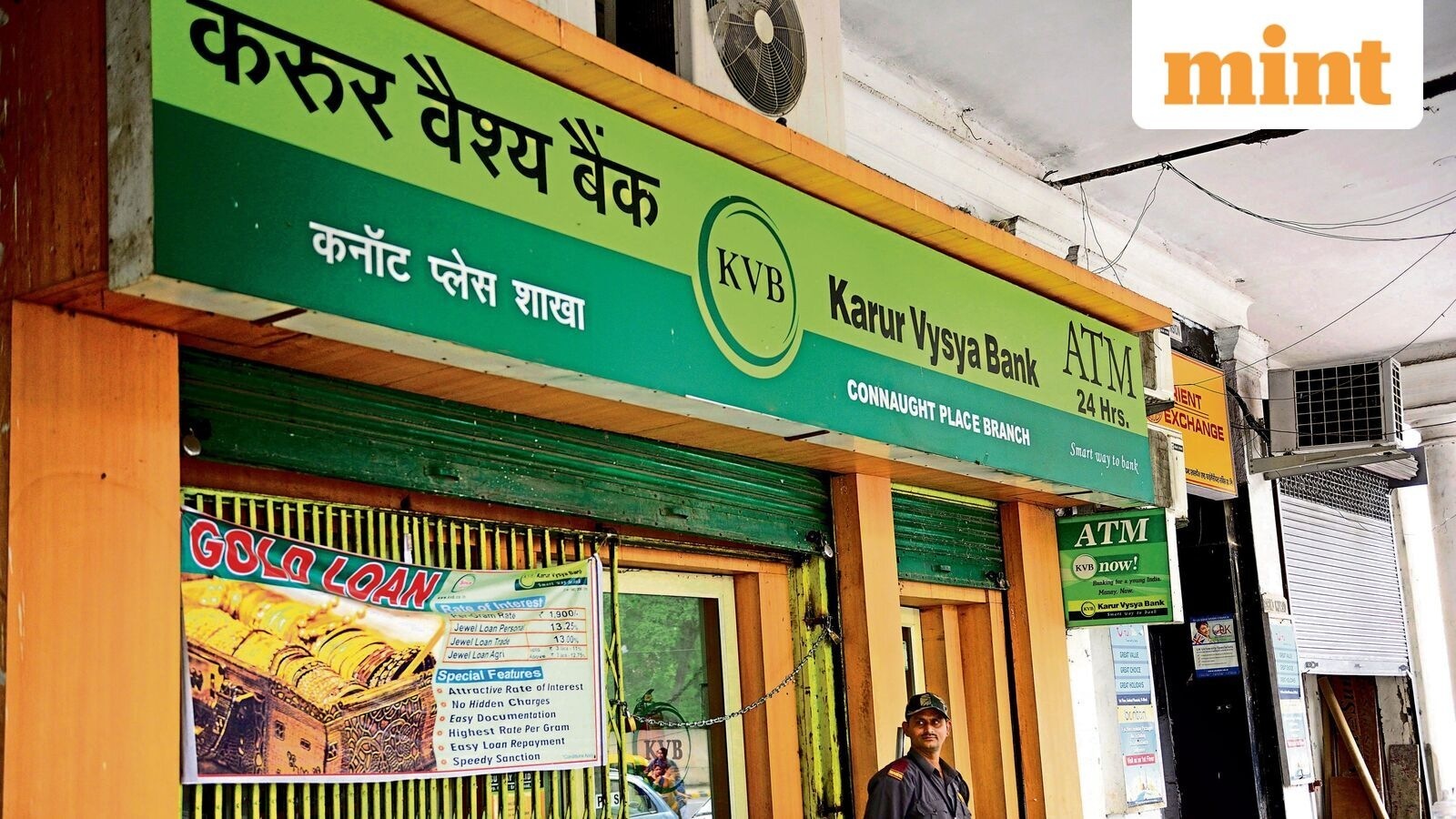
Karur Vysya Bank (KVB) has delivered a masterclass in regional banking efficiency for the financial year ended March 31, 2026. The bank reported a Net Profit of ₹725 crore for the final quarter, marking a massive 41.2% jump compared to the same period last year. For the full year, the bank crossed the ₹2,500 crore profit milestone, proving that its strategy of focusing on the RAM (Retail, Agriculture, and MSME) engine is firing on all cylinders.
While the broader banking industry struggled with deposit wars and shrinking margins, KVB managed to expand its Net Interest Margin (NIM) to 4.25% in Q4. What is even more striking is the asset quality; with a Net NPA of 0.19%, the bank’s book is arguably one of the cleanest in the Indian private banking space. The Board has rewarded shareholders by recommending a 130% dividend (₹2.60 per share), signaling immense confidence in its internal accruals and capital position.
1. At a Glance
Karur Vysya Bank is no longer just a “small town bank” from Tamil Nadu; it has evolved into a high-yielding financial powerhouse that is aggressively gaining investor attention. With a Market Cap of ₹29,319 crore and a Return on Equity (ROE) of 19.3%, KVB is punching significantly above its weight class.
The numbers are sensational. Total business has crossed the ₹2.14 lakh crore mark, growing at 15% YoY. This growth is not coming from reckless corporate lending but from a granular, well-diversified book where 86% of advances belong to the RAM sector. The bank’s ability to maintain a CASA ratio of nearly 27% despite intense competition for liquidity shows a very sticky and loyal customer base.
However, it is not all sunshine and rainbows. Conservative investors should note the regional concentration, as nearly 42% of the portfolio is still tied to Tamil Nadu. Any localized economic slowdown or regulatory shift in the South could impact the bank disproportionately. Furthermore, the Promoter holding is a microscopic 2.07%, which often raises eyebrows regarding long-term skin in the game, although institutional investors have happily filled that void, owning over 58% of the bank.
Is the bank becoming too dependent on its gold loan book? Jewel loans now stand at ₹29,492 crore, making up nearly 30% of the total advances. While these are safe, liquid, and high-yielding, a sharp drop in gold prices or a change in LTV (Loan-to-Value) norms could create temporary friction. The bank is currently flying high, but as it scales, the challenge will be to maintain these “gold standard” asset quality metrics without sacrificing growth.
2. Introduction
Established in 1916, Karur Vysya Bank is one of the few century-old institutions that has successfully navigated the digital revolution. Based in Karur, it has built a fortress in South India with a network of 901 branches.
The bank’s philosophy has shifted from mere survival to aggressive efficiency. Under the current leadership, it has pivoted away from bulky, low-margin corporate accounts and doubled down on MSMEs and retail borrowers. This shift is reflected in its Cost-to-Income ratio, which has dropped to a lean 37.27% in the latest quarter.
The recent approval by the RBI for ICICI Prudential AMC to acquire up to 9.95% stake is a massive institutional validation. It suggests that big money believes KVB’s “boring but stable” banking model is actually a high-growth engine in disguise.
With 97% of transactions now happening digitally, the bank has shed its legacy image. It is now a tech-enabled lender that uses its century-old trust to lower its cost of funds while using modern analytics to keep slippages below 1%.
3. Business Model – WTF Do They Even Do?
At its heart, KVB is a “Spread Master.” They take money from savers in semi-urban and rural India (where they have 55%