At a Glance
Steel City Securities Ltd is not your average, run-of-the-mill brokerage firm that merely survives on the whims of the Nifty 50. While the giants in Mumbai are busy fighting over who has the slickest app, Steel City has quietly built a fortress in the e-governance and retail broking space, specifically targeting the under-penetrated markets of South and Central India. This is a company that effectively moonlights as a government service center while simultaneously running a full-scale financial supermarket.
The numbers for FY26 are out, and they tell a story of a business that is essentially a cash-generating machine with a split personality. On one hand, you have the high-octane stock broking operations, and on the other, the steady, high-margin e-governance business that serves over 68 million customers cumulatively. We are looking at a market cap of ₹126 Cr, which, in the world of finance, is practically pocket change, yet the company is pulling in ₹62 Cr in annual sales with an operating profit margin (OPM) of nearly 27%.
The intrigue lies in the valuation. With a P/E of 8.81 and a dividend yield that sits at a juicy 4.80%, it looks like a value investor’s dream—or a trap for the unwary. The company is trading at 0.91 times its book value. Yes, you read that right. You are essentially buying the assets of the company at a discount, while getting the business for free. But wait, there is drama. SEBI recently decided to give the Managing Director a one-month “unpaid leave,” and the NSE has been handing out penalties for margin breaches like they’re participation trophies.
Why is a company with zero promoter pledge and a 74.7% promoter holding trading at such a massive discount to its peers like Angel One or Motilal Oswal? Is it the 399-day debtor cycle, or is the market just blind to the e-governance goldmine? We are diving deep into the balance sheet and the recent board outcomes to see if this “Steel” city is built on a solid foundation or if it’s just rusted iron waiting for a meltdown.
Introduction
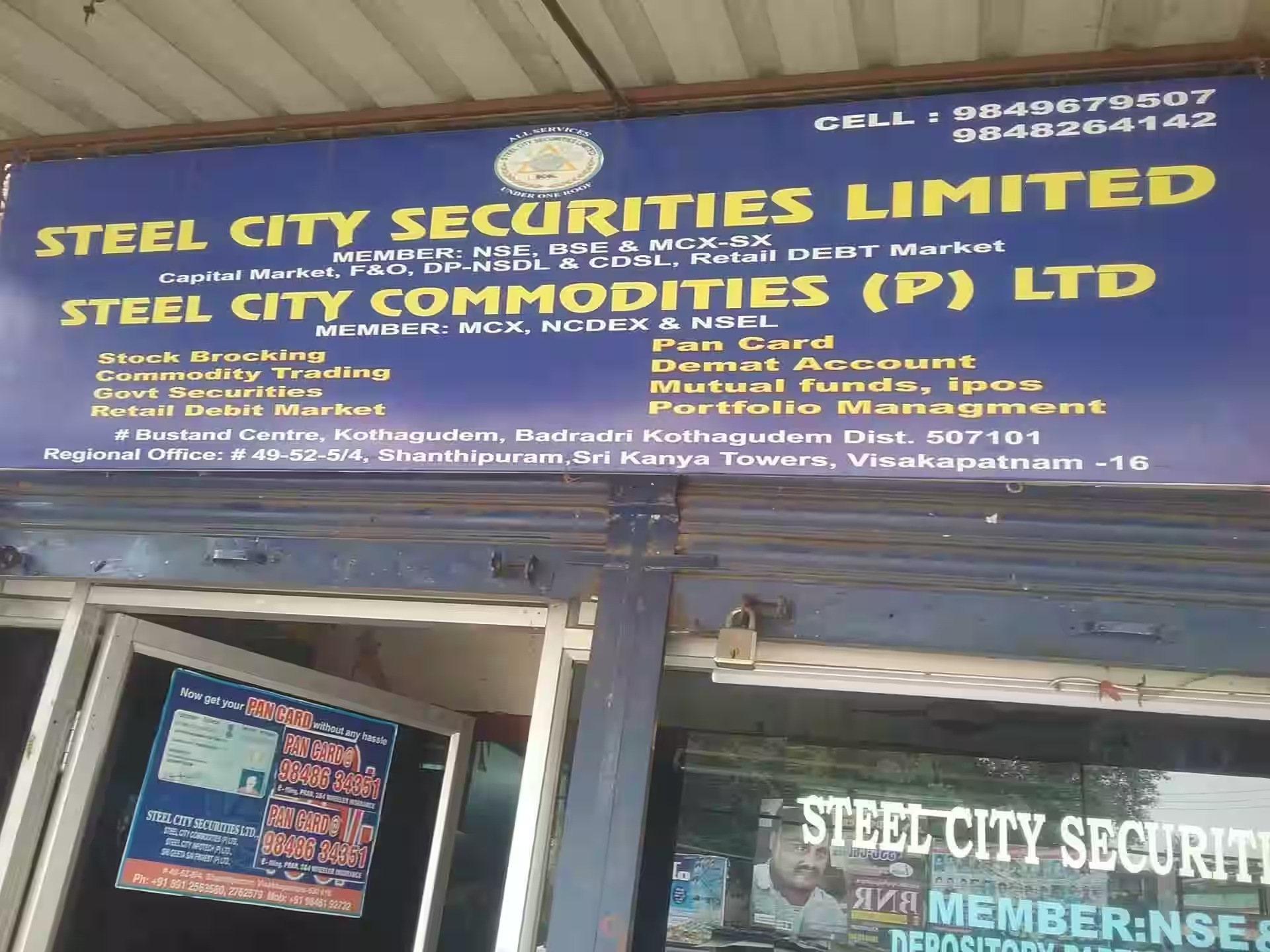
Steel City Securities was born in 1995, a time when “trading” meant shouting in a pit and “e-governance” sounded like a sci-fi concept. Fast forward to 2026, and they have expanded their footprint across Tamil Nadu, Karnataka, Odisha, Chhattisgarh, and Maharashtra. They aren’t just selling stocks; they are selling PAN cards, TAN registrations, and pension schemes.
The business model is cleverly diversified. They’ve got over 70 owned branches and a massive army of 16,000+ franchises. Think of them as the “neighborhood financial guy” who also happens to have a direct line to the NSDL and CDSL. They have managed to cross-sell everything from gold loans to insurance, creating a sticky customer base of over 3 lakh retail clients.
However, the recent financial year has been a rollercoaster. While the topline seems to have hit a plateau—with sales growth looking a bit sluggish at 2.39% over five years—the profitability remains robust. The company just concluded its board meeting on May 2nd, 2026, approving the audited results and appointing a new independent director, Nunna Satya Kumar.
The real question for any investor is: is this a stagnant legacy player or a misunderstood hybrid tech-fin firm? The e-governance segment provides a “moat” that pure-play brokers like Angel One can only dream of. When the market crashes and people stop trading, they still need their PAN cards and tax filings. This diversification is the secret sauce that keeps their OPMs consistently