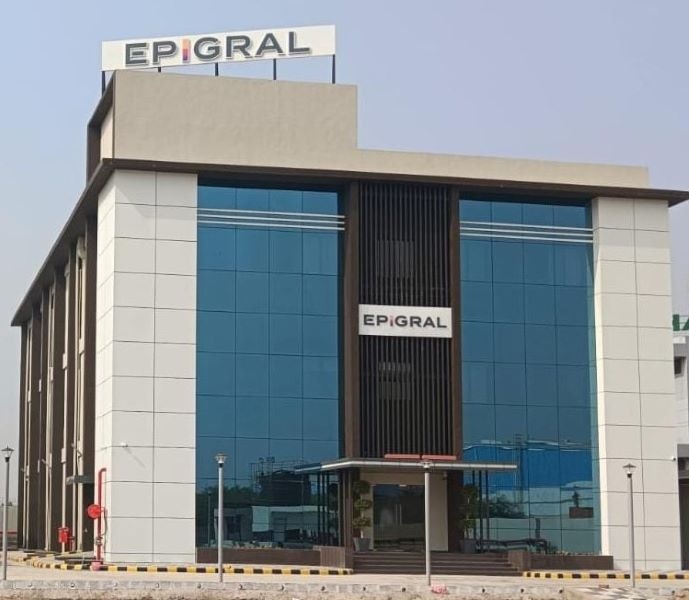
The chemical industry is often a game of survival where the weak get dissolved and the strong crystallize. Epigral Ltd (formerly Meghmani Finechem) just dropped its FY2026 report card, and it is a masterclass in navigating a “poly-crisis” of volatile raw materials and shifting global demand. While the rest of the sector is crying about China dumping and margin contraction, Epigral just printed its highest-ever quarterly revenue of ₹ 736 Crore.
This isn’t just about selling more caustic soda; it’s a fundamental structural shift. The company is aggressively moving away from being a commodity player to a specialty powerhouse. If you want to understand where the “new age” of Indian chemical manufacturing is headed, look no further than the Dahej complex.
1. At a Glance
Epigral is currently playing the role of the Integrated Predator in the Indian chemical landscape. Based out of a massive, automated complex in Dahej, Gujarat, they have evolved from a simple Chlor-alkali player into a specialized derivatives giant.
In FY2026, the company recorded a total revenue of ₹ 2,542 Crore. While the annual top line saw a marginal 1% dip compared to the previous year, the Q4 performance was a massive outlier, with revenue jumping 17% YoY to ₹ 736 Crore. This tells us one thing: the recovery isn’t “coming”—for Epigral, it has already arrived.
The “At a Glance” story for Epigral is defined by three massive moats:
- First Mover Advantage: India’s first manufacturer of Epichlorohydrin (ECH) and the largest capacity plant for CPVC Resin.
- The Specialty Pivot: Management has a “70:30” vision—aiming for 70% of revenue from high-margin Derivatives and Specialty chemicals by FY2027. They hit 54% in Q4 FY26, up from just 25% in FY2022.
- Efficiency Obsession: By utilizing a backward and forward integrated model, they consume their own Chlorine, Hydrogen, and Caustic Soda to create higher-value products. It’s the ultimate “waste-not-want-not” strategy on a multi-billion rupee scale.
With a Market Cap of ₹ 5,244 Cr and a Stock P/E of 15.8, the market is still treating them like a commodity company, while the financials are starting to look suspiciously like a high-growth specialty chemical firm.
2. Introduction
Epigral Limited isn’t your average chemical company that just pumps out stuff and hopes someone buys it. They are a “Value Chain Architect.” Incorporated in 2007, they spent the last decade building a fortress in Dahej.
The story of FY2026 was a tale of two halves. The first half was plagued by an extended monsoon and planned maintenance shutdowns that throttled utilization. However, the management didn’t sit around and watch the rain. They pushed forward with a massive capex plan to double their CPVC and ECH capacities.
The Q4 results show a PAT of ₹ 82 Crore, a staggering 109% growth over the previous quarter (Q3). This “Phoenix-like” recovery was driven by a 15% sequential increase in volumes. When you look at the full-year PAT of ₹ 333 Crore, it includes an ₹ 81 Cr deferred tax benefit. Stripping that away, the core performance remains robust in an industry that has been largely hammered.
They are currently the:
- 4th largest producer of Caustic Soda in India.
- 3rd largest producer of Caustic Potash.
- Largest producer of CPVC Resin in India.
The name change from Meghmani Finechem to Epigral wasn’t just a branding exercise; it was a declaration of independence and a focus on “Epigenetic Growth”—growing from within.
3. Business Model – WTF Do They Even Do?
Imagine you have a giant kitchen. Most people buy flour to bake bread. Epigral makes the flour, the yeast, and the oven, and then sells the most expensive artisanal sourdough you’ve ever seen.
The Chlor-Alkali Base (The Bread and Butter)
They produce Caustic Soda, Caustic Potash, and Chlorine. These are commodities. The problem with commodities is that the market dictates the price. If China decides to dump Caustic Soda, your margins go to the basement.
The Derivatives Pivot (The Secret Sauce)
Instead of just selling Chlorine (which is often hard to transport and sometimes even carries a “negative price”), Epigral uses it internally to make:
- CPVC Resin: Used in heat-resistant pipes. You see these in every modern apartment.
- Epichlorohydrin (ECH): The first of its kind in India. It goes into Epoxy resins used in everything from wind turbines to high-end adhesives.
- Chlorotoluenes: These are high-end intermediates for Pharma and Agrochemicals.
The Integrated “Flywheel”
Epigral’s Dahej plant is a closed loop. They produce their own power (Wind-Solar Hybrid), use their own co-products, and minimize waste. This integration allows them to stay profitable even when “ECU” (Electrochemical Unit) realizations