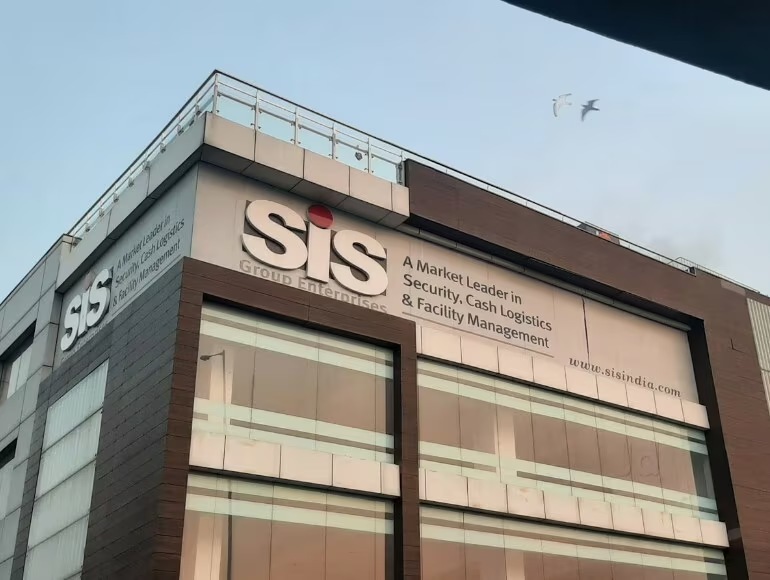
If you thought the private security business was just about guys in uniforms standing outside ATMs, you’ve clearly been living under a rock. SIS Ltd is a behemoth that essentially runs the “eyes and ears” of the Asia-Pacific region. We are talking about a company that manages over 300,000 employees, 3,200+ cash vans, and covers 300+ cities in India alone. They are the #1 security provider in India and Australia.
But the real drama isn’t in the patrol cars; it’s in the spreadsheets. The latest Q4 FY26 results are a masterclass in “The Good, The Bad, and The Accounting.” Revenue grew by a staggering 31% YoY, crossing the ₹4,400 Cr mark for the first time in a single quarter. It’s a massive milestone that smells like success, yet the market is squinting at the fine print.
Why the suspicion? Because the company just took a massive ₹290 Cr one-time exceptional charge related to the new Labour Codes. They’ve basically decided to take the hit for prior-period gratuity and leave liabilities all at once. Management calls it “conservative accounting”; an auditor might call it “cleaning the closet.”
The stock is currently trading at a P/E of 14.2, which looks like a bargain compared to its historical highs, but the “Labour Code” ghost is haunting the valuation. Is SIS a undervalued powerhouse or a margin-pressured giant struggling with the weight of its own workforce? Let’s dive into the guts of this beast.
2. Introduction
SIS Ltd is the undisputed heavyweight champion of “Manned Guarding” and “Facility Management.” Founded in 1974 by Ravindra Kishore Sinha (who recently stepped down as Chairman), the company has evolved from a local Bihar-based operation into a multi-national service provider.
They operate through three core pillars:
Security Solutions (India): The bread and butter.
International Security: The high-standard operations in Australia, Singapore, and New Zealand.
Facility Management: Housekeeping, pest control (Terminix), and HVAC maintenance.
The company is currently in a state of leadership transition. Rita Kishore Sinha has been appointed as the Executive Chairperson as of May 1, 2026. Transitioning from a legendary founder to the next generation is always a “hold-your-breath” moment for investors.
Financially, the company has been a growth machine, but the bottom line has been as volatile as a crypto chart. While revenue has grown at a 15% CAGR over 10 years, the PAT has been suppressed by high interest costs and recent one-time provisions. The question for the general public is simple: Do you buy the business or the balance sheet?
3. Business Model – WTF Do They Even Do?
Imagine you own a massive tech park. You need someone to guard the gates, someone to clean the toilets, someone to fix the AC, and someone to move the cash from the food court to the bank. Instead of hiring four different vendors, you call SIS.
The Manned Guarding (83% of Revenue): This is their core. They provide trained security personnel. In India, they have 29 training centers to churn out guards faster than a fast-food chain flips burgers. In Australia, they hold a 20% market share. It’s a volume game—more buildings equals more guards.
Facility Management (17% of Revenue): Under brands like ServiceMaster Clean and Dusters, they handle everything from janitorial services to specialized hospital cleaning. This segment actually has better margins than security but requires more specialized management.
Cash Logistics (Joint Venture): They don’t own 100% of this, but through a JV with Prosegur, they are the #2 player in India. Every time you see a van replenishing an ATM, there’s a high chance SIS is behind it.
The Roast: They are essentially a “human resources” company disguised as a security firm. Their biggest asset is people; their biggest nightmare is also people (minimum wage hikes, labor laws, and unions).
Question for the comments: If AI starts guarding buildings with drones and robots, does SIS become a tech company or a museum?
4. Financials Overview
Management promised a “year of rebound” in their Feb 2026 ConCall, and they delivered on the top line. However, the PAT took a wild ride due to the ₹290 Cr labor charge.
Note on Result Type: The latest announcement refers to “Audited Financial Results for the Quarter and Year ended March 31, 2026.” Therefore, this is QUARTERLY RESULTS for our calculation purposes.
Latest Quarter vs Peer Averages (₹ in Crores)
Metric
Q4 FY26 (Current)
Q4 FY25 (YoY)
Q3 FY26 (QoQ)
Revenue
₹4,489.3
₹3,428.0
₹4,185.0
EBITDA
₹207.0
₹165.0
₹189.0
PAT
₹102.0
₹93.0
(₹138.0)*
EPS (Quarterly)
₹7.26
₹6.60
(₹9.81)
Annualized EPS
₹29.04
₹26.40
N/A
*Q3 PAT was negative due to the exceptional one-time labor provision.
Witty Commentary:
Management “walked the talk” on revenue growth, but the margin walk felt more like a limp. They hit their ₹4,000 Cr+ quarterly revenue target, but the EBITDA margin is hovering at a thin 4-5%. In the ConCall, management tried to frame the ₹290 Cr charge as a “conservative choice.” They basically paid the bill now so they don’t have to worry about it later. Bold move, or just hiding the pain?
5. Valuation Discussion – Fair Value Range
We need to see if the stock is a “steal” at ₹355 or if it’s priced for a crash.