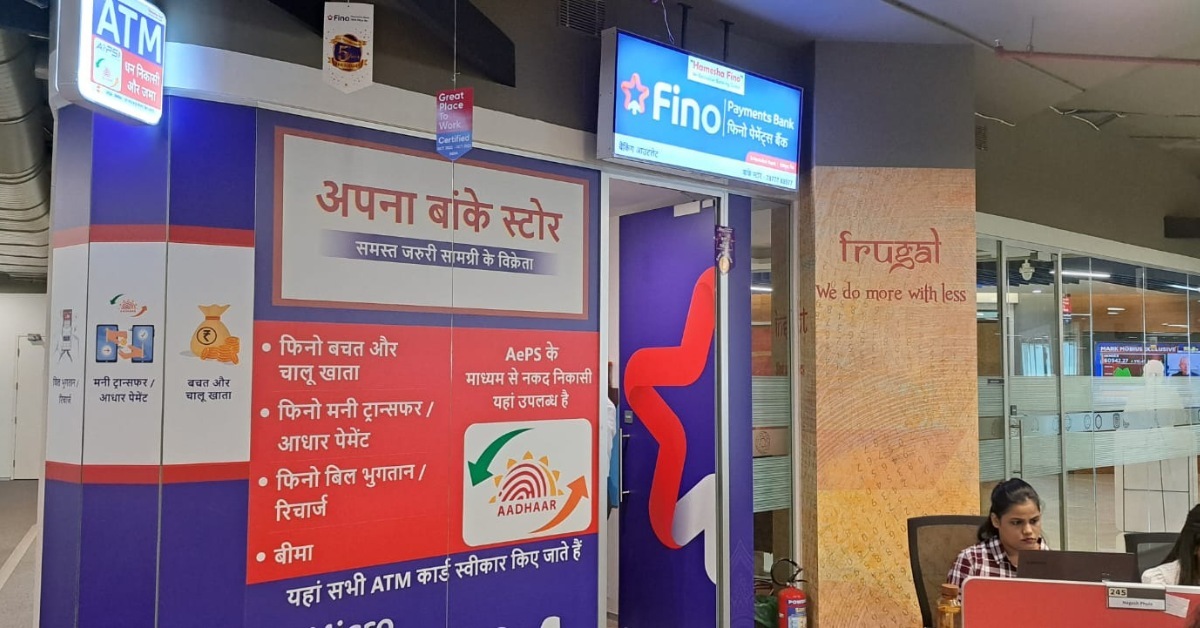
Fino Payments Bank Q4 FY26: PAT Falls 70%, Revenue Drops 31%, Deposits Hit ₹2,957 Crore — The Small Finance Bank Plot Thickens
Date of Publishing -
Spotted a factual error — a wrong number, date, or fact? Tell us and we will check the source.
1. At a Glance
Fino Payments Bank has delivered the kind of Q4 FY26 result that does not politely knock on the investor’s door. It barges in, drops a ₹340 crore quarterly revenue number, shows a 31% year-on-year revenue decline, then calmly points to deposits touching a peak end-of-day level of ₹2,957 crore in March 2026.
That is the Fino puzzle.
On one side, the bank is celebrating its transition story: in-principle approval from the RBI to become a Small Finance Bank, successful migration to Finacle Core Banking Platform, growing deposits, rising digital usage, and referral loan disbursals exploding to ₹592 crore in Q4 FY26.
On the other side, profit after tax for Q4 FY26 fell sharply to ₹7.1 crore from ₹24.0 crore in Q4 FY25, a decline of 70% year-on-year. PBT after exceptional item collapsed from ₹29.7 crore to ₹4.1 crore. Revenue declined from ₹493.5 crore to ₹340.0 crore. Cost-to-income moved from 25.5% in Q4 FY25 to 38.8% in Q4 FY26.
This is not a boring banking result. This is a detective file.
The headline says weakness. The strategic presentation says transition. The governance updates say caution. The balance sheet says deposits are rising. The P&L says profitability took a punch. The market price says investors are not exactly throwing rose petals.
As on 30 April 2026, the stock closed around ₹126, with a market capitalisation of about ₹1,050 crore. Book value is ₹92.6 per share, price-to-book is 1.36, ROE is 7.37%, and debt-to-equity is 5.08. For a company preparing to become a Small Finance Bank, this is not a clean victory lap. It is more like a marathon runner announcing a new training plan while limping slightly.
The bank’s operating story is actually not dead. Far from it. Average deposits for FY26 increased 30% year-on-year to ₹2,403 crore. CASA accounts reached 1.75 crore. Digitally active customers reached 63 lakh in March 2026. Digital throughput for FY26 stood at ₹262.0k crore. Total throughput reached ₹464.0k crore. Merchant count stood at 20.8 lakh. That is scale.
But scale without profitability discipline is like having a massive highway system where every toll booth is under repair.
The management’s SFB roadmap is ambitious. It wants to build ₹8,000–10,000 crore AUM by FY30, maintain credit cost below 1%, achieve more than 20% ROE, and keep cost of funds below 4%. The bank says its current net worth is 2x of regulatory requirement and no incremental capital is required for business growth until FY30. These are important claims.
But investors must ask a simple question: can Fino convert its distribution muscle into banking profitability without letting governance, execution cost, or regulatory drama eat the upside?
Because Q4 FY26 is not just a result. It is a stress test of the Fino story.
2. Introduction
Fino Payments Bank is a financial inclusion and payments-focused fintech bank with a wide merchant-led distribution network across India. The business is built around serving lower-income, semi-urban, and rural customers through a network that reaches deep into the physical economy.
The bank acts as a Business Correspondent for several banks and offers services such as CASA account opening, domestic remittances, Aadhaar-enabled payments, bill payments, mobile recharges, cash management services, digital payments, and other partner-led financial services.
As of FY25, the company operated approximately 19 lakh banking outlets, including own and open banking merchants, covering 97% of India’s pin codes. In the latest FY26 investor presentation, the merchant count is shown at 20.8 lakh and presence is shown across 98% of India’s pin codes.
This is the company’s greatest strength: reach.
Fino does not look like a traditional bank with heavy branch infrastructure. It looks more like a financial distribution engine with a banking licence attached. It uses merchants as last-mile service points. This keeps the model asset-light and gives it access to customers who may not walk into a formal bank branch but will happily transact through a neighbourhood merchant.
In theory, this is powerful.
In practice, the result depends on three things: transaction economics, regulatory comfort, and execution quality.
Payments banks in India are restricted from lending from their own balance sheet. They can accept deposits and offer payments-related services, but they cannot take credit risk like a normal bank. That is why Fino’s transition to a Small Finance Bank is central to the investment story. A payments bank can distribute. A small finance bank can lend. The moment lending enters the story, the economics can change meaningfully — provided underwriting does not turn into a circus with Excel sheets.
Fino has received in-principle approval from RBI for the Small Finance Bank transition. It is the first payments bank to achieve this distinction according to the investor presentation. The bank has also completed its Finacle CBS migration, with the new core banking system live from January 2026.
So the strategic direction is clear.
But the latest financials bring tension. Q4 FY26 revenue declined 31% year-on-year. PAT declined 70%. FY26 revenue declined 14% year-on-year, while FY26 PAT declined 43%. PBT softened. Cost-to-income increased. Other financial cost and depreciation rose sharply.
The bank is moving from payments-bank mode to SFB-preparation mode. That shift is not free. Technology, people, systems, compliance, product rollout, and leadership depth all cost money. The question is whether the future lending engine can justify the current earnings pain.
And then comes the governance file.
There are multiple regulatory announcements around the MD & CEO’s arrest, bail, interim CEO appointment, RBI fit-and-proper reassessment, a CID lien of ₹11.92 crore, and ICRA placing the bank’s overdraft rating on watch with developing implications after the MD/CEO arrest.
Management has repeatedly clarified that bank operations are stable and that the bank does not expect financial liability from the DGGI matter. Still, markets dislike uncertainty. They dislike governance uncertainty even more. Markets can forgive a weak quarter. They usually do not enjoy courtroom footnotes.
So Fino today is a transition story with numbers, opportunity, and smoke in the corridor.
The question is whether that smoke is temporary dust from renovation — or a sign that someone should check the wiring.
3. Business Model – WTF Do They Even Do?
Fino Payments Bank is not a normal bank that opens branches everywhere, hires armies of relationship managers, and then slowly discovers that rent is a silent predator.
Fino runs a merchant-led, asset-light financial inclusion model.
Its business is built around enabling payments, deposits, remittances, cash management, assisted banking, and digital transactions through a large distribution network. The company’s merchants act as neighbourhood financial touchpoints. These merchants help customers open accounts, deposit or withdraw cash, perform Aadhaar-enabled transactions, make payments, recharge phones, pay bills, and access financial products.
The main product buckets include:
Product Area
What It Means
CASA
Savings and current account-related income, including float income
Digital Payment Services
UPI and digital payments ecosystem services
Transaction Business
DMT, Micro ATM, AEPS and related services
CMS
Cash management services
BC Banking
Business Correspondent banking services
Treasury & Others
Income from treasury and miscellaneous activities
Referral Business
Partner-led loan referrals, important for SFB readiness
In FY26, product revenue mix showed CASA as the largest contributor at ₹629.7 crore, or 40% of revenue. Digital Payment Services contributed ₹272.9 crore, or 17%. Transaction business contributed ₹290.0 crore, or 18%. CMS contributed ₹115.5 crore, BC Banking ₹142.2 crore, and Treasury & Others ₹137.6 crore.
The business model is simple at the surface:
Acquire customers cheaply through merchants. Keep deposits. Earn float and fees. Process transactions. Cross-sell services. Eventually become a Small Finance Bank and lend to existing customers and merchants.
The real magic, if it works, is in data.
Fino has 1.75 crore customers and 20.8 lakh merchants. The bank says roughly 70% of customers are active. It also says around 22 lakh customers and merchants are already availing credit facilities through referral arrangements. This matters because lending to unknown borrowers is dangerous, but lending to existing transacting customers with behavioural data can be more intelligent.
That is the sales pitch.
The roast is this: payments businesses often generate enormous transaction volume and then spend years explaining why margins are still “evolving”. Fino has the reach. It has the transaction data. It has the SFB runway. But until it converts that into sustainable earnings, investors are still watching a promising engine idle in the garage.
One question for readers: is Fino’s 20.8 lakh merchant network a true banking moat, or just a very large distribution machine waiting for better monetisation?
4. Financials Overview
For Q4 FY26, the quarterly EPS is ₹0.85. Since this is Q4, the annual EPS used for valuation should be the full-year EPS, not Q4 EPS multiplied by four. The full-year EPS for FY26 is ₹6.30.
At a current price of ₹126, recalculated P/E is:
₹126 / ₹6.30 = 20.0x approximately.
Quarterly Comparison
Particulars
Latest Quarter Q4 FY26
Same Quarter Last Year Q4 FY25
Previous Quarter Q3 FY26
Revenue
₹340.0 crore
₹493.5 crore
₹394.4 crore
EBITDA
₹56.0 crore
₹63.9 crore
₹63.9 crore
PAT
₹7.1 crore
₹24.0 crore
₹12.2 crore
EPS
₹0.85
₹2.88
₹1.47
This table is where the detective story begins.
Revenue fell 31% year-on-year and 14% quarter-on-quarter. EBITDA fell 12% year-on-year and 12% quarter-on-quarter. PAT fell 70% year-on-year and 42% quarter-on-quarter. EPS fell from ₹2.88 in Q4 FY25 to ₹0.85 in Q4 FY26.
That is not a soft landing. That is a controlled descent with investors checking whether the landing gear is out.
The bank’s own P&L explains part of the pressure. Product cost declined sharply, which helped net revenue margin improve from 31.5% in Q4 FY25 to 40.0% in Q4 FY26. But operating cost remained heavy, other financial cost and depreciation increased, and PBT after exceptional item fell to ₹4.1 crore.
The exceptional item was ₹1.3 crore in Q4 FY26 and ₹4.4 crore for FY26, described as impact of New Labour Code. That is not the main problem. The main problem is that operating leverage has not yet delivered enough profit protection.
FY26 Comparison
Particulars
FY26
FY25
YoY Change
Revenue
₹1,587.9 crore
₹1,847.1 crore
-14%
EBITDA
₹243.2 crore
₹234.4 crore
+4%
PAT
₹52.5 crore
₹92.5 crore
-43%
PBT After Exceptional Item
₹67.4 crore
₹108.3 crore
-38%
Net Revenue Margin
36.8%
31.5%
+530 bps
Here the picture becomes more nuanced. FY26 revenue fell, but EBITDA improved 4%. That means the revenue mix and product cost discipline improved. But PAT still declined 43%, dragged by higher other financial cost and depreciation.
Management’s older concall comments after the March 2026 incident stressed business continuity,