1. At a Glance
There are companies that grow quietly. There are companies that overpromise loudly. And then there is Vakrangee — a company that has spent years walking the tightrope between turnaround story and market skepticism.
Now suddenly, FY26 numbers have arrived and the tape is harder to ignore.
Profit after tax rose 79.3% YoY to ₹11.1 crore. EBITDA grew 22.7%. EBITDA margin expanded from 11.0% to 13.4%. Cash flow from operations (pre-tax) swung positive to ₹63.7 crore against a deficit last year. Debt? Nil.
For a company trading near ₹761 crore market cap with annual revenue of ₹261.4 crore and PAT of ₹11.1 crore, these numbers have started forcing a question:
Is this finally a business compounding from a cleaned-up base?
Or is this another quarter of cosmetic improvement dressed in turnaround clothing?
That is where it gets interesting.
Because behind the small headline PAT, there sits a bizarre machine:
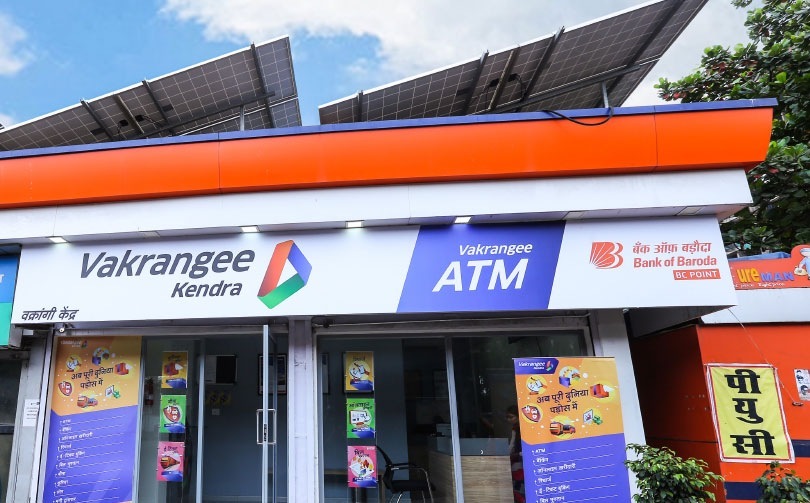
- 23,087 physical outlets
- 535 district master franchisees
- 6,073 ATMs
- ₹53,712 crore annual GTV
- 10.7 crore annual transactions
- 84% rural-heavy presence
Pause.
A company doing ₹261 crore revenue facilitating over ₹53,000 crore transaction value.
That operating leverage either hides enormous optionality…
Or very thin economics.
Which one is it?
Even stranger:
The stock trades at 62.3 times earnings.
Industry median sits around 26.
Book value is ₹1.63 while market pays 4.3x book.
ROE only 7.17%.
So investors are already paying premium multiples for a business still trying to prove durable economics.
That usually ends one of two ways:
Very well.
Or very badly.
And Vakrangee has enough history to make people suspicious.
Remember:
10-year sales CAGR: -25%
5-year stock CAGR: -31%
5-year profit CAGR: -25%
This is not a clean growth compounder suddenly misunderstood by markets.
This is a wounded franchise trying to reintroduce itself.
Which makes the FY26 improvement more important.
Because turnarounds are not about one good quarter.
They are about whether management finally walked the talk.
And interestingly, older management commentary around:
- margin expansion
- higher-value BFSI products
- non-cash financial services
- Vortex ATM monetization
- asset-light scaling
…is starting to show up in numbers.
That is new.
Question for readers:
Are we looking at India’s rural fintech distribution sleeper…
Or a business market keeps giving second chances to?
That is the puzzle.
And puzzles are where detective work begins.
2. Introduction
Vakrangee may be among Indian market’s strangest listed entities.
It gets classified as technology.
Operates like assisted commerce.
Earns like a financial distribution franchise.
Owns ATM hardware through Vortex.
And increasingly wants to become a rural super-app plus physical network hybrid.
That is either visionary.
Or too many stories in one stock.
Historically the market has leaned toward suspicion.
Not without reason.
Growth collapsed after earlier aggressive phases.
Return ratios disappointed.
Governance questions emerged over years.
Stock derated brutally.
Then management changed the script.
Less volume obsession.
More margin focus.
Exit low-margin business.
Push insurance, loans, assisted commerce.
Acquire Vortex.
Build annuity-like streams.
This year, pieces moved.
Revenue hardly grew.
PAT exploded.
Normally when profits grow much faster than revenue, an investor should immediately ask:
Real operating leverage?
Or accounting theatre?
Here EBITDA also rose 22.7%.
Margins expanded 249 basis points.
Cash generation improved.
Debt remains zero.
That strengthens credibility.
Still, another oddity:
Q4 revenue fell 9.1% YoY.
Q4 PAT fell 35.7%.
Yet full-year PAT surged 79%.
Why?
Management says deliberate reduction in low-margin business.
If true, lower revenue with better economics can be healthy.
But if revenue stagnates too long, multiple compression comes knocking.