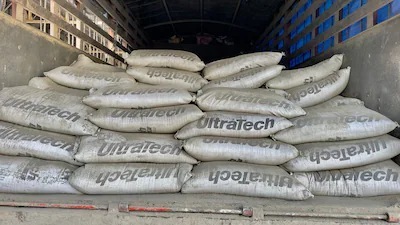
1. At a Glance — Something Big Is Happening in Cement
UltraTech is no longer behaving like a normal cement company.
Normal cement companies talk about utilization, fuel costs, freight and regional pricing.
UltraTech is talking about 240 MTPA capacity by FY28, entering cables and wires, crossing 200 MTPA domestic cement capacity, generating record operating cash flow of ₹14,398 crore, paying a ₹240 special dividend, and quietly integrating acquisitions while most peers are still discussing volume growth.
That does not look like ordinary cyclical business behavior.
That looks like scale compounding.
And perhaps something more interesting — industry power concentration.
FY26 numbers were extraordinary:
- Revenue up 17% to ₹87,384 crore
- PBIDT up 32% to ₹17,598 crore
- PAT (before exceptional items) above ₹8,300 crore
- EBITDA per tonne ₹1,253 in Q4
- Domestic capacity now 200.1 MTPA
- Net Debt/EBITDA improved to 0.94x
- Green power share rose to 43%
Read that again.
A company is simultaneously:
- expanding aggressively,
- reducing leverage,
- improving margins,
- increasing dividends,
- and entering adjacent businesses.
That combination rarely comes cheap.
And indeed it does not.
At 42x earnings and EV/EBITDA above 21x, UltraTech is priced like a premium compounder, not a commodity producer.
Question for readers:
When a “commodity company” starts trading like a consumer monopoly, is it still a commodity company?
That may be the central puzzle here.
There are red flags too.
Capacity additions across the sector are huge.
Competition risk remains.
Fuel costs can turn nasty.
South India pricing has historically behaved like a soap opera.
And there is always the classic cement problem:
Volumes look heroic until everyone adds capacity at once.
But management’s Jan 2026 concall had a very unusual tone.
Not defensive.
Almost imperial.
“South will be new North.”
“We are sold out.”
“Demand is the most important aspect.”
That is not recession talk.
This article may really be about one question:
Is UltraTech becoming India’s infrastructure toll booth?
Because if yes, this deserves a different lens entirely.
2. Introduction — The Cement Company That Refuses To Behave Like One
Most cement businesses are usually prisoners of:
- coal prices
- freight costs
- regional pricing wars
- election-linked construction demand
UltraTech has been trying to escape all four.
And FY26 looks like evidence it may be succeeding.
The trick seems simple.
Scale so large competitors bleed first.
Then lower costs faster than industry.
Then use balance sheet strength to buy assets during weak cycles.
Repeat.
It sounds simple.
It is not.
India Cements acquisition.
Kesoram integration.
New grinding units.
Renewable capacity.
Cable and wire foray.
This is not maintenance capex.
This is empire-building.
And yet management keeps leverage disciplined.
That is the part markets