1. At a Glance
Navkar Corporation has spent the last few years looking like a logistics company stuck in a traffic jam. Volumes were patchy, profits disappeared, Morbi ICD was eating cash, and the stock market treated it like that one cousin who keeps announcing new business ideas but never makes money.
Then came FY26.
Suddenly, quarterly revenue jumped to ₹201 crore in Q4 FY26 versus ₹104 crore in Q4 FY25. PAT rose to ₹14 crore from a loss of ₹19 crore. EBITDA margin climbed to 20% from negative territory a year ago. For a company that looked half asleep for years, this is not just improvement. This is the financial equivalent of showing up to school reunion after getting a gym membership, new haircut and a better salary.
But before investors start treating Navkar like the next great logistics superstar, there are still many questions.
Return on equity is still only 1.55%. ROCE is just 3.05%. Debt has increased to ₹174 crore. Working capital days have improved, but debtor days have shot up to 95 days. Morbi ICD is still not fully sweating its assets. And even after a strong turnaround, the stock trades at a P/E of 56 times.
That means the market is already pricing in a happy future where JSW Infrastructure fixes everything, logistics volumes explode, rail operations scale up, and Navkar becomes a mini-logistics empire.
That is possible.
But it is also possible that investors are getting excited a little too early.
The biggest plot twist is the arrival of the new मालिक. The old Mehta promoter family is effectively gone, and JSW Port Logistics, a subsidiary of JSW Infrastructure, now owns over 70% of the company. That changes the story completely.
Navkar is no longer a standalone small-cap logistics player fighting for cargo volumes near JNPT. It is now part of a much larger logistics and ports ecosystem. Suddenly, the company has access to group cargo, railway networks, new customers, more capital, and a parent that wants to build an ₹8,000 crore logistics business by FY30.
So the big question is simple.
Is Navkar just an old logistics business getting recycled into the JSW machine, or is this the beginning of a serious rerating story?
2. Introduction
Navkar Corporation is in the cargo transit business. It operates container freight stations near Nhava Sheva port, inland container depots, private freight terminals and rail-linked logistics assets.
In plain English, Navkar helps move containers, cargo and freight from ports to factories and vice versa.
It is not glamorous.
Nobody writes Bollywood songs about container freight stations.
But if India wants to become a manufacturing and export powerhouse, companies like Navkar become very important because they are the people moving the cargo after the ships arrive.
The company has three major pillars.
First, there is the traditional CFS business near JNPT. Second, there is the ICD and logistics park business in Morbi. Third, there is the rail-linked freight business.
The problem for Navkar over the last few years was that growth was not translating into profits. Volumes were weak, exports slowed, Morbi remained underutilised, and the company had too much capital tied up in assets that were not generating enough return.
Then JSW Infrastructure entered the scene.
JSW Port Logistics acquired the promoter stake in 2024, and suddenly Navkar became part of a much bigger logistics strategy. JSW wants to build rail, ICD, CFS and Gati Shakti terminals across India. Navkar is the ready-made platform sitting right in the middle of that plan.
JSW is not buying Navkar for nostalgia.
It is buying it because logistics is becoming the next big battleground. Ports alone are not enough anymore. Whoever controls the cargo journey from port to warehouse to factory will capture the bigger wallet share.
That is where Navkar becomes valuable.
The latest quarterly numbers suggest that the business is finally seeing some traction. Revenue growth is back. Margins are improving. Domestic cargo and EXIM volumes are growing. Morbi ICD is stabilising. Rail-linked opportunities are increasing.
But investors should not forget that this is still a low-return business with high fixed costs. One bad cargo cycle, one slowdown in exports, or one policy shift can hit profitability quickly.
This is not a clean, easy, beautiful compounder story.
This is a turnaround story with a new owner, fresh ambition and a lot of moving parts.
3. Business Model – WTF Do They Even Do?
Navkar essentially runs a logistics ecosystem.
Its container freight stations near JNPT help importers and exporters store, clear and move cargo. Think of these as giant parking lots for containers with customs, warehousing and handling services built in.
The company has three CFS facilities around Panvel and Nhava Sheva. These locations matter because they are close to the busiest container gateway in India.
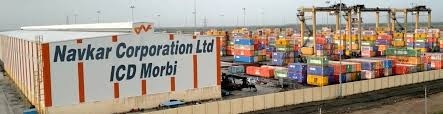
Then there is Morbi ICD.
Morbi is one of India’s biggest ceramic and manufacturing clusters. Instead of forcing every exporter to go all the way to the port, Navkar offers an inland depot where containers can be processed, stored and sent onward through rail.
Morbi is strategically located because it connects Gujarat manufacturing clusters to Mundra port and other parts of India.
Then comes the rail business.
Navkar has a Category 1 container train operator license and owns 8 heavy-duty container rakes. It also has private freight terminals and railway sidings.
That means it is not just a warehouse business.
It can actually move cargo across India.
This is important because rail is cheaper than road for bulk cargo. India wants rail freight share to rise from around 27% today to 45% by 2030. If that