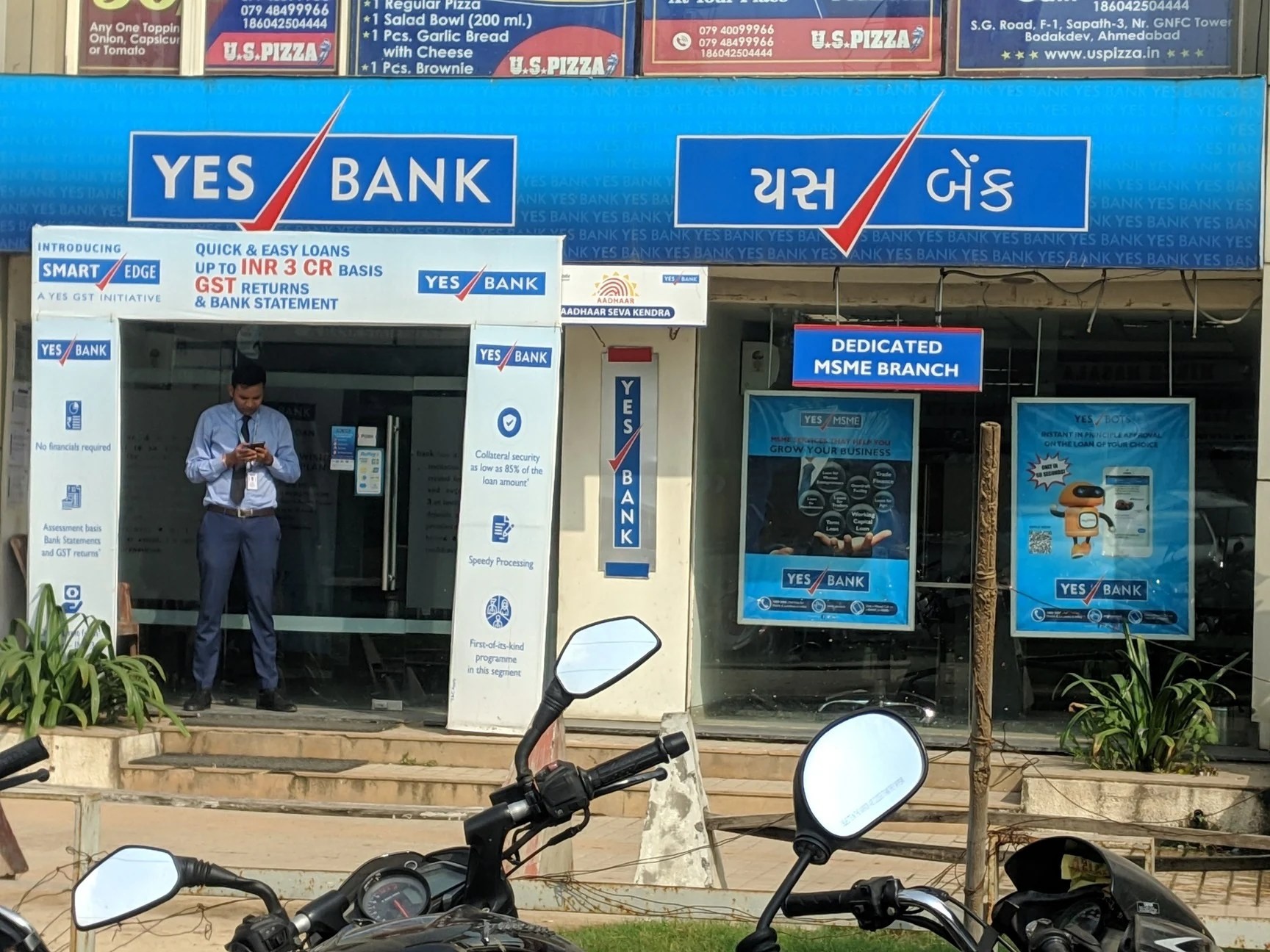
Yes Bank Q4 FY26 FY26: Profit Up 44.5%, GNPA At 1.3%, Deposits Cross ₹3 Lakh Crore, But Is This Finally A Bank And Not A Rehabilitation Project?
Date of Publishing -
Spotted a factual error — a wrong number, date, or fact? Tell us and we will check the source.
1. At a Glance
For years, Yes Bank was the financial equivalent of a guy showing up at a wedding after setting his own house on fire and asking for a second plate of gulab jamun. The bank had already lived through the full cycle: hyper-growth, governance disaster, RBI intervention, emergency recapitalisation, corporate clean-up, ARC transfer, reputation collapse, and then the long, boring, painful march back toward respectability.
Now look at Q4 FY26.
Net profit for the quarter came in at ₹1,068 crore, up 44.7% YoY. Full-year FY26 net profit stood at ₹3,476 crore, up 44.5% YoY. Return on assets reached 1.0% in Q4 and 0.8% for the full year. NIM improved to 2.7% in Q4 and 2.6% for FY26. Deposits crossed the psychological and strategic milestone of ₹3 lakh crore. CASA deposits crossed ₹1 lakh crore. GNPA fell to 1.3%. NNPA fell to 0.2%. Cost-to-income ratio improved sharply to 63.0% in Q4 and 66.7% for FY26.
That is not turnaround theatre. That is actual operating progress.
And the timing is delicious. Just when the market was still debating whether Yes Bank is merely a repaired machine or a genuinely investable franchise, the bank delivered its strongest annual profitability since reconstruction. Then came the governance cherry on top: SMBC emerged as the largest shareholder, Vinay Tonse took over as CEO, and management started speaking less like a crisis helpline and more like a bank that finally wants to compete.
But before anyone starts calling this the next ICICI Bank-style redemption arc, let us calm down and keep both slippers on the ground.
Yes Bank is better. Much better.
But it is not yet premium.
Its ROE is still just 7.0% for FY26. Its P/E is 18x, already above the industry median of 15.3x. Its ROE is well below the peer median of 13.2% and miles behind ICICI, Axis, Kotak or HDFC Bank. A chunk of FY26 profitability still got support from security receipt recoveries. The old ghost of bad lending is not fully dead; it is just quieter and currently under better supervision.
So what exactly is this bank today?
Not the corpse of 2020.
Not yet the prince of private banking either.
It is a half-repaired fighter with better scars, cleaner numbers, stronger parents, and enough momentum to make investors ask a dangerous question: what if this comeback is real?
That is where things get interesting.
2. Introduction
Yes Bank’s story is now split into two eras.
The old era was built on aggression. Growth was king. Corporate lending was the party trick. Risk discipline was treated like a boring relative nobody wanted to sit with. That strategy worked until it spectacularly did not. By 2020, the bank’s balance sheet had become a museum of poor underwriting decisions. Depositors ran, the RBI stepped in, and the bank entered reconstruction mode.
The post-2020 era has been about survival first, clean-up second, and rebuilding third. That process has involved capital infusion from the rescue consortium led by SBI, the FPO, preferential allotment, the transfer of stressed assets to JC Flowers ARC, a deliberate shift toward granular assets and liabilities, and a lot of public humility from a bank that previously had too much swagger and too little caution.
Q4 FY26 is important because it is the first time the bank’s quarterly and annual numbers look less like a patient recovering in ICU and more like a bank entering physiotherapy with hopes of jogging again.
The quarter was strong across almost every line that matters. Net interest income rose 15.9% YoY to ₹2,638 crore. Operating profit rose 23.1% YoY to ₹1,618 crore. Net profit rose 44.7% YoY to ₹1,068 crore. Advances grew 11.1% YoY to ₹2,73,445 crore. Deposits grew 12.1% YoY to ₹3,18,969 crore. CASA ratio improved to 35.1%. GNPA declined from 1.6% to 1.3% year-on-year. NNPA declined from 0.3% to 0.2%.
The FY26 full-year picture is equally important. NII grew 9.3% to ₹9,776 crore. Non-interest income grew 15.4% to ₹6,759 crore. Operating profit rose 29.4% to ₹5,506 crore. Net profit rose 44.5% to ₹3,476 crore. RoA improved from 0.6% to 0.8%. Cost-to-income ratio improved from 71.3% to 66.7%.
This is not just bad-loan recovery dressing up the P&L. This is a bank showing better operating jaws, lower funding costs, improving asset quality, and better deposit granularity.
Now add the management context from the Q3 FY26 concall. Back in January 2026, management had called Q3 a “breakout quarter” and outlined four profitability levers: reduction in legacy RIDF drag, granular deposits and assets, productivity-led cost control, and better asset quality. Q4 numbers suggest that management largely walked the talk. NIM improved further, cost-to-income improved further, slippages stayed low, deposits crossed ₹3 lakh crore, and RoA touched the 1% exit-quarter mark that management had talked about.
That does not make management saints. It simply means this time, the presentation did not completely outrun the numbers.
Question for the comments section: after everything that happened in 2020, how many clean quarters would you need before calling Yes Bank a normal bank again?
3. Business Model – WTF Do They Even Do?
At its core, Yes Bank is a universal private sector bank. That means it does not rely on one trick. It takes deposits, lends across customer segments, earns fee income from multiple products, runs treasury operations, and increasingly sells itself as a digitally capable, transaction-heavy franchise.
The current lending mix in Q4 FY26 tells you how management wants this bank to look. Retail Banking contributes 46% of advances, Commercial Banking 26%, and Corporate & Institutional Banking 28%. Compare that with Q4 FY25, when the mix was 49:25:26. In plain English: retail is still the largest bucket, but management is not trying to grow blindly in every retail pocket; it is reallocating toward segments where returns are sensible.
That caution was made very clear in the Q3 concall. Management openly said it is not aggressively chasing prime home loans, new car loans, and gold loans because the risk-adjusted returns do not justify the capital and funding costs. That is almost suspiciously mature language for a bank whose older version once behaved like every corporate borrower was a future Nobel laureate.
The commercial and corporate books are doing much of the heavy lifting now. In Q4 FY26, Commercial Banking advances grew 14.5% YoY while Corporate & Institutional Banking advances grew 19.7% YoY. Retail grew a more modest 4.7% YoY, but retail disbursement momentum accelerated, especially in secured and unsecured business loans and cards.
On the liability side, the model is becoming visibly more granular. Total deposits stood at ₹3,18,969 crore. CASA deposits reached ₹1,11,959 crore, crossing the ₹1 lakh crore milestone. Retail & branch-led deposits stood at ₹1,86,186 crore and formed 58.4% of total deposits. Retail and branch-led CASA ratio was 40.7%, which is healthier than the overall bank CASA ratio of 35.1%.
Then comes the digital piece. Yes Bank processes roughly one in three digital payment transactions in India according to its own presentation. It remains a major UPI player, runs IRIS for retail and IRIS Biz for businesses, has 1,500+ APIs, and is trying to sell itself as a banking utility for fintechs, corporates, merchants and retail customers alike.
This matters because fee income and customer stickiness improve when a bank becomes part of transaction plumbing instead of being just a lender.
So what does Yes Bank do?
It is trying to become a safer, more granular, more fee-rich, more digital private bank.
In other words, it is trying to become the exact opposite of what broke it the first time.
4. Financials Overview
The latest official result heading is Quarterly Results, so the EPS treatment is locked as quarterly-results logic. Since this is Q4 (March 2026), the correct rule is to use the full-year EPS only and not annualise.
Key comparison table
Metric
Latest Quarter Q4 FY26
Same Quarter Last Year Q4 FY25
Previous Quarter Q3 FY26
Revenue
₹7,662 Cr
₹7,623 Cr
₹7,553 Cr
EBITDA / Operating Profit proxy
₹1,618 Cr
₹1,314 Cr
₹1,234 Cr
PAT
₹1,068 Cr
₹738 Cr
₹952 Cr
EPS
₹0.34
₹0.24
₹0.30
Witty translation: revenue moved like a government office file, but profits moved like they finally found the correct stamp.