1. At a Glance
Donear Industries is one of those old-school Indian textile names that still believes fabric can win in a country increasingly addicted to ready-made fashion. On paper, the latest quarter looks spicy: Q3 FY26 sales came in at ₹240 crore, operating profit at ₹28 crore, and PAT at ₹17 crore, with quarterly EPS of ₹3.29. That is a sharp jump from the year-ago quarter. The stock also trades at a modest valuation versus many listed textile peers. Sounds lovely. But before anyone starts doing bhangra in the suiting aisle, there is a giant mattress stuffed with inventory and working capital sitting in the corner. Debt is ₹397 crore, debt-to-equity is 1.56, and the balance sheet still carries the tired expression of a business that sells respectable fabric but has to finance half the wardrobe of India before getting paid. The latest India Ratings upgrade to IND BBB+/Stable is good news, and the agency even noted better 9MFY26 margins plus expected support from planned solar capex. Yet it also highlighted continued high utilisation of working capital limits, long inventory cycles, and the structural shift of urban consumers toward garments over stitched fabric. In short: the quarter says “I am improving,” the balance sheet says “please don’t inspect the godown too closely,” and the cash flow says “brother, I need oxygen.”
So what exactly is Donear here? A hidden value textile play? A slow-burn balance-sheet puzzle? Or a traditional brand trying to survive in a market where customers now want fashion delivered faster than a Swiggy biryani? That is the real story. The company has legacy brands, distribution reach, franchise stores, and three manufacturing facilities with 600 looms. It also has the usual textile-industry headache combo pack: raw material volatility, competition from the unorganised sector, shifting consumer preferences, and a working capital cycle long enough to qualify for a home loan tenure.
2. Introduction
Donear is not some glamorous new-age apparel app with influencer-led demand and PowerPoint margins. It is a proper textile business. Fabric, suitings, shirtings, trousers, brands, dealers, franchise stores, inventory, receivables, warehouses, and enough operational moving parts to give any auditor acidity. The company manufactures and markets synthetic, cotton, and blended fabrics, owns brands like Donear and Mayur, trades garments under D’Cot, and also has a tiny rental property segment. Textiles still contribute about 99% of segment revenue, while rentals are basically the parsley garnish on the plate.
The business has clearly tried to evolve. In FY23, it added 100 new franchise stores, more dealers, more dealer stores, and acquired the Mayur brand and network. It also entered uniforms and later acquired a 22% stake in Neo Stretch Private Limited, with management focus on opening around 50 EBOs around neo-stretch fabric. That tells you one thing: Donear is not sleeping. It is experimenting, extending, and trying to stay relevant in a market where stitching cloth is no longer the first choice for many urban customers.
The problem is, evolution in textiles is expensive. You need stock across categories, colours, formats, stores, dealer points, and geographies. Donear’s own data shows huge inventory intensity. As of March 31, 2023, inventory was ₹321 crore, around 49.12% of total assets, and a chunk of stock was lying with third parties on a sale-or-return basis. That is not a small operational detail. That is the kind of thing that separates a nice profit and loss account from an actually comfortable business. Have you noticed how many textile companies look profitable until cash flow enters the room like an uninvited relative at a wedding? Donear is operating in exactly that genre.
3. Business Model – WTF Do They Even Do?
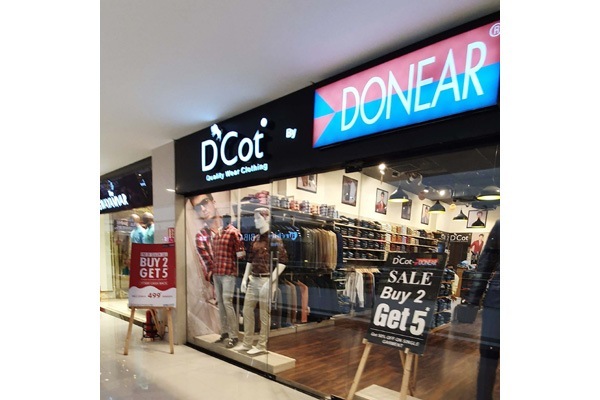
At its core, Donear sells fabric and related textile products through a distribution-heavy model. It manufactures synthetic, cotton, and blended fabrics mainly for suiting, shirting, and trousers. It also sells garments under D’Cot and works with wholesalers, franchisee outlets, dealer networks, and distribution stores. In plain English: this is not Zara. This is the old Indian textile ecosystem with sharper branding and wider reach.
The business has several moving pieces. First, there is the core fabric operation, which India Ratings says contributed 59% of FY25 revenue. Then garments contributed 21%. The B2C segment accounted for 34% of revenue and B2B 22%. The company also runs nearly 450 stores under the franchise model under D’Cot and exports to more than 20 countries across five continents. So the story is not just “fabric manufacturer.” It is a fabric-plus-brand-plus-channel-management machine.
That sounds solid, but this business model comes with a catch bigger than a cricket commentator’s pause before saying “dropped.” To keep dealers, franchise stores, and product variety alive, Donear has to hold a lot of inventory. That stretches the working capital cycle and pushes the company toward bank limits. India Ratings explicitly said inventory holding stays high because minimum stock has to be maintained at franchise outlets and dealer stores, coupled with a wide variety of products. So the business model works, but it works like an Indian joint family kitchen: always busy, always stocked, and always expensive to run.
Also, the biggest structural threat is not a competitor with better looms. It is consumer behaviour. India Ratings directly flagged the shift in Tier-1 cities toward ready-made garments instead of buying fabric and going to a tailor. That is the kind of change that quietly kills legacy categories over time. If Donear cannot keep moving toward faster-fashion-adjacent fabrics, garments, stretch products, and institution-led segments like uniforms, it risks becoming the corporate equivalent of a well-maintained VCR player: respectable, but increasingly ignored.
4. Financials Overview
The latest official result heading is Quarterly Results, so EPS treatment is locked as