01 — At a Glance
The Company That Killed Bugs But Couldn’t Kill Its Own Demons
- 52-Week High / Low₹3,030 / ₹1,229
- Q3 FY26 Revenue₹270 Cr
- Q3 FY26 PAT₹34 Cr
- Q3 FY26 EPS₹20.45
- Annualised EPS (Q3 × 4)₹81.80
- Book Value / Share₹707
- Price to Book1.81x
- 52-Week Return-53.3%
- 3-Year Return-19.6%
- 5-Year Return-12.0%
Flash Summary: Bharat Rasayan just posted Q3 FY26 revenue of ₹270 crore, up 5.48% QoQ. Sounds good? Not when you’ve been down 53% in a year and your 3-year profit growth is in the toilet at -13.2%. P/E at 15x looks cheap until you realize the company is rotting slower than cabbage in a Delhi basement. The 2-for-1 stock split in Dec 2025 was a CPR attempt on a patient who’d been flatline for 3 years. Monsoon was good last year, but markets don’t care. Death by a thousand disappointments.
02 — Introduction
The Pesticide King Who Lost His Crown to Bad Luck and Worse Timing
Bharat Rasayan Ltd was incorporated in 1989. That was the year of the Rajiv Gandhi assassination, the fall of the Tripura government, and India’s basmati rice export boom. In 1989, Bharat Rasayan began making pesticides. Fast forward to 2025, and the story has three chapters: it still makes pesticides, the monsoons still matter, and the stock price has the dignity of a broken calculator.
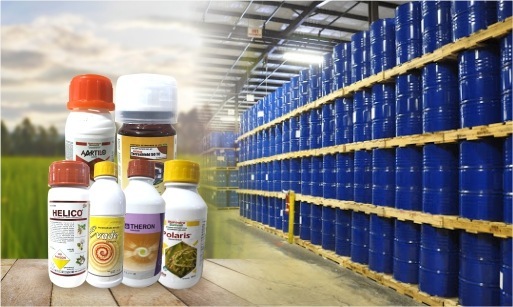
The company manufactures technical grade pesticides (80% of sales), intermediates (18%), and formulations (2%). Lambda Cyhalothrin, Metaphenoxy Benzaldehyde, Fipronil—these sound like names from a pharmaceutical thriller, but they’re the bread and butter that farmers use to keep insects from eating their wheat before the government’s procurement agencies can hoard it.
Scale-wise, the company operates two plants: Dahej (29,200 MTPA) in Gujarat and Mokhra (4,260 MTPA) in Haryana. It has 489 domestic registrations, 123 international registrations, serves 24 countries, and manages a distribution network of 4,800 dealers and 30,000 distributors. On paper, this sounds like a reasonably scaled agro-chemical business. On a stock chart? It looks like a man running up an escalator going down. The company’s been struggling since FY22. Revenue growth over 5 years: -0.71%. Profit growth over 5 years: -6.27%. Promoters hold 75%. International sales dropped from 52% in FY22 to 37% in FY24. Welcome to the nightmare.
The Bonus Situation (Dec 2025): Management declared a 2-for-1 stock split and a 1:1 bonus issue effective Dec 12, 2025. Translation: your ₹3,000 share becomes ₹1,500 and you get another one free. The stock crashes 50%+ in a year, so the board decides to give you twice as many pieces of the same failing thing. It’s like a restaurant saying “our food is terrible, so we’ll serve you twice the portion.”
03 — Business Model: WTF Do They Even Do?
They Make Poison That’s Legal. Good Margins. If Only Farmers Would Use It.
Members get full access to every article.