Search for stocks /

Unichem Laboratories:₹264 Cr Profit (With Exceptional Gain). But Your Stock Down 57% YTD.What Went Wrong?

Unichem Laboratories Q3 FY26 | EduInvesting
Q3 FY26 Results · Quarterly Results (Oct–Dec 2025)

Unichem Laboratories:
₹264 Cr Profit (With Exceptional Gain). But Your Stock Down 57% YTD.
What Went Wrong?

A generic pharma company that got acquired by IPCA, posted exceptional profits from land sales, but still managed to disappoint shareholders so badly that the stock price is in free fall. The paradox of modern Indian pharma: more profit, less stock love.

Market Cap₹2,098 Cr
CMP₹298
P/E Ratio7.11x
YTD Return-57.3%
ROE5.59%

The Company That Went From ₹728 to ₹298 in a Year. Plot Twist: It Made More Money.

  • 52-Week High / Low₹728 / ₹298
  • Q3 FY26 Sales₹521 Cr
  • Q3 FY26 PAT (Excl. Exceptional)₹17.4 Cr
  • TTM EPS₹41.9
  • Annualised EPS (Q1–Q3 Avg × 4)₹57.83
  • Book Value / Share₹346
  • Price to Book0.87x
  • ROCE6.24%
  • ROE (3-Yr Avg)-1.15%
  • Market Cap₹2,098 Cr
Flash Summary (The Sad Version): Unichem posted Q3 FY26 PAT of ₹264 crore, but ₹275 crore came from selling land to IPCA. Strip that out and quarterly profit is ₹17.4 crore — a 70% YoY collapse. Yes, you read that correctly. The entire profit is from real estate arbitrage, not the actual business. The stock trades at 7.11x P/E and 0.87x book value. Your cousin who bought at ₹728 is now ordering conspiracy theories on YouTube instead of biryani. The question nobody asks: Why is a generic pharma company selling land instead of making medicines profitably?

The Acquisition That Looked Smart on Paper. And Then Reality Arrived.

In August 2023, IPCA Laboratories — a mid-sized but scrappy pharmaceutical company with actual operating history and cost discipline — saw an opportunity and bought 52.67% of Unichem Laboratories through an open offer at ₹440 per share. The thesis was simple enough: Unichem has US generics exposure, API capabilities via backward integration, established USFDA-approved factories, and a pile of assets (some tangible, some land). IPCA, with its proven API muscle and cost structure, would integrate Unichem, extract synergies, and unlock hidden value.

What happened instead? The stock went from ₹728 (52-week high) to ₹298 (current) in nine months. That’s a 59% evisceration. Not for any scandal. Not for a failed drug launch. But because Unichem’s core business — generic formulations sold into a brutally competitive US market — is generating minimal profits. When you actually look at the operating earnings, Q3 FY26 core profit (excluding land sale) is ₹17.4 crore on ₹521 crore revenue. That’s 3.3% net margin. Your local kirana shop has better ROIs.

Here’s where it gets messy. In December 2024, Unichem sold land to IPCA (for ₹275 crore, recognized as exceptional gain in Q3). Why? Probably to prop up balance sheet metrics, show profitability, or fund operations. It worked! The numbers look great. Your P&L statement screams success. Your stock price screams the opposite.

ICRA Rating Note (Feb 2025): ICRA upgraded Unichem’s long-term rating from A to A+ in February 2025, citing improved margin trajectory and IPCA synergies. The rating action is purely based on medium-term potential — backward integration, cost optimization, and US market tailwinds. But ratings don’t buy shares; cash flows do. And right now, Unichem’s core cash flows are anaemic.

Generic Pills for Americans. Spoiler: Americans Also Buy From Bangladesh, China, & Your Neighbor’s Garage.

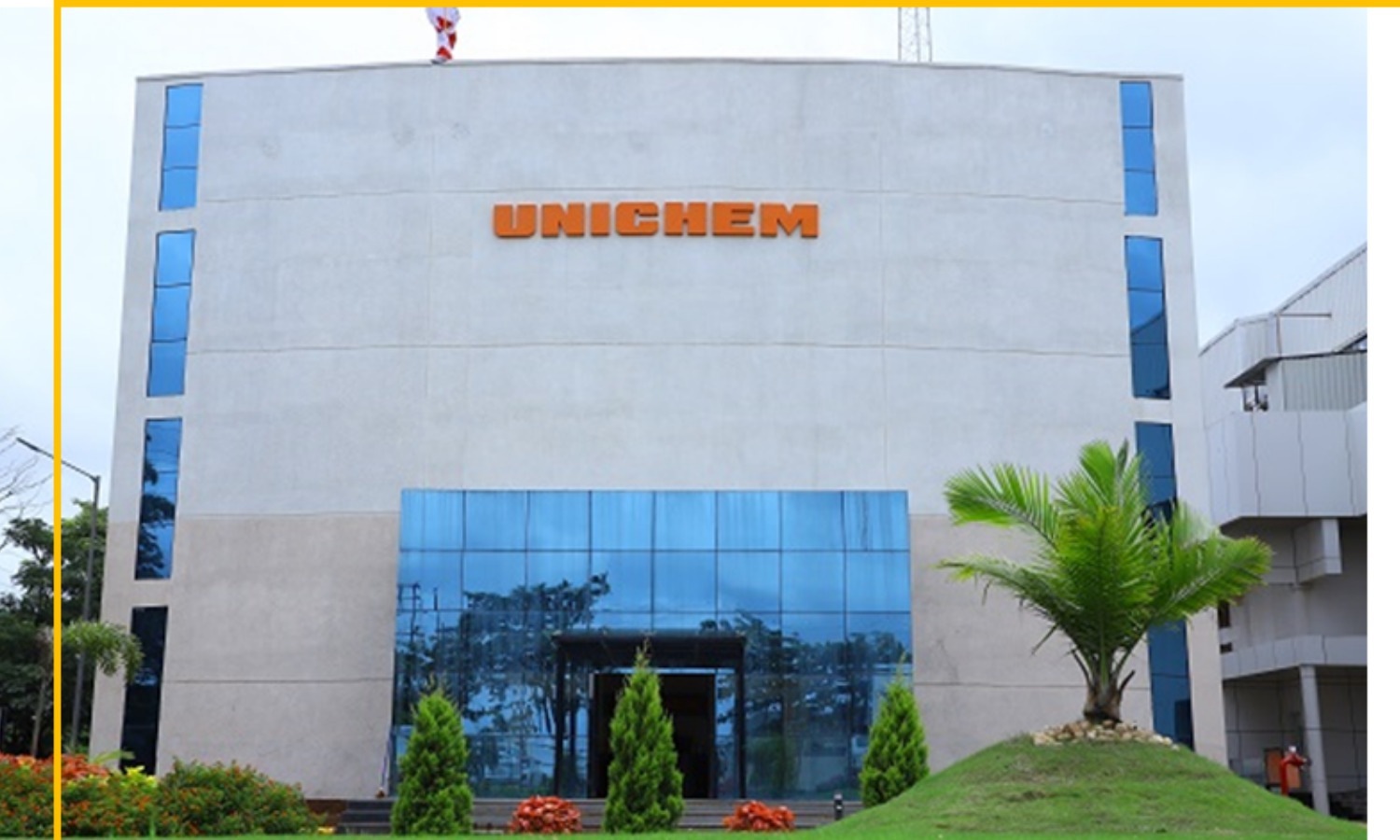
Unichem is a contract manufacturer and generic formulation exporter. The company operates factories in India (Goa, Baddi, Ghaziabad for formulations; Roha, Pithampur, Kolhapur for APIs), runs subsidiaries in regulated markets (USA, UK, Ireland, Brazil, South Africa, China), and ships generic drugs to international markets — primarily the United States.

Revenue mix: ~92% from generic formulations, 8% from APIs (bulk drugs). Geography-wise: ~61% from the USA, 37% from Rest of World, 2% from India (a company that dumped its domestic business but still exists in India for manufacturing). They’ve filed 75+ ANDAs (Abbreviated New Drug Applications) to sell generics in the US, developed 77 Drug Master Files (DMFs), and get their factories inspected by the USFDA every second Tuesday.

The business model is theoretically sound. Execute well, you get stable revenue and decent margins. Execute badly (as Unichem has), you get market share erosion, pricing pressure, and management scrambling to sell real estate to hide operational failures. Guess which mode Unichem is in.

Generic Formulation92%of revenue
USA Exposure61%of revenue
ANDA Filings75+in pipeline
API Facilities3under backward integration
Fun fact: Unichem has been trying to expand its API capacity since 2024. Phase 1 of the Pithampur API facility will add capacity for 600-700 MT API per annum. That was supposed to start operations in Q2 FY26. As of now (Q3 FY26), it’s “expected” to commence operations. In pharma, “expected” is what politicians say before missing deadlines by three years.

Q3 FY26: Profit Came From Land, Not From Lungs (The Medicine Kind)

Result type: Quarterly Results  |  Q3 FY26 EPS: ₹37.54  |  Avg Q1–Q3 EPS: (₹7.52+(-₹1.69)+₹37.54)/3 = ₹14.46  |  Annualised EPS: ₹57.83

Metric (₹ Cr) Q3 FY26
Dec 2025
Q3 FY25
Dec 2024
Q2 FY26
Sep 2025
YoY % QoQ %
Revenue521533579-2.24%-10.02%
Operating Profit458666-47.67%-31.82%
Operating Margin %9%16%11%-700 bps-200 bps
Exceptional Gain275One-offLand Sale
Net Profit (Incl. Exceptional)26458-12355%NM
Net Profit (Excl. Exceptional)-1158NMLoss
EPS (Reported)37.548.22-1.69356%NM
The Devastating Truth: Strip out the ₹275 crore land sale (exceptional gain), and Q3 FY26 operating profit was ₹45 crore on ₹521 crore revenue = 8.6% EBITDA margin. But even that looks rosy because “other income” of ₹287 crore in Q3 is almost entirely the land sale. The actual operating profit was ₹45 crore, which translates to ₹-11 crore net profit after interest and taxes. The company made a loss on its core business in Q3. Excluding one-time gains, Unichem’s earnings power is roughly nil. It’s trading on hopes of IPCA synergies and future API capacity commissioning. Hopes are fine; balance sheets aren’t built on them.
💬 If a company sells profitable-looking earnings by dumping its real estate, is it really growing? Or just rearranging the deck chairs? Sound off in the comments section.

What Is A ₹2,098 Crore Generic Pharma Company Actually Worth When Core Business Is Loss-Making?

error: Content is protected !!
Verified by MonsterInsights