01 — At a Glance
The Navy’s Favourite Electrician Just Made ₹12 Crore in One Quarter
- 52-Week High / Low₹258 / ₹155
- Q3 FY26 Revenue₹210 Cr
- Q3 FY26 PAT₹11.8 Cr
- TTM EPS₹3.86
- Annualised EPS (Q3)₹3.4
- Book Value / Share₹31.1
- Price to Book5.49x
- Order Book (Feb 2025)₹612 Cr
- Sales Growth (TTM)+13%
- Debt to Equity0.13x
Flash Summary: Marine Electricals just posted Q3 FY26 PAT of ₹11.8 crore on ₹210 crore revenue. The stock is at ₹171, down 21% in 3 months (ouch), trading at 44.3x P/E (double ouch). But here’s the thing: order book is ₹612 crore. Navy loves them. Datacentres trust them. Profit grew 127% YoY in Q3. The market, however, is having a panic attack about the valuation. Maybe it should. Maybe it shouldn’t. Let’s find out.
02 — Introduction
How Does an Indian Company Make Submarines More Alive Than You Are?
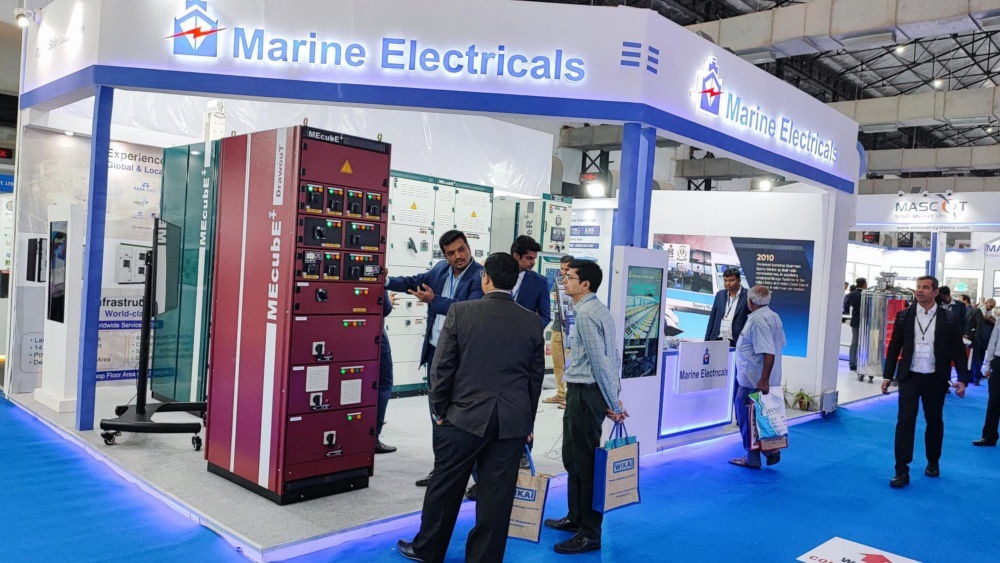
Established in 1978, Marine Electricals (MARINE) is basically the electrician your Navy calls when something needs to work perfectly the first time—because submarines are not the place for “jugaad” repairs. The company designs and installs complete electrical packages for naval vessels, commercial ships, and increasingly, for the data centres that are replacing temples as India’s new holy sites.
You won’t see them on Instagram. You won’t hear them on CNBC. But if you’ve sailed on a modern Indian Navy ship, an INS aircraft carrier, or worked in a data centre that never went down during peak season—Marine Electricals was the silent hero making sure the lights stayed on. The company has 50% market share in its marine product range in India. Translation: when the Navy needs power, Marine Electricals is the only serious option.
Q3 FY26 just delivered the goods: PAT of ₹11.8 crore (up 127% YoY), revenue at ₹210 crore (up 8.5% QoQ), and a fat order book approaching ₹612 crore. But the stock is down 21% in three months because the market decided that 44x P/E was suddenly too expensive. Funny how that works. One day you’re the hero. Next day you’re a lesson in “don’t catch falling knives.”
ICRA Ratings Update (Apr 2025): Upgraded to [ICRA]BBB+(Stable) from [ICRA]BBB(Stable). Credit limits enhanced to ₹322 crore. The rating agency noted “healthy order book position,” “comfortable capital structure,” and “stable profit margins.” So the people who actually read balance sheets for a living think this is getting safer. The stock market disagrees. Such is the gap between analysis and emotion.
03 — Business Model: Building Boats Is Their Actual Day Job
They Sell Electrical Solutions. But What They Really Sell Is “Your Submarine Won’t Sink” Insurance.
Marine Electricals operates in four distinct verticals, each printing money at different speeds. The Marine segment (44% of revenue in Q1 FY25) is their pride—supplying complete electrical packages to naval vessels, submarines, and commercial ships. They handle everything from switchboards to propulsion systems to integrated platform management. It’s not just a switchboard; it’s THE switchboard that keeps a submarine operational in the Arabian Sea.
The Industry segment (56% of revenue) is booming—LV and MV switchgears, automation solutions, integrated building management systems, all flowing into data centres, pharma plants, and high-rise towers. They’re literally the Schneider Electric’s largest licensee partner for Blokset panels in India. Translation: they manufacture 50% of a category and nobody even notices because it’s not a consumer product.
Then there’s Xanatos Marine (vessel traffic management systems) and Electric Vehicle charging solutions (Bijlify brand). The company is essentially a “boring” diversified engineer with a ₹612 crore order book. Boring is another word for “printing cash without drama.”
Industry Segment56%of revenue mix
Marine Segment44%of revenue mix
Order Book₹612 Cras of Feb 2025
Debt to Equity0.13xClean balance sheet
Fun fact: MARINE holds 75% stake in Xanatos Marine, a maritime domain awareness company. This is their play on India’s port privatisation boom. Every port in India needs a traffic management system. Most don’t have one. MARINE is betting that “essential infrastructure that nobody talks about” will suddenly become very valuable. They’re probably right. But the stock has already told us it’s pricing in failure, so there’s that.
04 — Financials Overview
Q3 FY26: Profit Up 127%. Stock Down 21%. Math Is Hard.
Result type: Quarterly Results | Q3 FY26 EPS: ₹0.85 | TTM EPS: ₹3.86 | Latest P/E: 44.3x
| Metric (₹ Cr) |
Q3 FY26 Dec 2025 |
Q3 FY25 Dec 2024 |
Q2 FY26 Sep 2025 |
YoY % |
QoQ % |
| Revenue | 210 | 194 | 222 | +8.25% | -5.41% |
| Operating Profit | 20 | 11 | 26 | +81.82% | -23.08% |
| OPM % | 10% | 6% | 12% | +400 bps | -200 bps |
| PAT | 11.8 | 5.2 | 16.8 | +127.69% | -29.76% |
| EPS (₹) | 0.85 | 0.38 | 1.20 | +123.68% | -29.17% |
The Math Check: TTM EPS = ₹3.86. CMP = ₹171. P/E = 44.3x. Industry median for similar companies? Try 27.6x. MARINE is trading at a 60% premium to sector median. For a company with 11.6% ROE and ₹612 crore order book. Now, here’s the plot twist: the order book is 2.9x annual revenue. That’s not normal. That’s “we have visibility for 3 years of work” levels of normal. Yet the stock is priced like it’s a software company about to go bankrupt.
💬 Why does a company with 127% YoY profit growth, clean balance sheet, and fat order book trade at 2x the sector P/E? Is it the working capital requirements, or is the market just being paranoid? Drop your hot take in the comments.
05 — Valuation Discussion
What Is This Electrical Engineer Actually Worth?