01 — At a Glance
India’s Cheese King Is Having an Identity Crisis (And It’s Kind of Fascinating)
- 52-Week High / Low₹377 / ₹142
- Q3 FY26 Revenue₹1,013 Cr
- Q3 FY26 PAT₹30.4 Cr
- TTM EPS₹10.5
- P/E Ratio18.5x
- Book Value / Share₹96.2
- Price to Book2.07x
- ROCE14.1%
- ROE (TTM)12.3%
- Debt / Equity0.45x
Flash Summary: Parag Milk Foods broke ₹1,000 crore quarterly revenue for the second consecutive quarter. Q3 PAT was ₹30.4 crore. The stock has crashed 36% in 6 months despite growing 31% annually and claiming 35% market share in cheese. Something is beautifully wrong here. The company just hired BCG to help them figure out strategy. Yes. BCG. To help a ₹2,489 crore dairy company that’s been around since 1992 find direction. Imagine calling a consultant to tell you what to do with your own cheese.
02 — Introduction
The Cheese Peddler Who Wants to Be a Tech Company
Let’s begin with a gentle observation: Parag Milk Foods is a company that doesn’t know what it is anymore. In the best possible way.
Founded in 1992 by Devendra Shah, PMFL is the dominant player in India’s cheese market with 35% market share. It’s also a cow ghee champion (22% market share), runs India’s largest automated dairy farm with 3,000+ Holstein Friesian cows, and recently launched Avvatar — a whey protein powder brand that has somehow grown sixfold in three years while the rest of the company is still figuring out how many litres of milk they’re processing per day.
The company’s ambition? Triple the business in four years. Their strategy? Nobody is 100% sure. But they hired BCG in November 2023 to help, which is either the smartest or dumbest decision a ₹2,489 crore market-cap company can make. Probably both.
Q3 FY26 delivered revenue of ₹1,013 crore, up 14% YoY, with volume growth of roughly 8%. Core categories (ghee, cheese, paneer) grew 12% in volume. New Age Business (Avvatar + Pride of Cows) crossed ₹100 crore in quarterly revenue for the first time and grew 123% YoY. The stock crashed 36% in six months anyway, trading at 18.5x P/E while peers trade at 24.6x. The market is saying: “Nice cheese. But we’re not convinced you know what you’re doing.”
CFO’s Reality Check (Feb 2026 Concall): Management admitted milk prices have spiked 20% YoY to ₹40 per litre. They’ve already taken multiple price increases. They expect “1 or 2 more price increases” in the next quarter. Translation: We’re passing inflation to customers until they stop buying cheese and switch to butter. At some point this breaks.
03 — Business Model: WTF Do They Even Do?
Milk-To-Muscle-Powder Pipeline. Also Cheese. Also Confusion.
Parag Milk Foods procures 15 lakh litres of milk daily from 5+ lakh farmers across India through 2,400+ Village Level Collection points. They’ve built three state-of-the-art processing plants — Manchar (Maharashtra), Palamaner (Andhra Pradesh), and Sonipat (Haryana, acquired from Danone in 2018).
The revenue mix in FY25 looked like this: Core Milk Products (cheese, ghee, paneer) at 57%, Liquid Milk at 10%, Ingredients & Skimmed Milk Powder (SMP) at 17%, New Age Business at 6%, and Others at 10%. Notice the problem? Half their revenue comes from commodity-ish products. The other half is scattered across ten subcategories. It’s like running a restaurant that sells pizza, pasta, panipuri, and protein shakes. Somebody’s family might be happy, but Wall Street has a migraine.
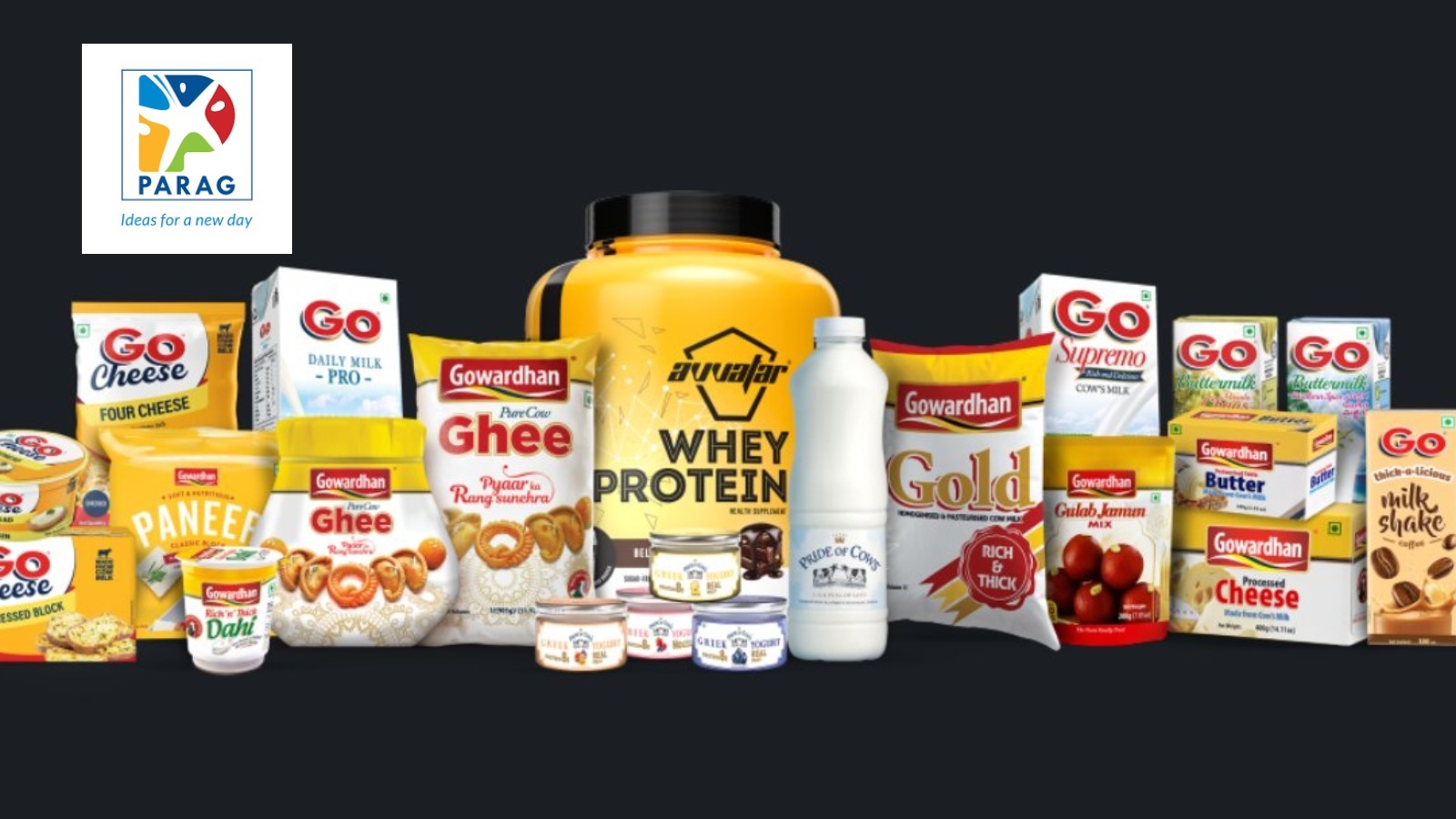
The company’s portfolio includes Gowardhan (everyday ghee/milk/paneer), GO (processed cheese), Pride of Cows (premium farm-to-home milk — fully automated, untouched by human hands), and Avvatar (sports nutrition, launched 2017). They also make paneer with a 75-day shelf life, which is either a miracle or the definition of too much preservative. Possibly both.
Core Products57%of revenue
Ingredients17%of revenue
New Age Business6%of revenue (growing)
Market Cap Growth-36%6 months
The Byproduct Margin Game: On the Feb 2026 concall, management spent 20 minutes explaining why their gross margins look worse than competitors. The reason? When you make ghee, SMP is a byproduct. So you list SMP sales separately, which increases your revenue denominator and depresses gross margin %. It’s accounting magic, but also kind of honest. If you combined ghee + SMP as one product, your margins would look better. Welcome to the world of dairy economics where transparency makes you look worse.
04 — Financials Overview
Q3 FY26: Revenue Roared, Profit Whispered
Result type: Quarterly Results | Q3 FY26 EPS: ₹2.36 | Annualised EPS (Q1+Q2+Q3 avg × 4): (₹1.82 + ₹2.45 + ₹2.36)/3 × 4 = ₹9.46
| Metric (₹ Cr) |
Q3 FY26 Dec 2025 |
Q3 FY25 Dec 2024 |
Q2 FY26 Sep 2025 |
YoY % |
QoQ % |
| Revenue | 1,013 | 885 | 1,008 | +14.5% | +0.5% |
| Operating Profit | 68 | 74 | 71 | -8.1% | -4.2% |
| OPM % | 6.7% | 8.4% | 7.0% | -170 bps | -30 bps |
| PAT | 30.4 | 31.5 | 45.8 | -3.6% | -33.6% |
| EPS (₹) | 2.36 | 2.45 | 3.65 | -3.7% | -35.3% |
The Income Statement Poetry: Revenue grew 14.5% YoY but profit fell 3.6%. Operating margin collapsed from 8.4% to 6.7% — a 170 basis point miss. This is what happens when milk inflation is 20% YoY and you’re still convincing customers to pay for premium cheese. One concall analyst asked management why margins are weaker than Hatsun Agro (which trades at 55x P/E and pretends margin pressure doesn’t exist). Management’s answer: “We have a different business mix. Also, SMP. Also, our Q3 is always heavier due to appraisals.” Translation: We’re confused about our business model too.
💬 Revenue up 14.5%, profit down 3.6%. At what point does growth without profitability become a feature instead of a bug? When does the market stop celebrating topline and start demanding the bottom line deliver? Thoughts?
05 — Valuation: Fair Value Range
What Is This Cheese Company Actually Worth?