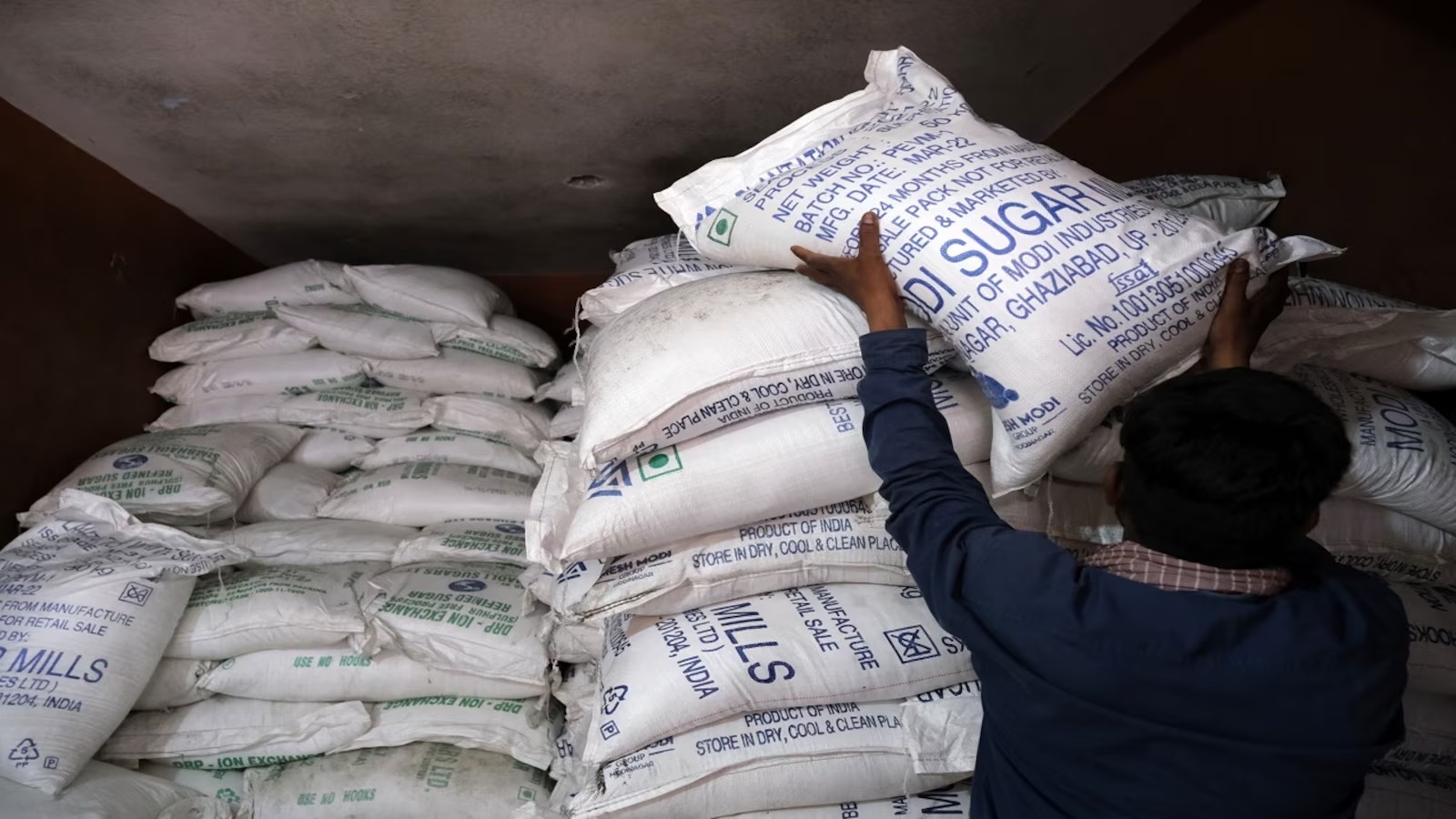
01 — At a Glance
The Sugar Crusader Nobody Talks About But Everyone Eats
- 52-Week High / Low₹465 / ₹261
- Q3 FY26 Revenue₹698 Cr
- Q3 FY26 PAT₹69.8 Cr
- TTM EPS₹41.9
- Annualised EPS (Q1-Q3 Avg × 4)₹21.80
- Book Value / Share₹399
- Price to Book0.80x
- Debt / Equity0.17x
- Interest Coverage7.20x
- Total Crushing Capacity43,200 TCD
Flash Summary: Dalmia Bharat just delivered Q3 FY26 revenue of ₹698 crore with PAT rising 17.6% quarter-on-quarter. The stock trades at 0.80x book value, 7.66x P/E, and just 1.87% dividend yield. While the market went chasing IPOs and tech startups, Dalmia quietly became one of India’s most capital-efficient sugar companies. The crushing capacity stands at 43,200 TCD. The distillery capacity is 950 KLPD and still growing. And the Dalmia family has controlled it for three decades without letting the stock run away on price. Welcome to boring excellence.
02 — Introduction
The Company That Turns Sweetness Into Returns (No IPO Banners Needed)
In 1994, when the Dalmia Group decided to enter the sugar business, it was not a glamorous decision. The sugar industry in India is about as predictable as the monsoons — which is to say, very unpredictable. You have government-mandated cane prices, FRP (Fair Remunerative Price), domestic export quotas, ethanol mandates that change faster than Union Budget tax slabs, and a farmer base that can be a blessing or a curse depending on the year’s rainfall.
Yet, Dalmia Bharat Sugar & Industries (DBSIL) did it. Thirty years later, they operate five sugar mills across Uttar Pradesh and Maharashtra with a crushing capacity of 43,200 tonnes per day. Four distilleries with 950 KLPD capacity. Cogeneration units producing 126 MW of power. The revenue is split: sugar (64%), distillery (30%), power (9%). The business is boring. The returns are not.
Q3 FY26 saw revenue of ₹698 crore, PAT of ₹69.8 crore. YoY profit growth: 17.6%. The stock is trading at ₹321 — down from 52-week high of ₹465, which means someone is selling a story nobody is buying. We’re here to find out why, and whether they should be buying more instead.
The ICRA Rating Note (Dec 2025): ICRA reaffirmed [ICRA]A1+ rating for commercial paper and gave comfort on the capital structure. The rating draws comfort from “operationally-efficient sugar mill operations” and “geographically diversified operations” providing “buffer against agro-climatic fluctuations.” Translation: the company is built to survive cyclicality. The question is: are investors buying it at the right price?
03 — Business Model: WTF Do They Even Do?
They Crush Cane, Distill It, Power It, and Profit From It. Repeat.
Dalmia Bharat’s business is simple: buy sugarcane from farmers at government-mandated prices, process it into sugar (gross recovery rate: 12.4-12.6%), divert a portion into ethanol (because sugar gluts are worse than cane debt), generate power from bagasse residue (because waste = energy), and sell everything at whatever the market permits. Rinse, repeat every crushing season.
The company’s two states of operation — UP and Maharashtra — have high sugar recovery rates and longer crushing seasons. Both states have advantages: UP provides volume, Maharashtra provides pricing power and export access. This geographic diversification is the kind of thing that auditors highlight in credit ratings and retail investors ignore. But it’s the reason the company survives bad years.
The forward-integration into distillery and power generation is the real secret sauce. When sugar prices crash (which happens every 3-4 years like clockwork), the ethanol and power revenue streams cushion the blow. ICRA notes that this “acts as a cushion against the cyclicality of the sugar business.” ICRA is being polite. What they mean is: “This company is built to not go bankrupt when the sugar industry melts down.”
Sugar Revenue Mix64%of total
Distillery Mix30%of total
Power Gen.126 MWcogeneration
Crushing Capacity43,200 TCDall mills
Fun fact: The company has been diverting sugar into B-heavy molasses and juice-based ethanol to avoid a sugar glut and maximize profitability per tonne of cane processed. In plain Hindi: jab sugar sasta ho jaye, toh ethanol bana lo aur zyada paise kamao. Translation: When sugar becomes cheap, make ethanol and earn more money. The government loves this because ethanol supports fuel blending targets. The farmers appreciate this because it means their cane gets processed. The company loves it because margins on ethanol can be attractive.
04 — Financials Overview
Q3 FY26: The Numbers Show Why Nobody’s Paying Attention
Result type: Quarterly Results | Q3 FY26 EPS: ₹8.62 | Avg Q1–Q3 EPS: (₹4.85+₹2.88+₹8.62)/3 = ₹5.45 | Annualised EPS: ₹21.80
| Metric (₹ Cr) |
Q3 FY26 Dec 2025 |
Q3 FY25 Dec 2024 |
Q2 FY26 Sep 2025 |
YoY % |
QoQ % |
| Revenue | 698 | 838 | 989 | -16.7% | -29.4% |
| Operating Profit | 109 | 101 | 56 | +8.0% | +94.6% |
| OPM % | 15.6% | 12% | 6% | +360 bps | +960 bps |
| PAT | 69.8 | 59 | 23 | +18.3% | +203% |
| EPS (₹) | 8.62 | 7.33 | 2.88 | +17.6% | +199% |
The Weird Math: Revenue is down 16.7% YoY and down 29.4% QoQ. But profit is up 18.3% YoY and up 203% QoQ. This happens in sugar when: (a) cane prices are lower, (b) sugar realization is better, (c) ethanol volumes are higher, and (d) power generation is optimized. The company is doing more with less cane. That’s efficiency. That’s the story the market is sleeping on. TTM EPS is ₹41.9, but annualized Q1-Q3 is only ₹21.80 — which means Q4 (March) will either be spectacular or devastating. Sugar seasonality is a bitch.
💬 Revenue down 30% QoQ but PAT up 200%? Is this operational genius or is Q3 just a statistical anomaly waiting to reverse in Q4? Drop your thought in the comments — are you impressed or suspicious?
05 — Valuation Discussion — Fair Value Range
What Should This Sugar Crusher Cost?
Method 1: P/E Based
TTM EPS = ₹41.9. Industry median P/E (sugar peers) = 12.01x. Given capital efficiency, low leverage (0.17x D/E), and forward-integrated operations, justified P/E band: 8x–11x.
→ 8x × ₹41.9 = ₹335.2 11x × ₹41.9 = ₹461
Range: ₹335 – ₹461
Method 2: Price to Book Value
Book Value = ₹399. Current P/BV = 0.80x. For sugar companies with 12.4% ROE, low debt, and steady operations, a 0.9x–1.2x P/BV is reasonable.
→ 0.9x × ₹399 = ₹359 1.2x × ₹399 = ₹479
Range: ₹359 – ₹479
Method 3: EV/EBITDA
TTM Operating Profit ≈ ₹450 Cr. EV = ₹2,479 Cr (Enterprise Value given). EV/EBITDA = ~5.5x. Given agri-commodity cyclicality and operational resilience, a 5x–7x band is fair.
Equity value per share at normalized 5.5x–6.5x implies ₹380–₹450 range.
Range: ₹380 – ₹450
Consolidated View: Across all three methods, fair value converges in the ₹350–₹465 range. CMP of ₹321 sits at the lower boundary. The stock has upside if: (a) cane prices stabilize, (b) sugar realization stays firm, (c) ethanol volumes scale as planned, and (d) the market re-rates cyclical stocks on earnings stability. The 52-week high of ₹465 is inside our fair value range, which means there was no valuation bubble at those levels.
⚠️ EduInvesting Fair Value Range: ₹350 – ₹465. This fair value range is for educational purposes only and is not investment advice. Please consult a SEBI-registered investment advisor before making any financial decision.
06 — What’s Cooking: News, Triggers & Drama
Management Changes, Capacity Expansion & The CFO Musical Chairs