01 — At a Glance
The Ethanol Millionaire That Nobody Asked For. But Here We Are.
- 52-Week High / Low₹3,633 / ₹321
- Q3 FY26 Revenue₹646 Cr
- Q3 FY26 PAT₹89.5 Cr
- TTM EPS₹60.43
- Q3 EPS₹31.99
- Book Value / Share₹727
- Price to Book1.33x
- Q3 Revenue Growth YoY62.9%
- Q3 Profit Growth YoY174%
- 3-Year Stock CAGR189%
The Headline That Matters: CIAN Agro just reported Q3 FY26 PAT of ₹89.5 crore — up 174% YoY. That’s not a typo. Revenue crossed ₹646 crore (up 63% YoY). The stock has returned 165% in one year and 189% in three years. The P/E is a humble 16.0x. The ROE is… well, 4.01%. Not great. Not terrible. Confusing, really. Like ordering biryani at a South Indian restaurant. It’s there. It works. But you know something’s off.
02 — Introduction
When Your Company’s Stock Goes 17x in One Year, You Know Someone Important Is Paying Attention
CIAN Agro Industries has been around since 1985, making masalas, oils, soaps, detergents — the unglamorous stuff that makes your dal taste better but nobody tweets about. For 40 years, it was a sleepy mid-cap agro company earning boring single-digit returns.
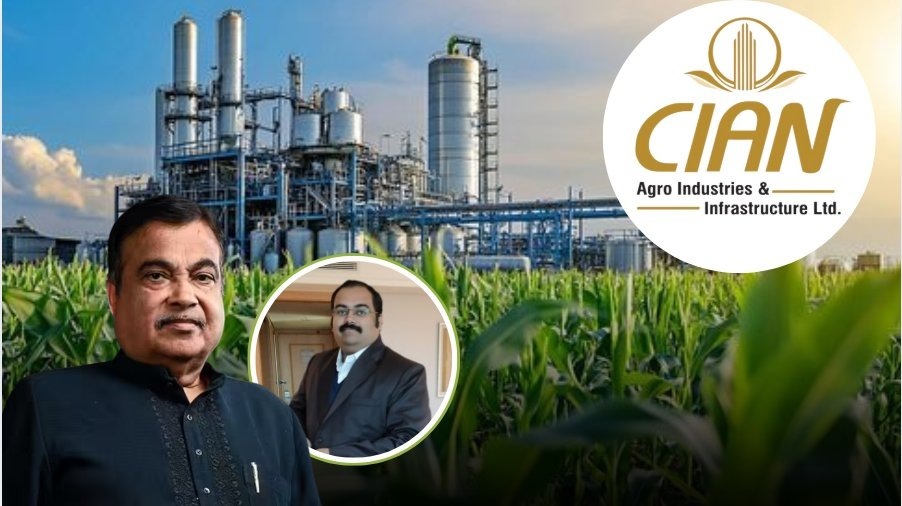
Then something changed. Around 2024–2025, the government — specifically the Ministry of Road Transport & Highways under Nitin Gadkari — started pushing E20 petrol with the force of a monsoon. E20 means 20% ethanol blended with petrol. The policy is real: reduce oil imports, help farmers earn more, reduce pollution, boost domestic ethanol producers.
Now here’s where it gets interesting. Nikhil Gadkari, son of the Union Minister, is connected to CIAN Agro’s promoter ecosystem. Not as a direct owner (that would be too obvious), but through the web of promoter entities and family business holdings. When your dad is the minister literally writing the policy that makes your company’s product mandatory in every petrol pump across India… well, let’s just say the growth wasn’t accidental.
CIAN Agro’s revenue went from ₹171 crore (Mar FY24) to ₹1,029 crore (Mar FY25) to ₹2,068 crore (TTM). That’s a 12x jump in 18 months. The stock went from ₹80 (18 months ago) to ₹970 (today) — a 12x move as well. Coincidence? Maybe. But when the Union Minister’s ministry is mandating the exact product your company produces, and your family has stakes in the company… investors get nervous. Not because there’s illegality (there probably isn’t), but because it smells like the kind of government-adjacent capitalism that works until it doesn’t.
The Uncomfortable Truth: CIAN Agro’s explosive growth is hitched to E20 policy. E20 policy is driven by Nitin Gadkari’s ministry. Nikhil Gadkari’s family is connected to CIAN’s promoters. This is neither shocking nor illegal in Indian capitalism — it’s how the system works. But it’s also why the stock could crash 50% overnight if either (a) the policy reverses, (b) political winds shift, or (c) media scrutiny increases. The stock price you see is partly real business, partly political risk premium.
03 — Business Model: WTF Do They Even Do? (The Honest Version)
Masalas, Oils, Soaps, Ethanol, and Now You Own Two Industrial Complexes You Didn’t Know About
CIAN Agro’s core business is dead simple: consumer products. Kitchen Queen masalas. Neu detergent. Oir soap. Stuff your mom buys without thinking. Operating margin: steady at ~19%. Nothing exciting. The margins aren’t spectacular because FMCG is a low-margin game where volume is king and profit is a suggestion.
Then they got ethanol. Ethanol production became the hidden growth engine. When E20 demand spiked, suddenly CIAN had a golden ticket. The revenue went from ₹171 crore in Mar FY24 to ₹1,029 crore in Mar FY25. That’s a 6x jump in a single year. Either the company discovered Einstein’s lost formula, or India’s ethanol policy is really, truly a tailwind.
They’ve also diversified into infrastructure — aluminium alloys, copper ingots, forging & machining through a subsidiary called Varron (acquired via NCLT in 2022). They own mango processing units. They’re doing contract farming. It’s like they threw darts at a business model board and said “sure, let’s do all of it.”
Agro/Food~75%revenue (FY23)
Infrastructure~20%revenue (FY23)
Healthcare~5%revenue (FY23)
Operating Margin19.4%TTM
The Honest Take: CIAN Agro is basically a holding company pretending to be an agro company. It’s got subsidiaries, joint ventures, manufacturing plants, and now oil refineries doing ₹645 crore per quarter. If this was a Bollywood film, the climax would involve the CEO realising he owns a petroleum company and never knew it.
04 — Financials: The Numbers That Made Papayas Jealous
Q3 FY26: When 174% Profit Growth Is Just Another Tuesday
Result type: Quarterly Results | Q3 FY26 EPS: ₹31.99 | Annualised EPS: ₹31.99 × 4 = ₹127.96 | TTM EPS: ₹60.43
| Metric (₹ Cr) |
Q3 FY26 Dec 2025 |
Q3 FY25 Dec 2024 |
Q2 FY26 Sep 2025 |
YoY % |
QoQ % |
| Revenue | 646 | 396 | 421 | +62.9% | +53.4% |
| Operating Profit | 167 | 80 | 74 | +108.8% | +125.7% |
| Operating Margin % | 26% | 20% | 18% | +600 bps | +800 bps |
| PAT | 89.5 | 33 | 19 | +174% | +371% |
| EPS (₹) | 31.99 | 11.70 | 6.79 | +173% | +371% |
Where Are These Numbers Coming From? Operating profit margin jumped from 20% to 26% YoY. That’s not just inflation adjustments — that’s real operating leverage. The PAT jumped 174% because (a) revenue surged, (b) margins expanded, and (c) lower tax rate (22% in Q3 FY26 vs mixed rates in previous quarters). The company’s tax strategy looks like it read a book called “Optimising for Efficiency.”
💬 A 174% profit growth in a single quarter — is this sustainable, or did CIAN just catch lightning in a bottle? Leave your take in the comments.
05 — Valuation: Fair Value Range (The Honest Conversation)
What’s a Company Worth When Its ROE Says One Thing But Its Stock Price Says Another?
Method 1: P/E Based Valuation
TTM EPS = ₹60.43. Q3 annualised EPS (if we believe it’s repeatable) = ₹127.96. Using the Q3 annualised: 16.0x (current P/E) × ₹127.96 = ₹2,047. But TTM-based valuation is more conservative: 16.0x × ₹60.43 = ₹967. The range widens based on whether you believe Q3 is repeatable or a one-time spike.
→ Conservative (TTM): ₹967 Optimistic (Q3 Annualised): ₹2,047
Range: ₹900 – ₹1,100 (conservative)
Method 2: Price to Book Value
Book Value = ₹727. Current P/BV = 1.33x. For a commodity-linked agro business, 1.0x–1.5x P/BV is reasonable. A low ROE (4.01%) suggests the stock shouldn’t command premium multiples — the business isn’t earning excess returns on shareholder capital.
→ 1.0x × ₹727 = ₹727 1.3x × ₹727 = ₹945
Range: ₹725 – ₹950
Method 3: EV/EBITDA (Operating Profit Basis)
TTM Operating Profit ≈ ₹402 Cr. Enterprise Value at ₹3,993 Cr. EV/Operating Profit = ~9.9x. For an agro/ethanol company, 8x–12x is reasonable depending on growth visibility. With commodity exposure, a 9–10x multiple is fair.
Implies stock value of ₹850–₹1,050 per share depending on net debt adjustments.
Range: ₹825 – ₹1,025
The Verdict on Valuation: All three methods converge around ₹825–₹1,050. The current price of ₹970 is right in the middle. At face value, the stock doesn’t look overvalued or undervalued — it’s fairly priced. The real question isn’t price; it’s whether the ethanol boom sustains and whether the ROE improves.
⚠️ EduInvesting Fair Value Range: ₹825 – ₹1,050. This fair value range is for educational purposes only and is not investment advice. Please consult a SEBI-registered investment advisor before making any financial decision.
06 — What’s Cooking: News, Triggers & The Awkward Stuff
NSE Listing Drama, M&A Spree, And The Political Risk Nobody’s Quantifying