01 — At a Glance
The Tyre Maker That Tried to Climb a Mountain Made of Rubber
- 52-Week High / Low₹4,788 / ₹2,430
- Q3 FY26 Revenue (Consolidated)₹917 Cr
- Q3 FY26 PAT (Consolidated)₹11 Cr
- TTM EPS₹58.4
- Annualised EPS (Q3 Avg)₹58.1
- Book Value / Share₹1,508
- Price to Book2.36x
- ROCE5.36%
- ROE (Last Year)2.35%
- ROCE (3-Yr)6.93%
Flash Summary: TVS Srichakra just posted Q3 FY26 consolidated revenue of ₹917 crore (up 14.2% YoY), but PAT collapsed to ₹11 crore due to raw material inflation and margin compression. The stock trades at 58.2x P/E — roughly 2.5x the industry median — on the back of one assumption: that the capex story is ending, margins return, and those ₹10 billion in capacity expansion finally justify the hype. The betting man awaits. The smart man? He’s still reading.
02 — Introduction
Welcome to Rubber’s Roulette Wheel: TVS Srichakra Edition
TVS Srichakra is not a household name. But if you own a two-wheeler in India — and one in four people do — the tyre under that bike or scooter has a decent chance of being a TVS Srichakra product. Founded decades ago, part of the storied TVS group (which also owns TVS Motor), TVSSC makes tyres for 2-wheelers, 3-wheelers, industrial applications, and export markets. Think of them as the quiet OEM supplier that sells to every major two-wheeler maker in India: Bajaj, Hero, Honda, Suzuki, Yamaha, even TVS Motor itself. Nothing sexy. Everything essential.
The company has two manufacturing plants: one in Madurai (Tamil Nadu) and another in Rudrapur (Uttarakhand). FY25 saw consolidated revenue of ₹3,254 crore and net profit of ₹21 crore. TTM numbers sit at ₹3,481 crore in revenue and ₹45 crore in PAT. The business is straightforward: buy raw materials (60-65% of revenue), make tyres, sell to OEMs and aftermarket, ship exports. Rinse, repeat. Watch margins vanish when natural rubber prices moon. Which, spoiler alert, they did in the second half of FY25.
But here’s the twist. The management launched a ₹1,000 crore capex plan in FY22 to double capacity in the off-highway tyre (OHT) segment and expand 2-wheeler capacity. By end-FY26, they’ll have spent ₹900+ crore. The final ₹100 crore is trickling in through Q4 FY26 and beyond. The bet: OHT margins are fatter, exports are growing, and once the capex burden subsides, the profitability story resets. Q3 FY26 results suggest we’re not there yet. But maybe — just maybe — we’re getting closer.
India Ratings Insight (Nov 2025): Ind-Ra affirmed TVSSC’s bank loan facilities at IND AA-/Stable and CPs at IND A1+. The agency expects margins to stabilize in FY26 on the back of moderating raw material prices and improved operating leverage. Translation: the rating agency believes in the turnaround. The market? Still pricing in the chaos.
03 — Business Model: WTF Do They Even Do?
Making Tyres for Two-Wheelers, OHT, and Prayer-Wheels
TVS Srichakra operates in four main segments. First: 2-wheeler tyres for OEMs (Bajaj, Hero, Honda, etc.). Second: 2-wheeler replacement tyres (aftermarket). Third: off-highway tyres (OHT) for tractors, earth-moving equipment, skid-steer loaders—basically anything that doesn’t run on tarmac. Fourth: exports to 90+ countries including USA, Europe, South America, Australia. Revenue splits roughly as follows: OEM ~60%, aftermarket ~30-35%, others ~5-10%. Geographically: domestic 82-85%, exports 15-18%.
The business is low-tech on the surface. Buy rubber (natural and synthetic), carbon black, chemicals. Heat-treat in massive vulcanization chambers. Mold into tyres. Ship. Collect money. Repeat 10,000 times per day. Yet, it’s ferociously capital-intensive and margin-volatile. A 5% move in natural rubber prices can wipe out a quarter’s profits. Forex fluctuations on imported raw materials add another layer of chaos. Operating leverage is beautiful when volumes are up and input costs are stable. It’s absolutely brutal when they’re not.
The company exports to 90+ countries. Its R&D centre in Milan (Italy) supports European market aspirations. The domestic aftermarket is expanding through 575+ distributors and 50,000+ retail outlets. But the real margin juice comes from OHT and higher-value replacement tyres. OHT is projected to double post-capex, contributing higher EBITDA margins (~15-18% vs. 7% currently). Management is betting the farm on this.
2W OEM~60%of revenue
2W Aftermarket~30%of revenue
OHT CapacityDoubledby FY26
Exports90+ Nations~15-18% rev
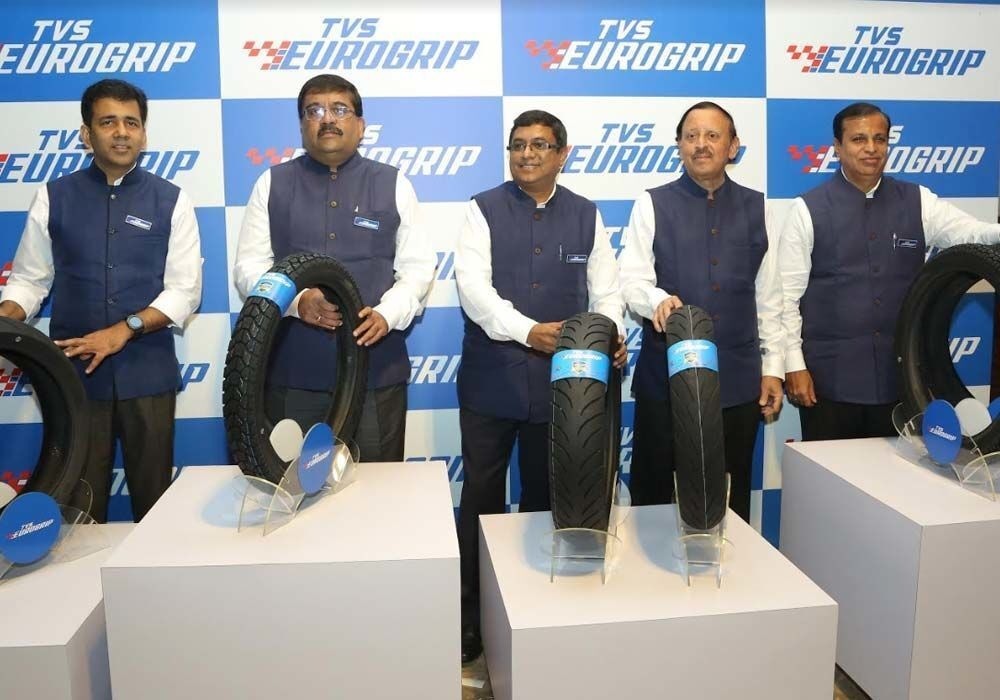
Fun fact: Aftermarket 2-wheeler tyres are a high-margin business. But building a brand in the aftermarket is harder than building a tyre. TVSSC has been trying to grab share from MRF and CEAT for years. Progress is visible but slow — like watching water evaporate in Rajasthan summer. The company’s advertising spend has increased, and Eurogrip (their international brand) is finally getting traction. But Rome wasn’t built in a quarter, and neither are aftermarket empires.
04 — Financials Overview
Q3 FY26: When Chaos Comes in a Tyre Form
Result type: Quarterly Results (Consolidated) | Q3 FY26 EPS: ₹14.56 | Avg Q1–Q3 EPS: (₹16.82+₹14.51+₹14.56)/3 = ₹15.30 | Annualised EPS: ₹61.2
| Metric (₹ Cr) |
Q3 FY26 Dec 2025 |
Q3 FY25 Dec 2024 |
Q2 FY26 Sep 2025 |
YoY % |
QoQ % |
| Revenue | 917 | 803 | 926 | +14.2% | -1.0% |
| Operating Profit | 78 | 44 | 66 | +77.3% | +18.2% |
| Operating Margin % | 8.5% | 5.5% | 7.1% | +300 bps | +140 bps |
| PAT | 11 | -6 | 11 | N/A | N/A |
| EPS (₹) | 14.56 | -7.80 | 14.51 | N/A | +0.3% |
The Good, Bad & Ugly: Revenue is up 14.2% YoY, driven by volume growth in all segments. Operating profit bounced back 77.3% YoY because Q3 FY25 was a bloodbath (negative PAT). But Q3 FY26 PAT is only ₹11 crore — the same as Q2 FY26 despite Q3 having higher revenue. Why? A sharp ₹1 crore increase in finance costs (interest expense jumped from ₹12 cr to ₹14 cr) and ₹36 crore in depreciation (capex comes with aging assets). The company is profitable, but barely. The stock is priced at 58.2x P/E on the hope that profitability normalizes as capex burden subsides.
💬 At 58.2x P/E (vs. industry median of 23.6x), is the market betting on a turnaround story or just pricing in hype? Drop your thoughts in the comments.
05 — Valuation Discussion: Fair Value Range
What Is This Rubber-Slinging Company Actually Worth?
Method 1: P/E Based
Annualised EPS (Q1–Q3 average) = ₹61.2. Industry median P/E = 23.6x. For a cyclical tyre company with capex headwinds and tight margins, a 15–20x P/E is justified. Conservative band: 12x–18x.
→ 12x × ₹61.2 = ₹734 18x × ₹61.2 = ₹1,102
Range: ₹735 – ₹1,100
Method 2: Price to Book Value
Book Value = ₹1,508. Current P/BV = 2.36x. For a tyre company with 2.35% ROE and deteriorating returns, 1.0x–1.5x P/BV is fair. The current 2.36x implies substantial margin recovery.
→ 1.0x × ₹1,508 = ₹1,508 1.5x × ₹1,508 = ₹2,262
Range: ₹1,500 – ₹2,260
Method 3: EV/EBITDA (Post-Capex Scenario)
TTM EBITDA ≈ ₹315 crore (estimated). Enterprise Value = ₹3,497 crore. Current EV/EBITDA ≈ 11.1x. Post-capex normalization with margins at 10%, EV/EBITDA of 8x–11x is reasonable.
At ₹3,350 cr EV with normalized capital structure, equity value implies ₹850–₹1,200 per share range.
Range: ₹850 – ₹1,200
Consolidated View: The three methods suggest a fair value band of ₹800–₹1,300 depending on how aggressively one assumes margin recovery and capex completion. Current price of ₹3,560 is significantly above all three ranges, suggesting the market is pricing in either near-perfect execution on the capex turnaround or has developed selective amnesia about historical volatility in this sector.
⚠️ EduInvesting Fair Value Range: ₹800 – ₹1,300. This fair value range is for educational purposes only and is not investment advice. Please consult a SEBI-registered investment advisor before making any financial decision.
06 — What’s Cooking: News, Triggers & Drama
Capex Completion, MD Reappointment & Tax Drama