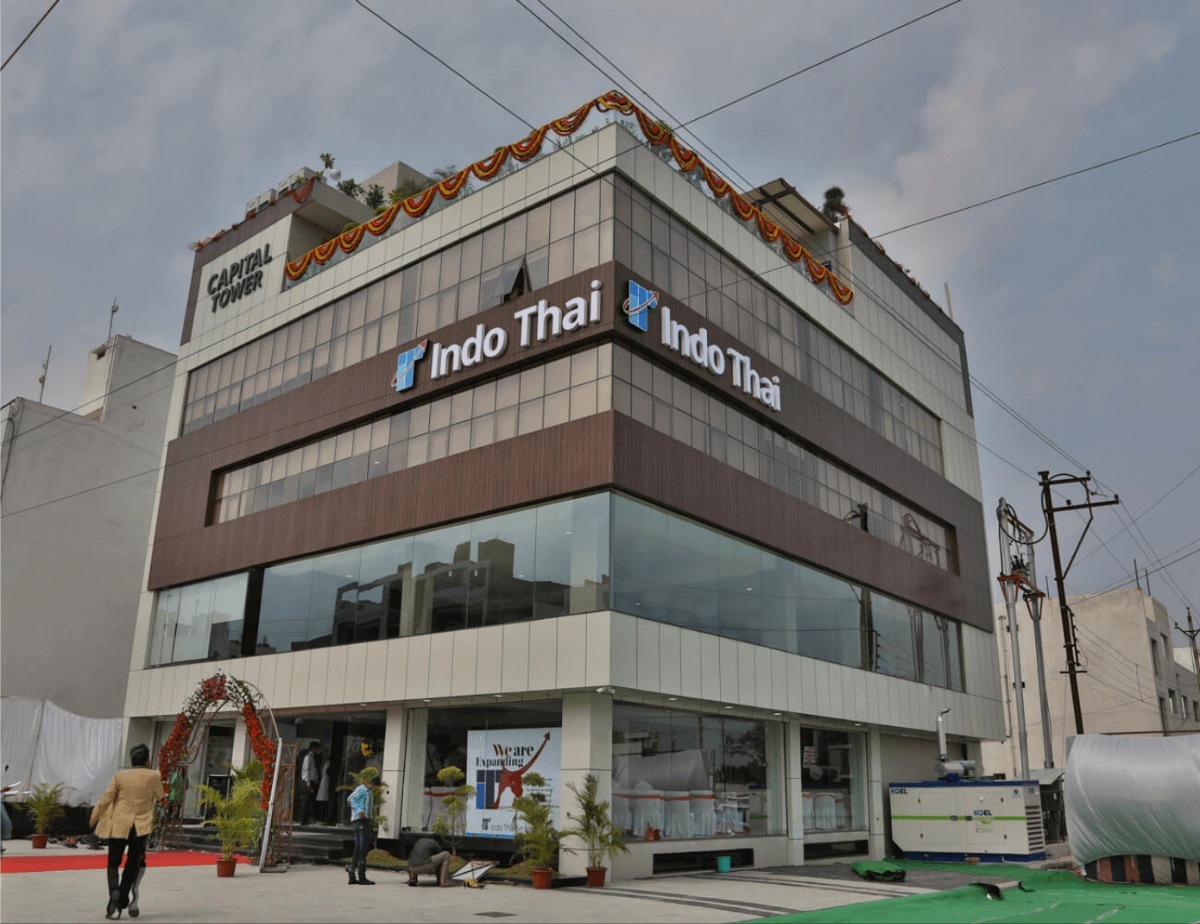
Indo Thai Securities:₹17 Cr PAT. +1,671% Growth. The Doshi Family’s Warrant Printing Machine

Indo Thai Securities Q3 FY26 | EduInvesting
Q3 FY26 Results · December 2025

Indo Thai Securities:
₹17 Cr PAT. +1,671% Growth.
The Doshi Family’s Warrant Printing Machine

A brokerage that went from modest profits to stratospheric earnings in three months. Or did they? Demerger announced. Warrants flying around like confetti. P/E of 88x. And the promoters are quietly diluting themselves. Let’s talk about what just happened here.

Market Cap₹3,305 Cr
CMP₹257
P/E Ratio88.4x
3M Return-28.8%
ROCE8.66%

The Micro-Cap Rollercoaster: A Doshi Family Production

  • 52-Week High / Low₹470 / ₹144
  • Q3 FY26 Revenue₹27.7 Cr
  • Q3 FY26 PAT₹17.0 Cr
  • Q3 FY26 EPS₹1.33
  • Annualised EPS (Q3×4)₹5.32
  • Book Value₹16.9
  • Price to Book15.2x
  • Dividend Yield0.04%
  • Debt / Equity0.02x
  • Debtors Days251 days
The Unfiltered Truth: Indo Thai Securities reported Q3 PAT of ₹17 crore, a stunning +1,671% increase from Q3 FY25’s ₹1 crore. Sounds great, right? Here’s the catch: the company had a ₹3 crore loss in Q3 FY25. When you go from a loss to profit, percentage gains become mathematically theatrical. The stock has crashed 28.8% in three months. P/E sits at 88.4x. The debtors cycle is at 251 days — Indian bankers call that “optimistic auditing.” Meanwhile, the promoters are issuing warrants like they’re going out of style. This is not your dad’s brokerage.

Welcome to the Warrant Carnival at 60 Dalal Street

Let’s start with the obvious: Indo Thai Securities is a brokerage. Founded in 1995 by the Doshi family, it sits in the messy, competitive world of stock broking in India — where your business depends entirely on trading volumes, margin money, and how many retail investors you can herd through your app.

For a long time, Indo Thai was a steady, forgettable mid-cap: consistent dividend payer, reliable execution, boring financials. But something changed around mid-2024. The stock started flying. Warrants got issued. More warrants. Then a demerger was announced. Then more warrants. By December 2025, the promoter holding had fallen from 72% to 56.8%, and the share count had exploded from 10 crore shares to over 12 crore. The market cap is now ₹3,305 crore — which means a brokerage with ₹71 crore in full-year revenue (TTM) is valued at nearly 47x sales.

Earnings growth of 189% (TTM), a 251-day debtors cycle, a P/E of 88x, and a 0.04% dividend yield. If you’re asking “what could go wrong,” buckle up — this is the financial equivalent of eating samosas off a moving train.

The Doshi Family Strategy (Allegedly): Issue warrants → dilute shareholding → squeeze public float → announce demerger → watch retail investors FOMO into call options. Rinse, repeat. At last count, 15,932 retail shareholders held the stock. That’s up from 3,984 in March 2023. Retail participation up 300%. Promotion value creation: TBD.

Stock Broking: Where Retail Gets Excited and Money Vanishes

Indo Thai Securities is a full-service investment broker. They execute equity trades, derivatives trades, commodity trades. They manage mutual funds (AUM of ₹182.51 crore as of Sept 2025). They offer wealth management, portfolio services, insurance — basically, anything that lets them collect fees from Indians with ₹5 lakh in their savings account.

Revenue breakdown (FY23): 64% from fees and commissions, 21% from interest income, 3% from dividends, and the rest from odds and ends. The business is simple: more trading volume = more commissions. Flat market = flat revenues. Market crash = potential margin calls, but that’s someone else’s problem.

Indo Thai operates in 60+ locations across India, has a membership in NSE, BSE, NCDEX, MCX, and a depository license from CDSL. They’re also a mutual fund distributor and a portfolio manager. The organizational structure is a Swiss Army knife designed to extract fees from every possible angle.

But here’s where it gets interesting: the company announced a demerger in October 2025. They plan to split the “Broking & Distribution” segment into a separate listed entity called ITFSL with a 1:1 share swap. This is classic capital restructuring mixed with valuation arbitrage. More on this later.

FY23 Fee Income64%Commissions
Interest Income21%Loans & Advances
AUM (Latest)₹182 CrSept 2025
Locations60+Across India
Business Model Reality Check: A brokerage is essentially a fee extraction machine that works well during bull markets and falls apart during bear markets. Indo Thai’s FY25 OPM was 44%, which means for every rupee of revenue, 44 paise stays as operating profit. That’s generous for a broking firm. But when trading volumes compress, that 44% can shrivel to 10% overnight. The stock is valued as if trading will never stop.
💬 Quick thought experiment: If the market crashes 20% tomorrow, how many of those 15,932 retail shareholders will still own this stock? Place your bets in the comments.

Q3 FY26: Where a Loss Quarter Becomes a +1,671% Gain

Result type: Quarterly Results  |  Q3 FY26 EPS: ₹1.33  |  Annualised EPS (Q3×4): ₹5.32  |  Full-year FY25 EPS: ₹0.71 (TTM)

Metric (₹ Cr) Q3 FY26
Dec 2025
Q3 FY25
Dec 2024
Q2 FY26
Sep 2025
YoY % QoQ %
Revenue27.716.9424.27+299%+14.2%
Operating Profit23.362.0220.21+1,058%+15.6%
OPM %84%30%84%+5,400 bps±0 bps
PAT17.001.0914.43+1,561%+17.8%
EPS (₹)1.330.091.19+1,378%+11.8%
⚠️ The Statistical Illusion: Q3 FY25 had a PAT of ₹1.09 crore (EPS of ₹0.09). That wasn’t a normal quarter — it was actually a ₹3 crore loss when you look at the full dataset (see the raw data: Mar 2025 had -₹2 crore, so Q3 FY25 had Q1 + Q2 + Q3 earnings, but the base loss distorts the comparison). When comparing a loss or near-breakeven quarter to a profit quarter, percentage growth numbers become meaningless. The OPM jumped from 30% to 84% because revenue composition changed — not because of operational leverage. FY25 TTM revenue is ₹71 crore. FY26 is on pace for ₹100+ crore if this continues. But broking revenues are cyclical, and India has been in a sustained bull market since Oct 2023. The moment it flatlines, these numbers collapse.
What Actually Happened in Q3: Trading volumes remained strong (NSE equity turnover was healthy, derivatives segment was active, commodity trading continued). But the real lift came from higher margins — probably better order flow, lower competition in certain segments, or accounting changes post-demerger preparations. The 84% OPM is not normal for broking. Expect mean reversion.

What’s This Company Actually Worth? (Spoiler: Nobody Knows)

Leave a Reply

error: Content is protected !!
Verified by MonsterInsights