01 — At a Glance
When Your Customer Is America, And America Gets Angry
- 52-Week High / Low₹1,397 / ₹769
- YTD Revenue (9M FY26)₹159 Cr
- YTD PAT (9M FY26)₹37 Cr
- Q3 FY26 EPS₹0.47
- TTM EPS (Latest)₹13.0
- Book Value₹139
- Price to Book5.57x
- Debt / Equity0.16x
- Order Book (Feb 2026)₹210 Cr
- 3-Year Profit CAGR+183%
The Plot So Far: Unimech Aerospace is a ₹3,926 crore aerospace tooling & precision engineering company that went public in Dec 2024. In Q3 FY26, revenue face-planted 37% to ₹33.7 Cr (from ₹61 Cr in Q2). Net profit crashed 84.6%. But here’s the kicker: management claims it’s all tariff-related turbulence, not a structural decay. They’re sitting on ₹210 crore in order book (highest ever), and say tariff relief in Feb 2026 is a “clear turning point.” Stock down 16% in a year. Investors are not amused. Yet.
02 — Introduction
The Company That Builds Tools For Boeing’s Tools. Yes, Really.
Imagine being so specialized that 95% of your revenue comes from selling complex metal tooling and precision components to aerospace giants. Now imagine 89% of that 95% comes from just 2 customers. Now imagine those customers are based in the U.S., and the U.S. decides to slap 50% tariffs on imports from South Asia. Now imagine what your Q3 looks like.
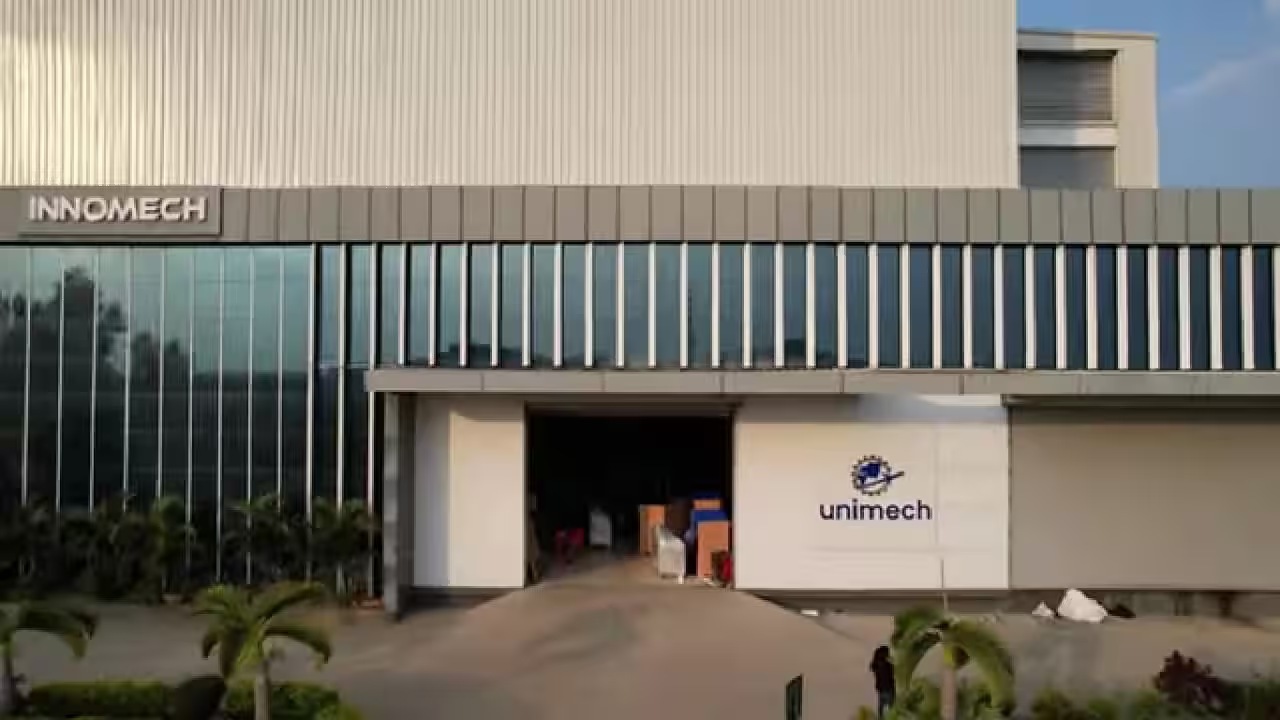
Welcome to Unimech Aerospace and Manufacturing Limited — a company incorporated in 2016, listed on NSE in Dec 2024, and by Feb 2026 already weathering geopolitical chaos like a startup founder on pitch day.
The business: they manufacture aero engine tooling, airframe tools, precision components, and mechanical assemblies for companies like Boeing, Airbus, GE, Rolls Royce, and Dassault. The problem: 95% export-dependent. The opportunity: $210 million order book, nuclear business scaling, Saudi Arabia JV launched, precision segment ramping. The cliff: U.S. tariffs at 50% (now dropped to 18% in Feb 2026) destroyed Q3 demand visibility. Revenue ₹33.7 Cr in Q3 vs ₹61 Cr in Q2. PAT ₹2.4 Cr vs ₹15.7 Cr. Gross margin still 71%, so the core machine still works.
Management says Q3 was a tariff-induced inventory correction. Let’s dig in with all the cynicism, math, and occasional sympathy that this deserves.
Feb 2026 Concall Highlights: “The softness was never structural.” “We received orders worth ₹1.2 million in the first week of February alone.” “FTWZ facility nearly complete; regulatory approvals expected this quarter.” — Management clearly invested in a good speechwriter.
03 — Business Model: Building Hammers For Hammer Builders
Tooling, Precision, Subsystems. And A Saudi Arabia Plot Twist.
Unimech manufactures complex aerospace tooling — think: ground support equipment, engine stands, airframe assembly platforms, and electromechanical subsystems. These are not widgets. A single engine stand can weigh tons and cost millions. The build-to-print, build-to-spec model means every customer need creates a new SKU (they manage 2,500+).
Revenue breakdown: roughly 77% aero tooling, 23% precision components & other segments (nuclear, semiconductors, power gen). The margins are fat — gross margin 68–71% even in bad quarters — because specialization = pricing power. Nobody else can deliver what they do, at the quality they do, with the certifications they have (ISO 9001:2015, ISO 45001:2018).
Geography mix: ~95% export (mostly North America ~92%, Germany ~5%, India ~3%). Two large customers (89% of revenue combined). This is the double-edged sword — predictable mega-contracts, but any tariff/geopolitical shock hits like a hammer to the forehead.
Capacity: ~1.66 lakh sq ft across two manufacturing units in Bengaluru. Installed capacity ~486,720 hours for aero tooling, 147,120 hours for precision parts. Utilization in Q3: dropped to 58–60% (from 90%+ pre-tariff). That’s why they’re sitting on ₹30 Cr in finished goods and ₹60–70 Cr of WIP. The machines didn’t forget how to work — demand just paused.
Export Revenue Mix~95%Concentration risk
Top 2 Customers~89%Customer exposure
Gross Margin68–71%Even in Q3
Wildcard Bet: They’re launching a Saudi Arabia JV with Yusuf Bin Ahmed Kanoo (Unimech 51%, Kanoo 49%). Investment: up to $30M phased over 3 years. Target: $30M revenue by year 5, with 35% EBITDA and 20% PAT margins. If this works, they’re no longer 95% export-to-US. If it doesn’t, it’s a $30M dead duck. Management’s appetite for capital deployment says they believe the tariff pain is temporary.
💬 Question: If you’re a ₹3,900 Cr company and 89% of revenue comes from 2 customers, do you lie awake at night? Or is it just called “enterprise sales”? Thoughts?
04 — Financials Overview
Q3 FY26: The Tariff Disaster That Became A Buy-The-Dip Moment
Result type: Quarterly Results | Q3 FY26 EPS: ₹0.47 | Annualised EPS (Q3×4): ₹1.88 | TTM EPS: ₹13.0
| Metric (₹ Cr) |
Q3 FY26
Dec 2025 |
Q3 FY25
Dec 2024 |
Q2 FY26
Sep 2025 |
YoY % |
QoQ % |
| Revenue | 33.72 | 53.90 | 62.99 | -37.4% | -46.5% |
| Operating Profit | 1.55 | 15.69 | 19.80 | -90.1% | -92.2% |
| OPM % | 4.6% | 29.1% | 31.4% | -2,450 bps | -2,680 bps |
| PAT | 2.39 | 15.57 | 15.67 | -84.6% | -84.8% |
| EPS (₹) | 0.47 | 3.06 | 3.08 | -84.6% | -84.8% |
The Real Story (Beyond The Headline Carnage): Revenue down 37% YoY. Gross margin stayed at 71% (so cost of goods didn’t bloat). But operating margin collapsed to 4.6% because depreciation (₹6.9 Cr due to new machines) and finance costs (₹1.6 Cr on working capital borrowings) didn’t scale down with revenue. They maintained full headcount and operational readiness, betting on a fast recovery. That’s a choice. A risky one if recovery takes 3 quarters instead of 1. But correct if tariffs were truly temporary (and Feb 2026 data suggests they were). P/E on TTM is 59.2x — expensive on a revenue-crashed basis, but cheap if normalcy returns and they earn ₹13 per share again.
05 — Valuation Discussion
Fair Value Range: When Tariff Dumpsters Meet Order Book Optimism
Method 1: P/E Based (Using TTM)
TTM EPS = ₹13.0 (pre-tariff normal run rate). Aerospace & defense peer median P/E ~45–55x (high-spec, long-cycle businesses). Unimech justifies 40–50x given 22% ROCE, 183% 3Y profit CAGR, and order book strength. Fair P/E band: 40x–50x.
Range: ₹520 – ₹650
Method 2: EV/EBITDA Based
TTM EBITDA ~₹67 Cr (assuming Q3 ₹1.55 Op Prof + ₹23 depreciation back-add). Current EV ~₹3,967 Cr → EV/EBITDA = 59.2x (!). Long-cycle industrial companies trade at 12–18x EV/EBITDA in normal times. If EBITDA normalizes to ₹150–180 Cr (post-tariff recovery, better utilization), EV/EBITDA should compress to 18–22x.
Fair EV (18x–22x EBITDA of ₹160 Cr): ₹2,880 – ₹3,520 Cr → Per share:
Range: ₹580 – ₹715
Method 3: DCF Based (Normalized Post-Tariff)
Base FCF assumption: FY27 revenue ₹300 Cr (beating FY26 aspirational ₹240 Cr, post-tariff recovery). PAT margin: 18% (normalized from 23% pre-tariff due to higher depreciation). FCF ₹45 Cr. Growth 8–10% for 5 years, terminal 3%. WACC 11%.
→ PV of 5-year FCFs: ~₹200 Cr
→ Terminal Value: ~₹2,800 Cr
→ Total EV: ~₹3,000 Cr (less debt ₹114 Cr)
Range: ₹520 – ₹600
Fair Min: ₹520
CMP: ₹772 | TTM P/E: 59.2x
Fair Max: ₹715
CMP ₹772
Fair Max ₹715
⚠️ EduInvesting Fair Value Range: ₹520 – ₹715. CMP ₹772 is trading above the fair value range on a normalized basis. The stock is pricing in not just tariff recovery, but also flawless nuclear execution, Saudi JV ramp, and semiconductor scale-up. This fair value range is for educational purposes only and is not investment advice. Please consult a SEBI-registered investment advisor before making any financial decision.
06 — What’s Cooking: Drama, Orders & Desperation
Record Order Book. Tariff Reset. FTWZ Pending. Everything Hinges On Feb’s Recovery.