01 — At a Glance
The IPO That Listed At ₹555. Now Trades At ₹512. Healthy.
- 52-Week High / Low₹799 / ₹481
- Q3 FY26 Revenue (₹ Cr)₹184
- Q3 FY26 PAT (₹ Cr)₹7.99
- Q3 FY26 EPS (₹)₹1.01
- Annualised EPS (Q3×4)₹4.04
- Stock P/E (Annualised)126.7x
- FY25 Full Year EPS₹1.81
- TTM Profit Growth+121%
- Debt / Equity0.18x
- Free Cash (₹ Cr)Negative
Auditor’s Red Alert: Capillary went public in November 2025 at ₹555. Stock now at ₹512 (−7.7% post-IPO). Listed with negative free cash flow, a P/E of 379x, and ROE of −14.6% over three years. The company insists 111% NRR proves it’s a SaaS unicorn. The balance sheet insists ₹100 crore in debt and declining equity value. One of them is lying. Spoiler: it’s the cheerleader narrative.
02 — Introduction
When IPO Hype Meets The Laws of Gravity (Physics, Not BSE)
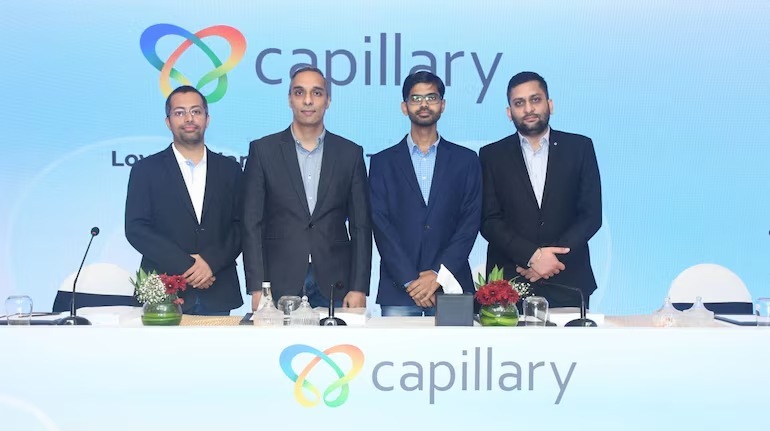
Capillary Technologies. Founded in Bangalore in 2012. Went global. Built a “cloud-native SaaS loyalty platform.” Got funded by Norwest, Microsoft, Cisco, and their cousins. Raised ₹877.5 crore in an IPO just three months ago at ₹555 per share. Market cap: ₹4,062 crore. Enterprise value: ₹3,948 crore. Revenue? ₹598 crore in FY25. PAT? ₹13 crore. Profit margins? A flat 2.2%.
Today’s stock price: ₹512. That’s below the IPO price. That’s what’s called a “warm welcome to public markets, you optimistic fool.”
The company swears it’s not broken. Management chants “111% Net Revenue Retention,” “Forrester Wave leader,” “20 Fortune 500 clients,” and “1.8 billion consumer profiles.” Every metric that sounds big. Conspicuously absent from the chanting: actual profitability, positive cash flow, or reasonable valuation multiples.
Q3 FY26 results dropped three weeks ago. Revenue up 16% YoY to ₹184 crore. EBITDA up 24% YoY to ₹30 crore at 16.4% margin. PAT… ₹7.99 crore. After three quarters of deliberate losses in FY25. The turnaround is real. The valuation is still insane. Let’s audit this.
Concall Intel (Feb 27, 2026): Management positioned itself as a “system of record”—like an ERP or banking ledger—not just campaign tooling. A “loyalty ledger” handling billions in live transactions. That’s strategic positioning, not fact. We’ll separate both by Q4.
03 — Business Model: What They Actually Sell
Loyalty Software. But Make It Feel Like You’re Building Enterprise Infrastructure.
Here’s the one-line version: Capillary sells software that manages customer loyalty programs. You’re Walmart India. You have 50 million loyal customers. Each buys things. Earns points. Redeems points. The math is complicated if you do it in Excel. So you pay Capillary to do it for you, 24/7, at “99.999% uptime,” for ₹X per year.
The product stack: Loyalty+ (the core ledger), Engage (marketing automation), Insights (analytics), Rewards (payout mechanics), and the new hotness: aiRA (an AI agent that writes campaigns and queries data without UI). Pricing: typically three-to-seven-year contracts, tied to “number of members” or “transactions” rather than seats or GMV. Translation: the more your customers use it, the more you pay.
Client base: 410 brands across 47 countries. ~115 enterprise customers (Tata Digital, ABFRL, Puma, Domino’s, Frontier Communications, some European banks). Revenue concentration: North America 56%, APAC 25%, EMEA 19%. Enterprise customers = 98.2% of revenue. One bad account = three-year-plan broken.
The moat? High switching costs (nine integrations per customer). Deep brand/ledger data. 1.8 billion consumer profiles on the platform. Network effects if you squint hard enough. The threat? Any mid-market SaaS vendor could pivot to loyalty. Any agency could hire developers and do it cheaper. And every customer is asking: “Why are we not building this ourselves?”
Revenue Mix98.2%Enterprise Share
Geographic56%North America
Brands Served410+Global
Transactions160K/hourPlatform Throughput
Concall Nuance: Management explicitly positioned this as “a system of record” — like how ERP is to transactions. Competing claim: they’re just another UI vendor in a mature space. Winning claim: integrations are so sticky that replacement friction is massive. Most likely truth: it’s a solid mid-market SaaS business priced like it invented software itself.
💬 Have you ever used a loyalty app? Did you know a SaaS startup owns the backend of that Points ledger? Sit with that for a minute.
04 — Financials Overview
Q3 FY26: The Plot Twist Nobody Expected
Result type: Quarterly Results | Q3 FY26 EPS: ₹1.01 | Annualised EPS (Q3×4): ₹4.04 | Full-year FY25 EPS: ₹1.81
| Metric (₹ Cr) |
Q3 FY26
Dec 2025 |
Q3 FY25
Dec 2024 |
Q2 FY26
Sep 2025 |
YoY % |
QoQ % |
| Revenue | 184.04 | 159.00 | 179.33 | +15.8% | +2.6% |
| Operating Profit | 24.98 | 22.96 | 18.65 | +8.8% | +33.9% |
| OPM % | 13.57% | 14.44% | 10.40% | -87 bps | +317 bps |
| PAT | 7.99 | 10.26 | 0.29 | -22.1% | 2650% |
| EPS (₹) | 1.01 | 1.40 | 0.04 | -27.9% | +2,425% |
The Gratuity Curveball: Q3 PAT fell 22% YoY despite 16% revenue growth. Why? One-time gratuity expense of ₹1.6 crore due to Direct Labour Code compliance. IPO expenses: ₹2 crore. Management claims: “Normalize for these and PAT is flat to Q3 FY25.” True. Misleading? Also true. The real issue: operating leverage is weak (OPM fell 87 bps YoY). That’s the story the cheerleaders won’t highlight.
05 — Valuation: Betting On Turnaround Hype
Three Methods To Convince Yourself You’re Not Insane
Method 1: P/E Based
FY25 EPS = ₹1.81. CMP = ₹512. Current P/E = 282.9x (insane). Forward annualised P/E (Q3×4 = ₹4.04) = 126.7x (still insane). SaaS peers trade at 25x–45x. Capillary is paying a “near-bankruptcy comeback” premium that would make a Bollywood script jealous.
Range: ₹150 – ₹250
Method 2: EV/EBITDA Based
Q3 EBITDA annualised (₹30 Cr × 4) = ₹120 Cr. Current EV = ₹3,948 Cr → EV/EBITDA = 32.9x. Quality SaaS trades at 12x–20x. Capillary is at 1.6x–2.7x the sector median. Even if EBITDA grows 30% annually, this premium melts in 2–3 years.
EV range (15x–25x EBITDA): ₹1,800 Cr – ₹3,000 Cr → Per share:
Range: ₹185 – ₹310
Method 3: DCF (Turnaround Scenario)
9M FY26 operating CF = ₹101 Cr. Annualised = ₹135 Cr (but management says 142% OCF/EBITDA is “anomaly”; sustainable ~105–110% suggests ~₹126 Cr). Growth: assume 18% (well below 30% SaaS standard). Terminal growth: 4%. WACC: 9% (lower risk now that they’re profitable).
→ PV of 5-year FCFs at 9%: ~₹700 Cr
→ Terminal Value (4% growth / 5% cap rate): ~₹3,400 Cr
→ Total EV: ~₹4,100 Cr (near current)
Range: ₹250 – ₹420
⚠️ EduInvesting Fair Value Range: ₹180 – ₹310. CMP ₹512 sits at the aggressive end of any reasonable scenario. This assumes continued 15%+ revenue growth, margin expansion to 15%+ EBITDA, and zero customer concentration risk. The DCF range (₹250–₹420) applies only if you believe the “system of record” narrative and ignore the negative three-year ROE. This fair value range is for educational purposes only and is not investment advice.
06 — What’s Cooking: The Acquisition Machine
M&A as a Growth Hack. Or a Debt Trap. Depends on Lunch Money.