01 — At a Glance
The Boxes That Took Forever To Make Money
- 52-Week High / Low₹147 / ₹92.2
- Q3 FY26 Revenue₹2,716 Cr
- Q3 FY26 PAT₹13.3 Cr (Reported)
- Adjusted PAT (Q3)₹24 Cr
- Full Year FY25 EPS-₹0.31
- Book Value₹44.2
- Price to Book2.33x
- Debt / Equity1.14x
- Net Leverage2.1x (FY25)
- Promoter Holding43.0%
The Cliff Notes Version: TVS Supply Chain Solutions reported Q3 FY26 revenue of ₹2,716 crore (+11.1% YoY), with adjusted EBITDA up 31.2% and adjusted PBT of ₹24 crore. Translation: They finally figured out how to make boxes profitable. Also, the previous CEO resigned. Then they hired another one. Then that one resigned too. Leadership meetings must have been thrilling.
02 — Introduction
The Supply Chain Company That Supply-Chained Its Own Profitability Away
TVS Supply Chain Solutions is what happens when you tell a logistics company: “Go acquire 20+ businesses across 26 countries, integrate them into a single profit-and-loss statement, and report quarterly without losing your mind.” Spoiler: they lost their mind. Then found it. Then lost it again.
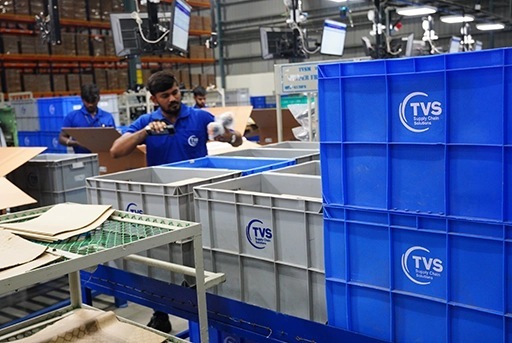
For the uninitiated: TVS SCS is a fully integrated supply chain management player. They handle everything. Warehousing. International freight. In-plant operations. Final-mile delivery. They ship boxes across the world like a hyper-ambitious Indian startup, except they’re actually profitable now — sort of — and they did acquisitions before it was cool.
For eight consecutive quarters before Q3, TVS SCS was either losing money or making margin so thin you could read the business plan through it. Q3 FY26 changes that narrative slightly. Not dramatically. Just slightly. Like, “We learned how to turn on the profitability machine” slightly.
In December 2025, they acquired Swamy & Sons (a ₹88 crore 3PL play) to deepen FMCG exposure. In January 2026, they appointed Vikas Chadha as Global CEO with Ravi Viswanathan (the MD) transitioning to retirement. Everything about this company screams “we’re finally getting our act together,” but the evidence is more “Q3 was one good quarter” than “structural turnaround underway.”
Concall Soundbite (Feb 2026): Management: “Project One savings are already visible in ISCS margin improvement.” Translation: We cut costs by exiting money-losing contracts and letting European staff go. It works!
03 — Business Model: The One Where They Ship Stuff Globally
55% Supply Chain Bliss. 45% Global Freight Chaos.
TVS Supply Chain has two main business lines, and they are as different as biryani and chai. First: Integrated Supply Chain Solutions (ISCS) — sourcing, procurement, warehousing, in-plant operations, finished goods, aftermarket logistics. Second: Global Forwarding Solutions (GFS) — ocean freight, air freight, final-mile delivery, all the stuff that gets hurt when global trade sneezes.
ISCS is growing, profitable-ish, and has fortress customer relationships (Fortune 500 clients averaging 10–14 years with them). GFS is the emotional rollercoaster: when freight rates are high, margins are glorious; when rates collapse (like the last two years), margins evaporate faster than your investment confidence.
They operate in 26 countries: India, UK, US, Spain, Germany, Singapore, Thailand, and more. Their customer base is 6,900+ customers strong, with 91 Fortune 500 clients now (up from 61 in FY22). No single customer exceeds 10% of revenue — which is both a strength and a sign that winning big deals is harder than it looks. They have over 459 warehouses and 25.5 million square feet of warehouse space. That’s a lot of real estate. Most of it leased. Asset-light business model, they claim. But debt-light? Not really.
ISCS Revenue55%Up from 40% (FY22)
GFS Revenue45%Down from 60% (FY22)
Fortune 500 Clients91Up from 61 (FY22)
Global Customers6,900+Highly diversified
The Business Model Unpacked: Asset-light means they lease warehouses instead of owning them. The advantage? Flexibility. The disadvantage? They’re paying rent to landlords while trying to convince investors they’re capital-efficient. It’s like bragging about your low credit utilisation while maxing out your EMIs.
💬 Drop a comment: Would you invest in a company that says “asset-light” but has 2.1x net leverage? Asking for a stressed CFO.
04 — Financials Overview
Q3 FY26: Finally, A Heartbeat
Result type: Quarterly Results | Q3 FY26 EPS: ₹0.24 (Reported) | Annualised EPS (Q3×4): ₹0.96 | FY25 Full-Year EPS: -₹0.31
| Metric (₹ Cr) |
Q3 FY26
Dec 2025 |
Q3 FY25
Dec 2024 |
Q2 FY26
Sep 2025 |
YoY % |
QoQ % |
| Revenue | 2,716 | 2,445 | 2,663 | +11.1% | +2.0% |
| Operating Profit (EBITDA) | 206 | 151 | 182 | +36.4% | +13.2% |
| EBITDA Margin % | 7.6% | 6.2% | 6.8% | +140 bps | +80 bps |
| PAT (Reported) | 11.3 | -24 | 16 | NM | -29.4% |
| PAT (Adjusted)* | 24 | -16 | ~20 | NM | +20% |
| EPS (₹) | 0.24 | -0.56 | 0.35 | NM | -31.4% |
Adjusted PBT Explained: CFO clarified in the Feb 2026 concall: “Adjusted PBT ₹24 cr vs loss ₹16 cr last year; reported PBT ₹16 cr after exceptional cost ₹9.1 cr (labor codes impact).” In other words, there’s a one-time labour code impact of ₹9.1 crore that made reported profit look worse than adjusted profit. Strip it out, and margins are expanding. Include it, and the narrative gets murkier. Welcome to CFO theatre.
05 — Valuation: The Fair Value Guessing Game
What’s This Logistical Mess Actually Worth?