01 — At a Glance
The Bauxite Bazar: Digging for Treasure, Finding Lawyers
- 52-Week High / Low₹925 / ₹316
- Q3 FY26 Revenue₹960 Cr
- Q3 FY26 PAT₹76.3 Cr
- Annualised EPS (Q3×4)₹35.3
- Full-Year TTM EPS₹39.5
- Book Value₹149
- Price to Book3.3x
- Debt / Equity0.86x
- Return on Equity (TTM)27.1%
- Promoter Holding47.88%
The Honest Disclaimer: Ashapura Minechem crushed it in 9M FY26: ₹3,268 crore revenue (+50% YoY), ₹303 crore PBT (+37% YoY), and a TTM EPS of ₹39.5 giving a P/E of 12.2x—literally cheaper than the sector median of 14.9x. Also crushing it: the CBI, which filed cases in Oct 2024 and found the company guilty of smuggling and tax fraud in Oct 2024. The stock decided to dive -34% in 3 months anyway. When crime pays more than stock price appreciation, you know something’s off. That something is Guinea bauxite pricing, margin compression, and the law. Also liquidity. Let’s dissect.
02 — Introduction
Ashapura Minechem: The Mineral Monopoly Nobody Asked For
Ashapura Minechem Ltd is a specialized mining company that sells minerals—bentonite, bauxite, kaolin, bleaching earth, and a dozen other industrial inputs that nobody has heard of but everyone relies on. World’s 3rd largest bentonite producer. World’s 3rd largest bleaching clay producer. India’s largest refractory materials producer. And by far the largest beneficiary of the global bauxite market’s recent “reset.”
The company went public in 1982 and has spent 40+ years digging holes across India, Guinea, and Oman. The business is straightforward: mine minerals, process them, sell them. Boring? Absolutely. Profitable? Very much. The company has generated ROCE of 18–20% for years, maintains a 27% ROE, and—until recently—was the boring stability play every portfolio needed.
Then Q1 FY26 hit with bauxite volumes exploding out of Guinea (₹1,356 crore, +90% QoQ, +100% YoY), profits jumped to the moon, and everyone started calling it the next 100-bagger. The stock went from ₹316 to ₹925 in 11 months. Absolutely insane. Then Q2 and Q3 revealed the Achilles heel: bauxite prices are collapsing faster than your portfolio after an election result. Guinea volumes are constrained by logistics. India business is soft. And the CBI is very interested in the company’s past, having charged it with smuggling and tax evasion in 2024.
This is not a growth story. This is a commodity trading business masquerading as a mining company, run by a promoter under legal fire, trying to convince you that Guinea is the future while margin compression is the present.
February 2026 Concall Highlight: “Remarkable improvement in our EBITDA margin” despite volumes missing and prices falling. Translation: No demurrage costs and cheaper China Railway logistics saved the quarter. Priced in yet? No.
03 — Business Model: WTF Are They Mining?
They Dig Holes. Sell What’s Inside. Hope Nobody Sues.
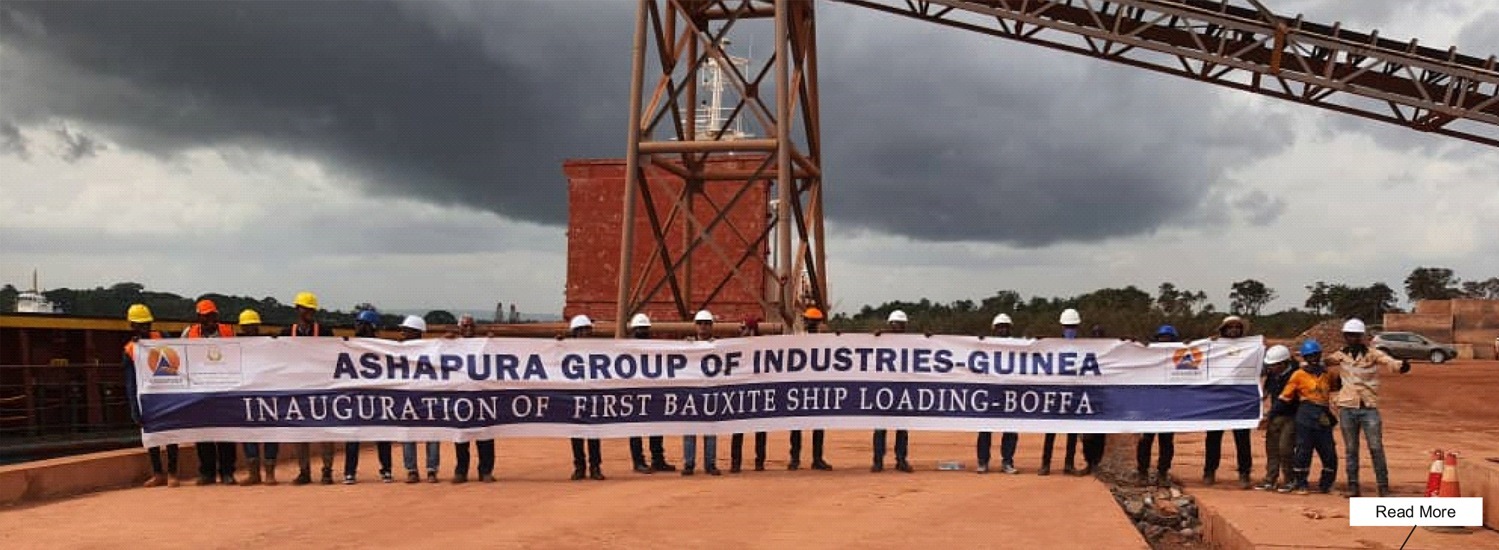
Ashapura is a multi-mineral specialist. The company operates in two distinct geographies: India and Guinea. India contributes ~24% of revenue and is a cash cow of stable, lower-margin mineral sales (bentonite, kaolin, bleaching earth). Guinea is the new star, suddenly accounting for ~76% of revenue, because bauxite volumes exploded in FY25-FY26 from a new mining concession that was finally permitted by Guinea’s government.
Bauxite is the raw ore for aluminum production. It’s bulk commodity—low value per unit, high freight costs, heavily influenced by China’s aluminum production cycle. Ashapura extracted bauxite from Guinea Boffa concession at approximately $60–70 CIF China in Q3, sold it at spot prices to Chinese smelters, pocketed the spread (estimated EBITDA of ~$10/ton in Q3), and hoped nobody cancelled orders.
The business works like this: Mining cost = ~$2–3 per ton. Ocean freight = ~$25 per ton. Port handling, duties, taxes = ~$5 per ton. Total cost to China = ~$55–60 per ton. Sell at $70, you make $10 EBITDA per ton. Sell at $61, you make $1 EBITDA per ton. Sell at $52, you’re reconsidering your entire Guinea strategy. Currently, bauxite is trading around $60–61 CIF, which management described as potentially a “new normal.” That’s not a moat. That’s a margin squeeze wearing a moat costume.
Guinea Revenue76%Bauxite
India Revenue24%Multi-Mineral
Export Share53%All Revenue
Capacity Target15 MTBy FY28
Capital Efficiency Note: Management says “most capex is completed” in Guinea and only “20–25% more capex” is needed over the next 12–18 months. Translation: You’re near peak capacity, future returns will come from working capital, not growth capex. Lower growth, not higher.
💬 If bauxite at $52 makes you reconsider Guinea, and current price is $60–61, how much downside before the business model breaks? This is the question nobody’s asking.
04 — Financials Overview
Q3 FY26: The Volume Trap
Result type: Quarterly Results (Q3 FY26) | 9M FY26 EPS: ₹30.43 | Annualised Q3 EPS (Q3×4): ₹35.28 | TTM EPS: ₹39.48
| Metric (₹ Cr) |
Q3 FY26
Dec 2025 |
Q3 FY25
Dec 2024 |
Q2 FY26
Sep 2025 |
YoY % |
QoQ % |
| Revenue | 960 | 865 | 952 | +11.0% | +0.8% |
| Operating Profit | 114 | 135 | 131 | -15.6% | -13.0% |
| OPM % | 12% | 16% | 14% | -400 bps | -200 bps |
| PAT | 76 | 108 | 106 | -29.6% | -28.3% |
| EPS (₹) | 8.82 | 11.04 | 10.11 | -20.1% | -12.8% |
The Real Story: Revenue up 11% YoY (₹960 Cr vs ₹865 Cr) but PAT down 30% YoY (₹76 Cr vs ₹108 Cr). This is margin compression in action. Q3 OPM collapsed to 12% from 16% in Q3 FY25. Management blamed “prolonged monsoon in Guinea” and lower bauxite pricing. But here’s the math: Guinea volumes were 729 crore of the 960 crore revenue, meaning India was ~231 crore. That’s a soft India business mixed with lower-priced Guinea bauxite. The “remarkable improvement in EBITDA margin” QoQ (+100 bps) was entirely due to demurrage reduction and China Railway logistics savings, not operational excellence.
05 — Valuation Discussion
What’s This Commodity Trading Company Actually Worth?