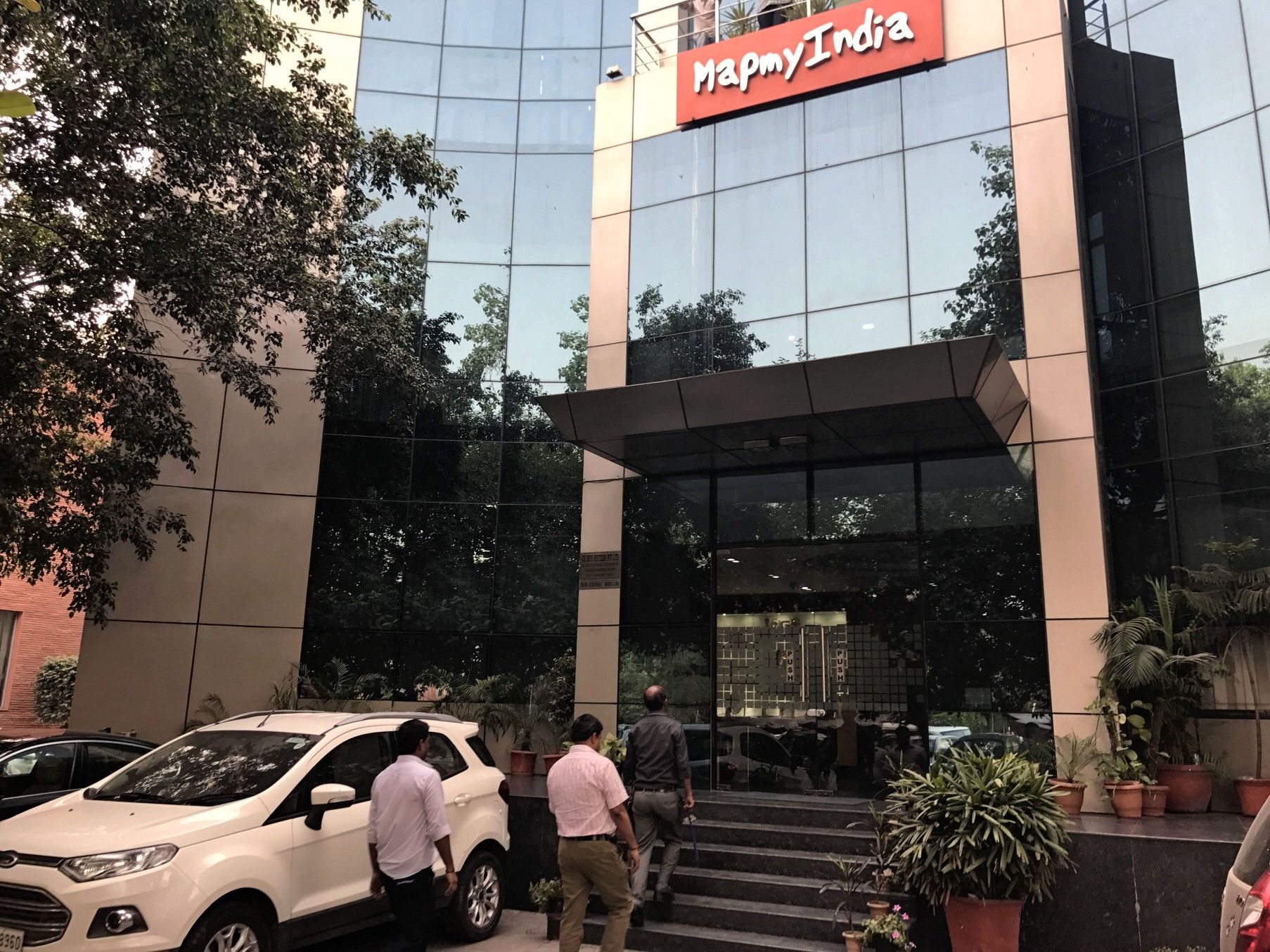
01 — At a Glance
The Mapping Company That Forgot How to Deliver
- 52-Week High / Low₹2,167 / ₹877
- Q3 Revenue₹93.7 Cr
- Q3 PAT₹18.8 Cr
- Q3 EPS₹3.43
- Annualised EPS (Q3×4)₹13.72
- Book Value₹152
- Price to Book5.81x
- Dividend Yield0.39%
- Debt / Equity0.01x
- Open Order Book₹1,770 Cr
The Brutal Audit Summary: MapmyIndia closed Q3 FY26 with ₹94 Cr revenue (-18% YoY), ₹19 Cr PAT (-42% YoY), and an open order book of ₹1,770 Cr sitting in management’s pocket. The math is there. The execution is not. Stock down 46% in one year. Investors confused. Government projects getting “delayed delivery from our side to the customers in Q3… in accordance with customers’ requests.” Translation: we promised by December. We didn’t ship. They said okay. We’ll do it later. A very Indian corporate solution to a very Indian government problem.
02 — Introduction
Welcome to the Company That Mapped India, Then Lost Itself
MapmyIndia. The company that convinced India it needed digital maps before Google Maps arrived and made everyone forget they existed. Incorporated in 1995, when “the internet” was still something your friend’s cousin in Bangalore could explain if you listened long enough. Early mover. Market leader. 80% market share in embedded navigation for auto OEMs. Sounds good.
Then Q3 FY26 happened, and suddenly the P&L looked like the map of India after Partition — divided, confused, and bleeding.
Revenue declined 18% YoY. PAT collapsed 42% YoY. The CFO went on the earnings call and explained it wasn’t bad execution—it was customers delaying their own projects. The stock fell 46% in a year. The order book swelled to ₹1,770 crore. Wall Street called it a “timing issue.” Retail investors called it a scam. Management called it “strong fundamentals with near-term visibility challenges.” We’re calling it what it is: a company caught between a government that’s always five quarters behind schedule and a market that’s lost patience with excuses.
The data centre angle is real. The IoT strategy is sound. The automotive moat is there. But when you’re down 46% and management is still saying “the order book is strong,” investors start wondering if the order book is actually a trophy or a tombstone.
Concall Reality (Feb 2026): Management: “Q3 was a weak quarter… primarily due to delayed delivery from our side to the customers.” Investor: “So you underperformed?” Management: “In accordance with customers’ requests.” Translation: we can’t admit failure without sounding incompetent.
03 — Business Model: WTF Do They Even Do?
Digitally Map the Whole Country. Collect ₹94 Cr a Quarter. Simple.
MapmyIndia’s business model is elegant. It’s also been beaten to death by Google, disrupted by free alternatives, and is now fighting a government procurement process that moves slower than a VPN connection on a Delhi railway station WiFi.
They do three things: Maps, Platforms, and IoT. Maps is 60% of revenue—digital representations of India’s 6.5 million km of roads, 70 million points of interest, and ~23 million building addresses. PhonePe uses it. Hyundai uses it. Even Flipkart uses it to figure out where to deliver your package to the wrong house. The 80% market share in auto OEM embedded navigation is the crown jewel—every Hyundai, Kia, and soon-to-be-electric-vehicle needs MapmyIndia’s maps to not drive you off a cliff.
Platforms (Mappls, APIs, GIS software) is the second basket—location-based SaaS for enterprises, governments, and developers. Then there’s IoT: fleet management, workforce automation, smart city solutions. A ₹25 crore investment in Zepto for quick commerce last year tells you management is desperate to find the next growth vector.
The model works when customers actually pay and take delivery on time. The model breaks when government projects get delayed by elections, grant funding timelines, and bureaucratic approval cycles—which, in India, is most of the time.
Auto OEMs80%Nav Share
IoT Revenue~35%9M FY26
Customer Base1,000+Enterprise
Road Coverage6.5 Mn KmIndia
OEM Love is Real, Billing is Not: When Hyundai launches a new vehicle, MapmyIndia’s maps are inside day one. Scale feels assured. Revenue shows up… eventually. Government projects with “central funded schemes” are their kryptonite—cash disbursement depends on state execution capacity and political will, neither of which respect quarterly balance sheets.
💬 If Google Maps is free and infinitely better, why would any enterprise pay for MapmyIndia? Drop your answer—management definitely wants to know too.
04 — Financials Overview
Q3 FY26: The Numbers That Haunt Management
Result type: Quarterly Results | Q3 FY26 EPS: ₹3.43 | Annualised EPS (Q3×4): ₹13.72 | FY25 Full-Year EPS: ₹24.21
| Metric (₹ Cr) |
Q3 FY26
Dec 2025 |
Q3 FY25
Dec 2024 |
Q2 FY26
Sep 2025 |
YoY % |
QoQ % |
| Revenue | 93.7 | 114 | 114 | -18.2% | -17.8% |
| Operating Profit | 25 | 26 | 26 | -4.2% | -5.1% |
| OPM % | 26% | 23% | 23% | +300 bps | +300 bps |
| PAT | 18.8 | 19 | 19 | -42.1% | -42.8% |
| EPS (₹) | 3.43 | 5.96 | 3.38 | -42.1% | +1.5% |
The OPM Story They Want You to Ignore: Operating margins expanded to 26% from 23% YoY. This is management’s way of saying “look, we’re more efficient even though we’re selling less.” It’s technically true. It’s also meaningless when you’re not delivering. Blame the invoice for 60–70% of the Q3 government decline to “delays in Maharashtra and Bihar due to urban state elections.” Translation: voters were voting, not approving map projects. Fair point, actually.
05 — Valuation: Fair Value Range
What’s This Company Worth When It Can’t Execute?