01 — At a Glance
The Sugar Company That Lost Its Sweet Spot (And Its Net Worth)
- Q3 FY26 (Dec 2025) Revenue₹2,273 Cr
- Q3 FY26 PAT₹-38 Cr
- 9M FY26 Loss-₹7,191 Cr
- Full-Year EPS (CY25)₹-2.72
- YoY Quarterly Var+81.2% (Loss Reduced)
- Net Worth₹-253 Cr
- Book Value Per Share₹-10.9
- Total Debt (Sep 2025)₹6,266 Cr
- Debt / EquityNegative
- 52-Week Range₹35.8 / ₹22.8
The Situation: Shree Renuka Sugars is operating in a financially precarious state. Negative equity of ₹-253 crores as of Sep 2025. The company is technically insolvent on a standalone basis — meaning shareholders’ capital has been wiped out by accumulated losses. Yet the company is rated IND A by India Ratings because Wilmar (62.5% promoter) keeps throwing cash at it like an uncle with a drinking problem throwing cash at his nephew’s bad business ideas. Expect more restructuring, more forex volatility, and more parent support. The math is grim. The parent’s commitment is inexplicable. Welcome to sugar industry finance.
02 — Introduction
The Sugar Mill Where Lemons Are Turned Into… More Lemons
Shree Renuka Sugars Limited is an integrated sugar producer — meaning it crushes cane, refines sugar, makes ethanol (ethyl alcohol for fuel blending), generates power, and provides heartburn to shareholders in equal measure.
The company operates eight sugar mills in Karnataka, two refineries in Gujarat and West Bengal, distillery capacity of 1,250 KLPD, and 259 MW of cogeneration power. On paper, it sounds like a diversified renewable energy play during India’s ethanol blending revolution. In practice, it’s a company drowning in ₹6,266 crore of debt, with negative equity, forex losses, and a 9M cumulative loss of ₹7,191 crores that would make even the most optimistic analyst question their career choices.
The saviour: Wilmar International Limited, a Singapore-listed commodity trading and oleochemical giant, which owns 62.5% and keeps providing liquidity support through trade payables, extended credit on raw sugar, and external commercial borrowings (ECBs) that are guaranteed by the parent. Without Wilmar, SRSL would have defaulted three refinancings ago.
The latest drama: In March 2025, India Ratings revised the outlook on SRSL’s debt to Negative from Stable — signalling that the company’s credit profile is deteriorating and could face further downgrades if EBITDA doesn’t improve and debt doesn’t reduce. The company posted a Q3 FY26 loss of ₹-38 crores, down from ₹-204 crores in Q3 FY25 — meaning losses are reducing, but profits remain mythical.
Auditor’s Opening Note: SRSL is trading at 0.54x Price-to-Sales, a 73% discount to market cap relative to its sales base. The stock delivered a -13.1% return over one year. Wilmar shares Bordeaux châteaux with this equity base, while publicly committing to support. That mismatch is the entire story.
03 — Business Model: WTF Do They Even Do?
They Make Sugar. They Make Ethanol. They Make Losses. That’s The Model.
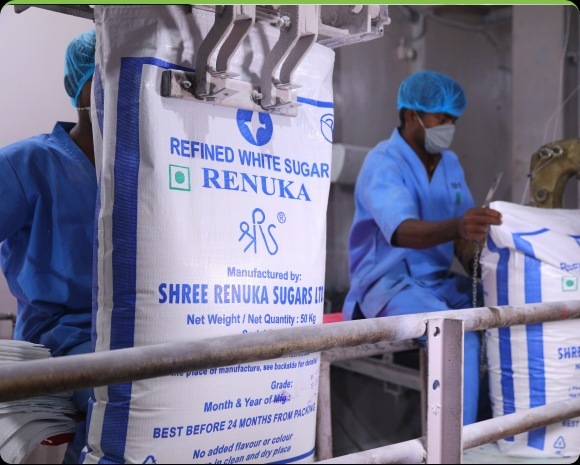
SRSL operates three interconnected businesses. Milling: Crush sugarcane, produce raw sugar, send to refineries or sell as commodity (22% of revenue in Q1 FY25, down from 32% in FY22). Refining: Import raw sugar from global suppliers (including Wilmar itself), refine it, and sell packaged refined sugar domestically and globally. This segment now dominates at 70% of revenue, up from 44% in FY22. Distillery: Produce ethanol from molasses and cane juice for blending into petrol — government mandated, fuel-grade ethanol (4% of revenue). Cogeneration: Use bagasse (cane residue) and coal to generate power, sell to state grids.
The “flagship brand Madhur” claims 30% of India’s branded sugar market by volumes — supposedly a margin-accretive moat. Except branded sugar sales fell to 30% of total sales in 9M FY25 from 38% in FY24, because volumes are under pressure and refinery spreads (the margin on importing and refining raw sugar) are the only thing keeping the company’s profitability breathing.
Here’s the problem: Refinery spreads are volatile. In January 2025, they crashed to USD 100/mt. By March 2025, they recovered to USD 120/mt. SRSL’s entire earnings narrative depends on this random dance of international commodity prices. Meanwhile, sugarcane prices keep rising (Fair and Remunerative Price (FRP) increased 8% yoy to ₹340/quintal for SS25), cane availability is patchy, and government policy chooses winners and losers on a whim.
Milling Revenue22%Q1 FY25 Mix
Refining Revenue70%Margin Driver
Ethanol + Cogen8%Emerging Opportunity
Why The Refinery Gamble? When you’re losing money on domestic milling (low cane supply, high cane costs, regulated sugar prices), the only way to survive is to become a refinery business. SRSL acquired Anamika Sugar Mills in October 2023 for ₹345 crores to expand refining capacity and access fresh sugarcane in Uttar Pradesh. The strategy: exit pure milling, become a commodity refiner, and compete on spreads. Risky, capital-intensive, and entirely dependent on parent support for working capital. Classic.
💬 If you owned a sugar mill and couldn’t make money from sugar anymore, would you add refinery capacity or diversify entirely? Drop your thoughts!
04 — Financials Overview
Q3 FY26: The Numbers That Make Auditors Weep
Result type: Quarterly Results | Q3 FY26 EPS: ₹-0.18 | Annualised EPS: ₹-0.72 | Full-year FY25 EPS: ₹-1.41
| Metric (₹ Cr) |
Q3 FY26
Dec 2025 |
Q3 FY25
Dec 2024 |
Q2 FY26
Sep 2025 |
YoY % |
QoQ % |
| Revenue | 2,273 | 2,603 | 2,423 | -12.7% | -6.2% |
| Operating Profit | 249 | -2 | -182 | NM | NM |
| OPM % | 11% | -0% | -8% | +1,100 bps | +1,900 bps |
| PAT | -38 | -204 | -369 | +81.2% | +89.7% |
| EPS (₹) | -0.18 | -0.96 | -1.73 | +81.2% | +89.6% |
Translation: Revenue fell 12.7% YoY because cane crushing declined and ethanol sales tanked (syrup-based ethanol sales rose to 45 Mn litres in 9M FY25, but total ethanol production is still lower than two years ago due to government restrictions). Operating profit, however, improved dramatically — 11% OPM in Q3 FY26 vs negative in Q3 FY25 — because refinery spreads were healthier and SRSL benefited from lower ethanol production costs. But PAT loss reduced by 81% YoY — still negative, but less negative. The company is loss-reducing, not profit-expanding. The math of incremental improvement in a negative equity base is what keeps Wilmar’s commitment on life support.
05 — Valuation: When Book Value Goes Negative
Fair Value = We Honestly Don’t Know Anymore