01 — At a Glance
The Company That Sold Dreams. Then Woke Up to Gravity.
- IPO Listed (Dec 12, 2025)₹224
- 52-Week High / Low₹224 / ₹154
- Q3 FY26 Revenue (Highest Ever)₹4,213 Mn
- Q3 FY26 PAT₹319 Mn
- Q3 EPS (Annualised Q3×4)₹3.88
- 9M FY26 Revenue₹11,453 Mn
- 9M FY26 PAT₹674 Mn
- IPO Raise (Dec 2025)₹1,289 Cr
- Investable Cash (Dec 31, 2025)₹889 Cr
- Return from IPO Price-30.8%
Reality Check: A company lists at ₹224, promises “highest ever quarterly revenue,” and within 3 months drops 31%. The stock market is an emotional pendulum operated by algorithms that have the attention span of a goldfish. Q3 had record revenue (₹421 Mn), yet the stock tanked because investors realized that (a) PAT margin is only 7.6%, and (b) the founder is still learning how to spell “profitability.” Oh wait — the PAT includes ₹39.3 Mn from Labour Code changes. Strip that out, and the true run-rate PAT is more like ₹280 Mn. That’s a 6.6% margin. Welcome to adjusted reality.
02 — Introduction
The D2C Mattress Play: Where India’s Founders Go to Sleep on Spreadsheets
Wakefit Innovations Limited is a D2C (Direct-to-Consumer) home and sleep solutions company incorporated in 2016. They sell mattresses (61% of revenue), furniture (29%), and furnishings (10%). The thesis: vertical integration, jargon-heavy management speak, and a bet that 1.4 billion Indians can be convinced to buy a mattress online without lying on it first.
IPO-ed in December 2025 at ₹224/share. Raised ₹1,289 crore. Now trades at ₹155. Down 30.8% in 3 months — a velocity that would make free-falling objects jealous. Management says Q3 was “timing-distorted” due to GST changes and festive season shifts. Translation: our growth model works perfectly except when it doesn’t, which is every quarter.
They claim “well under 1%” of India’s home and furnishings market. Do the math: if they’re doing ₹11,453 Mn in 9 months, that means the total market is north of ₹1.2 trillion per annum. Good news: ocean. Bad news: their kayak is leaking.
The concall (Feb 11, 2026) was notably quiet on unit economics. Management threw around percentages (“35% repeat customer ratio,” “EBITDA margin 14%”) like confetti at a wedding, but said zero about customer acquisition cost, lifetime value, or why the stock deserves to trade anywhere above a mattress discount code.
Founder Ankit Garg’s Moonlight Plan (Feb Concall): “We expect store opening rate to be 50% higher next fiscal.” Translation: ₹889 Cr of IPO cash is begging to be deployed. Retail real estate in Tier 1 cities is expensive. Math is hard. Press the expansion button anyway.
03 — Business Model: WTF Do They Even Do?
Vertical Integration Bingo: When a Founder Builds Everything Except Demand
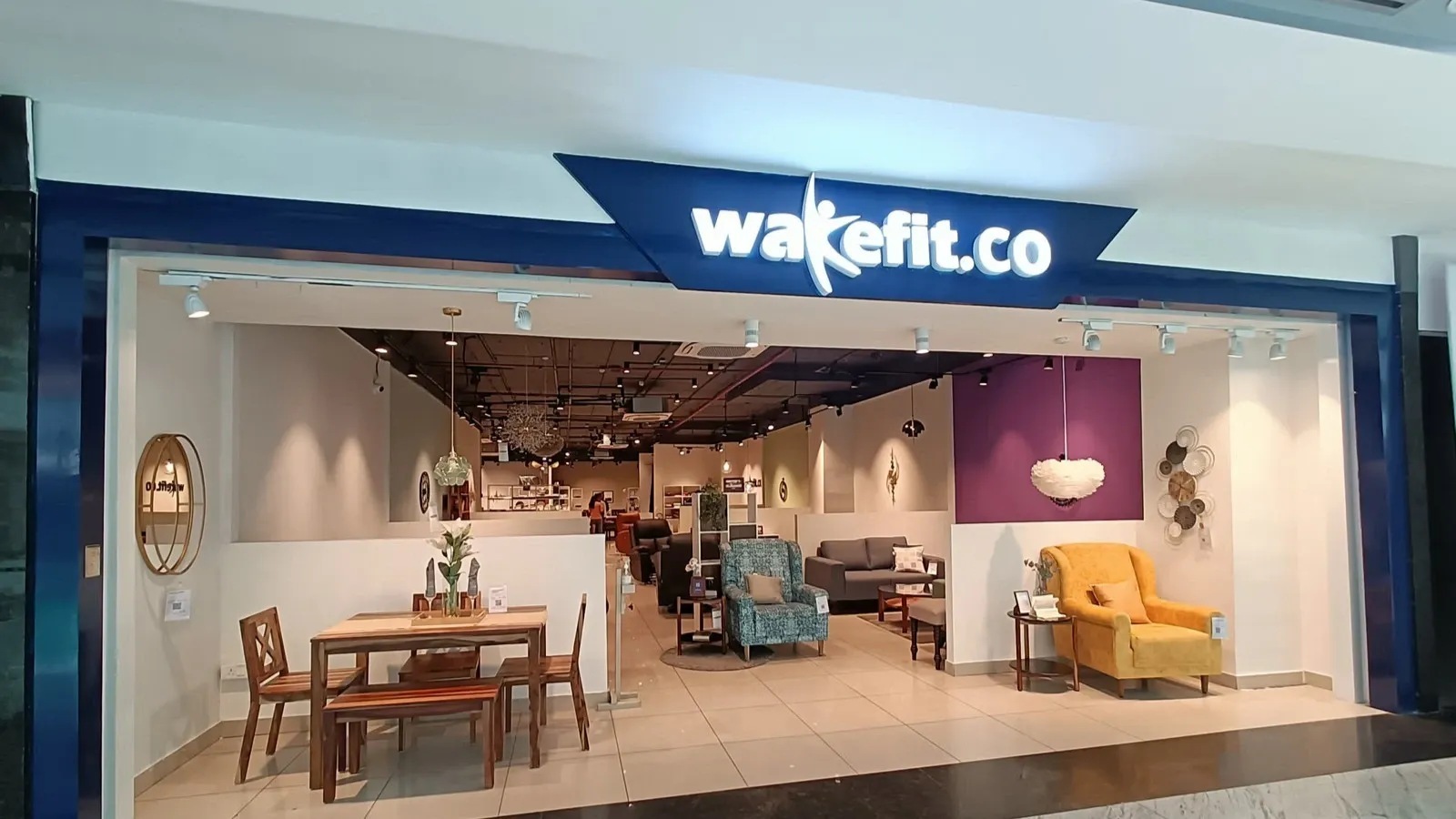
Wakefit claims “full-stack vertical integration.” They design in-house (CAD/CAM systems), manufacture at five facilities in Karnataka, Tamil Nadu, and Haryana, and distribute via three channels: owned website, COCO stores (137 as of Dec 2025), and MBOs (1,700 stores). Working capital model: furniture runs on “confirmed order” basis. No orders = no production = no inventory. Brilliant, except when nobody orders furniture because they’re waiting for the next 50% sale.
Market position: “Early double digits” share in organized mattress market. Specific number? Management said “we can’t quantify it because lack of frequent industry reports.” Translation: we don’t actually know our share. It could be 8%. It could be 15%. We’re vibing. COCO stores contribute “64.7% of 9M revenue”; MBOs and online contribute the rest. COCO same-store sales growth: “above 20%.” Definitely. Not in mattresses though — they declined festively.
Manufacturing capacity: 0.64 million units for mattresses, 0.33 million for furniture, 1.59 million for furnishings. Utilization rate: 28.89% for mattresses as of Mar 2024. Translation: they built a factory that’s 70% empty, and they’re celebrating the 30% they’re using. Magnificent.
Revenue MixMattresses61.3% (9M)
Revenue MixFurniture29% (9M)
Revenue MixFurnishings9.7% (9M)
Store Count (Dec)137 COCO+1,700 MBOs
The Vertical Integration Paradox: Wakefit controls everything — R&D, manufacturing, supply chain, distribution. Yet they can’t control the one thing that matters: customers who actually show up. Management’s Feb concall revealed that “repeat customer contribution is 35%.” Which means 65% are one-time buyers. In FMCG terms, that’s a retention rate so low it makes Maggi look like a loyalty brand.
💬 Have you ever bought a mattress online without lying on it? If not, how many people did Wakefit’s founder think do that when he designed his distribution model?
04 — Financials Overview
Q3 FY26: The Numbers That Explain The Stock Fall
Result type: Quarterly Results | Q3 FY26 EPS: ₹3.88 annualised | 9M FY26 PAT: ₹674 Mn | IPO Price: ₹224 | CMP: ₹155
| Metric (₹ Mn) |
Q3 FY26
Dec 2025 |
Q3 FY25
Dec 2024 |
Q2 FY26
Sep 2025 |
YoY % |
QoQ % |
| Revenue | 4,213 | 3,854 | 3,776 | +9.4% | +11.6% |
| Operating Profit (excl. lease) | 592 | 296 | 414 | +100% | +43% |
| OPM % (excl. lease) | 14.0% | 7.7% | 11.0% | +630 bps | +300 bps |
| PAT | 319 | 32 | 163 | +895% | +96% |
| EPS (₹) – Annualised | 3.88 | 0.39 | 1.98 | +895% | +96% |
The Fine Print Magic Show: Q3 PAT jumped 895% YoY, but ₹39.3 Mn came from Labour Code changes (one-time benefit) and ₹10.1 Mn from IPO cost reversals. Strip those out: Q3 PAT is really ₹269.6 Mn, or a 6.4% margin. The EBITDA of ₹592 Mn is “operating EBITDA” which excludes Ind AS lease impacts (₹230 Mn of rental depreciation). Translation: if you add back the cost of renting 137 stores, the true EBITDA is more like ₹362 Mn, or 8.6%. Still, it’s better than last year’s 7.7%. Management calls this “doubled YoY.” Technically true if you use magic accounting. Investors prefer base-case math.
05 — Valuation: The Cliff Nobody’s Talking About
Fair Value Range: Between “Expensive IPO” and “Waiting for Chapter 11”