01 — At a Glance
The Mixer That’s Been Getting Rained On (Literally & Figuratively)
- 52-Week High / Low₹757 / ₹451
- Latest Quarter Revenue (Q3 FY26)₹434 Cr
- Q3 FY26 PAT₹38.2 Cr
- Q3 EPS (₹)₹3.34
- Annualised EPS (Q3×4)₹13.36
- Book Value₹109
- Price to Book4.37x
- Dividend Yield0.00%
- Debt / EquityNegligible
- 9M FY26 Revenue₹1,345 Cr
The Brutal Summary: Ajax Engineering is India’s concrete equipment king with ~70% market share in self-loading mixers — a business as mission-critical as oxygen to construction. Yet, Q3 FY26 revenue crashed 21% YoY to ₹434 crore, PAT plummeted 40%, and the stock has returned -22% in one year. Why? Monsoon chaos, emission norm transitions that caught contractors by surprise, and government payment delays that left contractors with empty wallets and Ajax with empty order books. The “transition period” continues into Q4. Management remains, charitably, optimistic.
02 — Introduction
The Concrete Jungle Gets Real
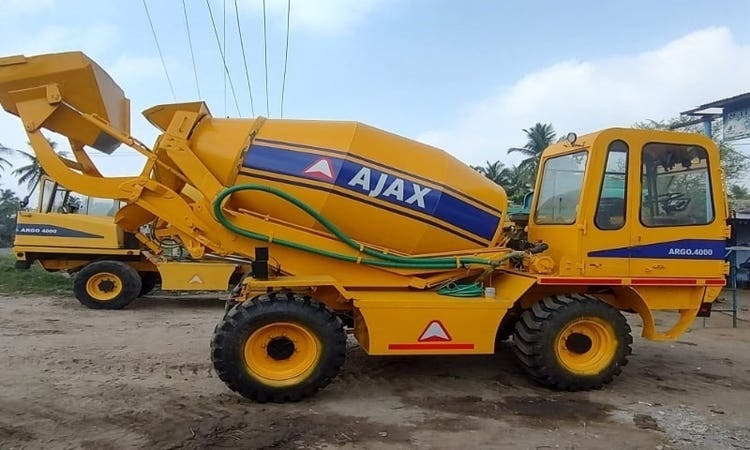
Once upon a time, there was a company called Ajax Engineering. Founded in 1992, it became India’s undisputed king of self-loading concrete mixers — those big yellow trucks that show up on construction sites, mix concrete, and dispense it without needing a separate batching plant. Genius invention. Everyone in construction loves them. The government loves them. The company’s 70% market share is proof.
For 30 years, Ajax printed money. Double-digit revenue growth. Fortress balance sheet. Almost zero debt. Then Q3 FY26 arrived, and someone forgot to tell the monsoon gods that the company wanted profitable quarters. Unseasonal rainfall ravaged project execution across India. Contractors, who had taken on new work orders, suddenly couldn’t execute because their sites were waterlogged. They delayed accepting equipment. Orders evaporated.
Simultaneously, new CEV-5 (Bharat Stage) emission norms kicked in on January 1, 2025. Equipment that met CEV-4 standards became instantly obsolete for new sales. Ajax had the new machines ready. Buyers didn’t. They held back, uncertain of pricing. And the cherry on top? State governments in Karnataka, Maharashtra, Telangana, and Rajasthan delayed contractor payments, which meant contractors couldn’t afford to take on new work because they weren’t getting paid for old work. Classic India.
The management’s Feb 2026 earnings call was brutally honest: “extended monsoon conditions, changes in the emission norms, slower pace of project execution, and cash flow constraints faced by our customers.” That’s four horsemen of business apocalypse in one sentence. And yet, Ajax’s balance sheet is so clean, so fortress-like, that even a 40% profit decline doesn’t threaten the company’s long-term viability. It just hurts like hell in the short term.
Concall Reality Check (Feb 2026): “Secondary sales remained healthy… indicating sustained underlying demand.” Translation: Retail demand is fine. Contractors just can’t pay because governments haven’t paid them. Nothing a good monsoon and faster project execution won’t fix. Assuming both things happen. In India. Simultaneously. So… by 2027?
03 — Business Model: WTF Do They Even Do?
They Make Trucks That Mix Concrete. Miraculous? No. Mandatory? Absolutely.
Ajax manufactures concrete equipment across the entire value chain: self-loading concrete mixers (SLCMs), batching plants, transit mixers, boom pumps, concrete pumps, slip-form pavers, and even 3D concrete printers. The flagship product is the SLCM — essentially a truck that carries dry materials, water, and a mixing drum, eliminating the need for external batch plants. It’s genius engineering that reduces project cycle time, cuts logistics overhead, and makes contractors’ lives infinitely easier.
Market share in SLCMs? About 70%. That’s not leadership — that’s near-monopoly. No other company even comes close. Gulf Oil, the nearest challenger, has roughly 20% of this market. Ajax doesn’t compete; it dominates. The company sells through 52 dealers across 26 Indian states and operates 4 manufacturing facilities in Karnataka. Exported to 40+ countries across Asia, Middle East, and Africa. The business model is straightforward: manufacture durable, high-quality equipment, distribute through exclusive dealer networks, and let the government’s infrastructure capex do the selling.
Revenue mix (H1 FY26): SLCM 83%, Non-SLCM 9%, Spares & Services 8%. That SLCM concentration is both the superpower (brand moat, unstoppable demand) and the kryptonite (if SLCMs slow down, the entire ship sinks). And in Q3 FY26, the ship sank.
SLCM Share~70%Market Domination
Manufacturing Plants4All in Karnataka
Dealer Network5226 States Coverage
Product Variants141Customization Galore
The Product Concentration Bomb: 80%+ of Ajax’s revenue comes from SLCMs. If the SLCM market flatlines, Ajax flatlines. The company has been trying to diversify into non-SLCM products (boom pumps, batching plants) for years. Non-SLCM revenue is now 9% of total. That’s growth in the right direction. It’s also proof that diversification is glacially slow. The SLCM kingdom still rules, for better or worse.
💬 Your city just got a new metro project. Guess what equipment shows up on site? AJAX. Now if only contractors could afford to buy it while waiting for government cheques…
04 — Financials Overview
Q3 FY26: The Monsoon Massacre
Result type: Quarterly Results | Q3 FY26 EPS: ₹3.34 | Annualised EPS (Q3×4): ₹13.36 | Full-year FY25 EPS: ₹19.68
| Metric (₹ Cr) |
Q3 FY26
Dec 2025 |
Q3 FY25
Dec 2024 |
Q2 FY26
Sep 2025 |
YoY % |
QoQ % |
| Revenue | 434 | 548 | 445 | -20.8% | -2.5% |
| Operating Profit (EBITDA) | 48 | 88 | 45 | -45.5% | +6.7% |
| EBITDA Margin % | 11% | 16% | 10% | -500 bps | +100 bps |
| PAT | 38.2 | 68 | 39 | -43.8% | -1.9% |
| EPS (₹) | 3.34 | 5.96 | 3.42 | -43.9% | -2.3% |
The Breakdown: Revenue down 21%, EBITDA down 46%, PAT down 44%. Pick your metric, they’re all terrible. Margin compression of 500 bps YoY is catastrophic — driven by gross margin hit from “increased cost of production and product mix change” (management’s words), plus one-time marketing spend for the new CEV-5 rollout and exhibition costs. The absence of slip-form paver sales (high-margin products) also didn’t help. Full-year FY25 EPS was ₹19.68; annualised Q3 EPS is ₹13.36. That’s a 32% annualised profit decline. Factor in the cyclical downturn and the outlook looks murky for now.
05 — Valuation: Fair Value Range
When is a 33% ROCE Worth 24x P/E?