01 — At a Glance
The Hospital Chain That’s Growing Beds Faster Than Its Stock Price
- 52-Week High / Low₹6,725 / ₹5,050
- FY25 Revenue₹1,373 Cr
- FY25 PAT₹209 Cr
- Full-Year EPS (FY25)₹190.96
- Latest Qtr EPS (Q4 FY25)₹59.42
- Book Value₹1,088
- Price to Book4.67x
- Dividend Yield0.19%
- Debt / Equity0.34x
- Operating Beds (Mar 2025)1,847
The Hospital Audit Note: KMCH closed FY25 with ₹1,373 crore revenue (+12.4% YoY), ₹209 crore PAT (+16.5% YoY), 23.3% ROCE, and bed count climbing from 1,525 to 1,847 operating beds. Outpatient visits hit 12.4 lakh (+35% in three years). But the stock? Down 11.9% over three months. Because apparently, India’s healthcare sector decided to trade on pessimism when growth was clearly on steroids. Thoda jhatka dena zaroori hai.
02 — Introduction
Welcome to the Hospital That’s Not Trying to Be a Tech Company (Yet)
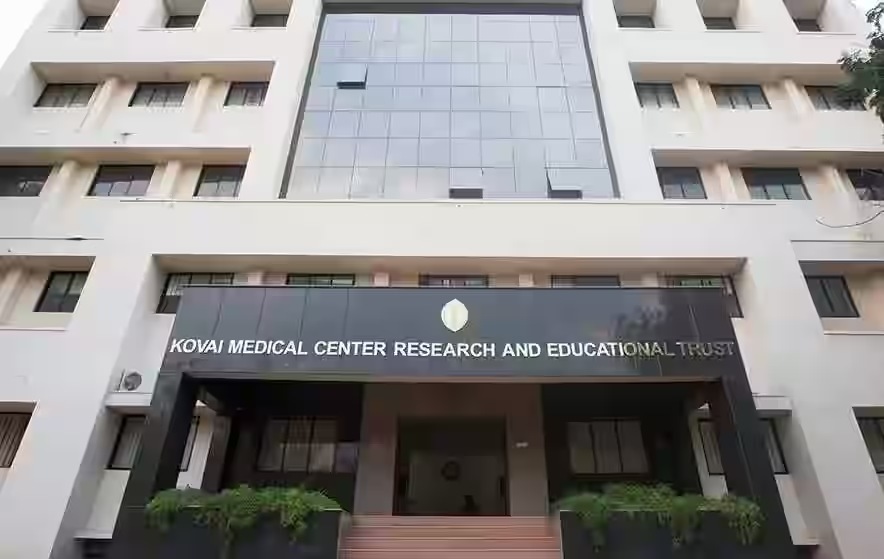
Let’s talk about Kovai Medical Center & Hospital Ltd. Founded in 1985, operating since 1990 from Coimbatore, with satellite centres in Sulur, Erode, Kovilpalayam, and a medical college started in 2019. This is not a startup. This is not a billion-dollar dream. This is a group of Tamil Nadu doctors who built a hospital in Coimbatore, treated patients well, reinvested profits, and kept building more beds. Very boring. Very profitable.
The company operates 1,847 beds across four facilities (as of March 2025), runs 750-bed medical college hospital with 150 MBBS students annually, and serves both urban Coimbatore elites and rural Tamil Nadu and Kerala patients. In FY25, they delivered ₹1,373 crore in revenue — up 12.4% year-on-year. Outpatient count: 12.4 lakhs. Inpatient count: 1.05 lakh. Bed occupancy rate: 60.44%, up from 48.7% just three years ago.
Not flashy. Not trading on “blockchain healthcare innovation.” Just a well-run hospital chain with promoters who have four decades of healthcare industry experience. Dr Nalla G Palaniswami and Dr Thavamani Devi Palaniswami don’t do CNBC interviews. They do appendectomies. And apparently, they’re quite good at both.
But here’s the plot twist: they’ve just announced ₹600 crore in new expansion — ₹300 crore for a 300-bed Sulur facility, another ₹300 crore for a children’s hospital, 3-year timeline. Chennai land acquisition for ₹121 crores already done. This is the moment where a profitable regional player is building a national footprint.
Press Release Insight (Feb 2026): “Board approved ₹300 crore Sulur expansion (300 beds) and ₹300 crore children’s hospital (300 beds), 3-year timeframe.” Translation: We’re going to have 2,400+ beds by 2029, which means more OTs, more ICU beds, more equipment, and significantly higher revenue run rate. Meanwhile, the stock is trading at 23.5x P/E. Fair? Expensive? You’ll decide by the end of this.
03 — Business Model: WTF Do They Even Do?
They Treat Sick People. Charge Them. Reinvest Profits. Repeat.
KMCH operates in two segments. First: Healthcare (93% of FY25 revenue) — inpatient care, outpatient care, diagnostics, ICU services. Second: Education (7% of FY25 revenue) — MBBS degree program, faculty, hospital attached to the medical college. The healthcare business is what it sounds like — patients come, doctors treat, hospital makes money. Simple. Effective. Boring in the best way possible.
Revenue mix from healthcare is diversified — Neurology and Cardiology contribute 23% of total revenue. They also do transplants (kidney, liver), gynecology, paediatrics, oncology. In FY23, they installed IceCure, a cancer treatment system — third in India, first in South India. In FY24, they added AI-driven CORI Robotic Joint Replacement from the USA and Siemens 3D C-Arm for precision fracture surgeries. They invest 4% of revenue annually into equipment and technology upgrades.
The medical college is a separate cash generator. 150 MBBS students per year, ₹14 lakh average annual fee, fully subscribed. 750-bed college hospital is operational at full capacity. This is not just a hospital with a college attached — it’s a structured education business that generates ₹85-100 crore annually (7% of total revenue).
Bed Occupancy60.4%FY25: Up from 48.7%
Outpatient Visits12.4LFY25: Up 35% (3yr)
Inpatient Count1.05LFY25: Growing steady
ARPOB (₹)22,581Average Rev/Bed/Day
Healthcare Unit Economics: Average Revenue Per Occupied Bed (ARPOB) is ₹22,581 in FY25, up from ₹21,144 in FY23. With 1,847 operating beds and 60.4% occupancy, they’re running ~1,115 occupied beds per day. That’s ~₹74 crore annual revenue from inpatient alone (1,115 × 22,581 × 365 days), plus OPD and education. Simple math. High repeat economics.
💬 Have you ever noticed how hospitals never advertise bed occupancy rates? KMCH does. Confidence or coincidence?
04 — Financials Overview
Q4 FY25: The Latest Numbers
Result type: Quarterly Results (Q4 FY25) | Q4 FY25 EPS: ₹59.42 | Annualised EPS (Q4×4): ₹237.68 | Full-year FY25 EPS: ₹190.96
| Metric (₹ Cr) |
Q4 FY25
Mar 2025 |
Q4 FY24
Mar 2024 |
Q3 FY25
Dec 2024 |
YoY % |
QoQ % |
| Revenue | 407 | 357 | 392 | +14.0% | +3.8% |
| Operating Profit | 116 | 101 | 107 | +14.9% | +8.4% |
| OPM % | 28% | 28% | 27% | ~0 bps | +100 bps |
| PAT | 65 | 55 | 59 | +12.5% | +10.2% |
| EPS (₹) | 59.42 | 49.99 | 53.79 | +18.9% | +10.5% |
EPS Math Check: FY25 annualised EPS via Q4×4 = ₹59.42 × 4 = ₹237.68. But full-year FY25 EPS = ₹190.96. Why the gap? Because Q4 was the strongest quarter. Q1-Q3 averaged lower. Current CMP ₹5,073 ÷ FY25 actual EPS ₹190.96 = P/E 26.6x. But if you annualise the last quarter’s run rate, you get 21.4x. The stock is priced between “growth priced in” and “market’s being cautious.” Healthcare stocks trade on bed capacity. KMCH just added 300+ beds in Q4 itself (commissioning of new blocks). Next year’s EPS annualisation will be higher than actual. This is the beauty of expansion cycles.
05 — Valuation Discussion: Fair Value Range
What’s This Hospital Chain Actually Worth?