01 — At a Glance
The Toilet Paper Stocks Everyone Wanted Is Now Just… Toilet
- 52-Week High / Low₹7,275 / ₹4,463
- Q3 FY26 Revenue₹499 Cr
- Q3 FY26 PAT₹24 Cr
- Q3 FY26 EPS₹18.35
- Annualised EPS (Q3×4)₹73.4
- Book Value₹1,063
- Price to Book4.26x
- Dividend Yield1.42%
- Debt / Equity0.04x
- FY26 Guidance (Revised)Cutting growth
The Auditor’s Honest Moment: Cera delivered Q3 revenue of ₹499 Cr (+11.1% YoY), which looks flashy until you see that EBITDA margin collapsed from 13.2% to 10.2% YoY. PAT fell 47.8% YoY to ₹24 Cr. Project discounts? Up. Brass costs? Up 12%. Senator stores bleeding cash? Also up. The stock has delivered -29% returns in 6 months. Meanwhile, the company is quietly slashing guidance for its ₹20 Cr new-brand launches. Nothing screams “growth story” like cutting your own forecasts in half.
02 — Introduction
Luxury Bathrooms for People Who Can’t Afford Them
Cera Sanitaryware is a study in contradictions. It’s market leader in India’s sanitaryware space with a genuinely beloved brand. Go to any architect’s Pinterest board and Cera is there. Ask any Indian middle-class family what they’d buy if they were renovating and you’ll hear “Cera.” Yet, the stock trades at 26x P/E while managing 10.2% EBITDA margins, works with 61% outsourcing in sanitaryware (meaning it’s halfway to a asset-light model it can’t quite commit to), and just cut guidance for its luxury Senator brand by a full 50% because “stores have been taking some time to get ready.” Translation: nobody’s walking into ₹50,000 bathtub showrooms in Bangalore.
The company has three brands now: CERA (mass-premium), CERA Luxe (premium), and Senator (the new luxury play that cost ₹6 Cr in Q3 alone in operating losses). Management says Senator is “structurally important” for long-term margin enhancement. Investors are increasingly wondering if “structure” here is a technical term for “we’re burning cash for a decade and calling it strategy.”
Q3 FY26 results landed in December 2025. Revenue up 11.1%, growth feels good until you realize it came from project sales at 12% discounts. EBITDA got slapped by brass inflation (12% jump), gas cost creep, and marketing spend phasing (₹17.27 Cr in Q3 vs ₹13.87 Cr in Q2 — almost ₹4 Cr just to sell more bathrooms). The stock tanked 29% in 6 months. Yet the P/E is still 26x. This is the story of a company in a perpetual state of becoming something else while its core business slowly loses profitability.
From the Concall (Feb 2026): “Gradual revival in market conditions… structural in nature and sustainable in the near term.” Translation: demand is still uneven, we’re taking project deals at any discount to hit numbers, and we have no idea if next quarter will be as strong. But sure, it’s “structural.”
03 — Business Model: WTF Do They Even Sell?
Bathrooms, Tiles, and Broken Dreams
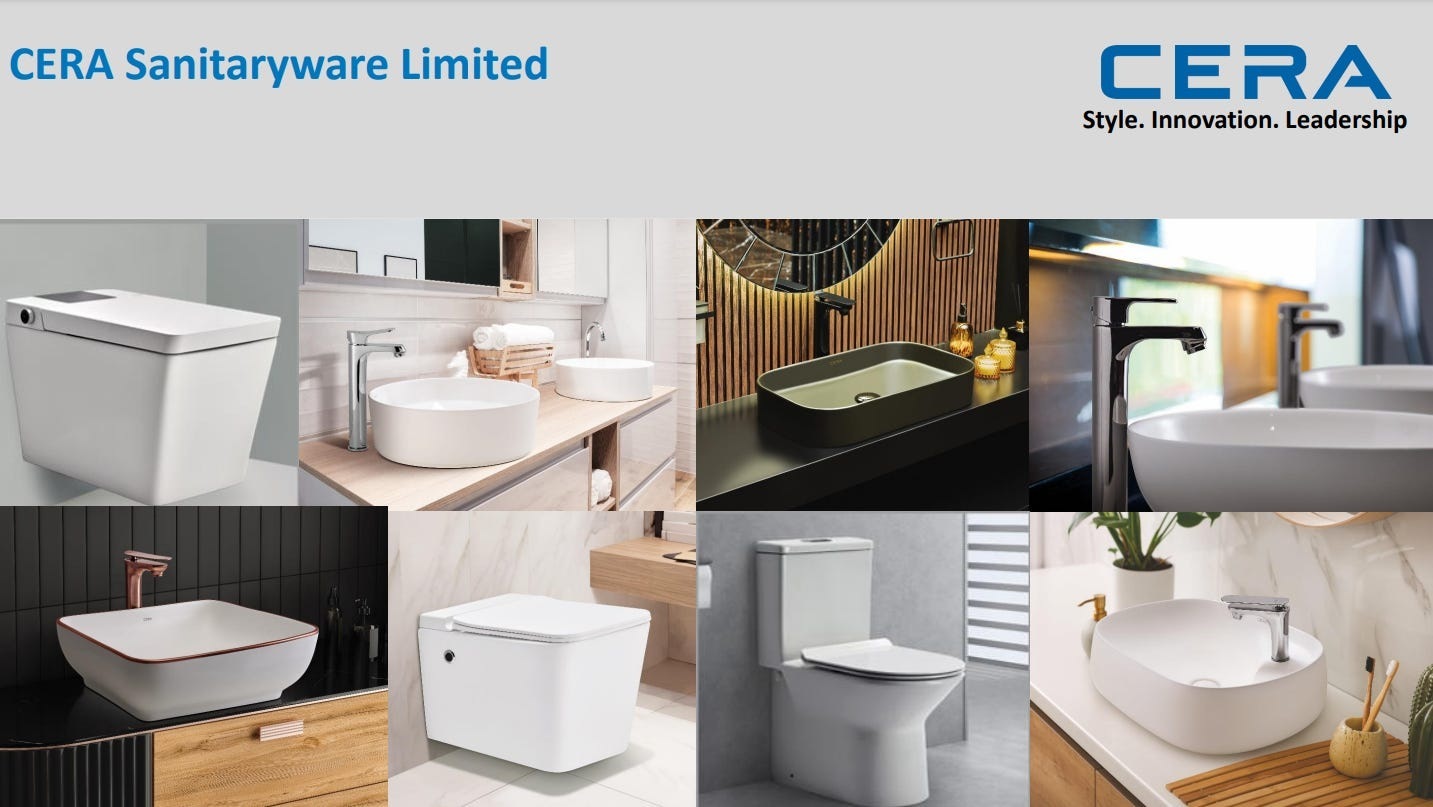
Cera makes sanitaryware (toilets, sinks — things that hold water), faucetware (taps and fittings), tiles, and wellness products (bathtubs and shower enclosures). It has three brands: CERA (the workhorse, mass-premium), CERA Luxe (the aspiration play), and Senator (the luxury showpiece that costs ₹20+ Cr to build showrooms for and generates ₹7-8 Cr in annual sales). The company operates through a mix of in-house manufacturing and outsourcing, with ~57% of sanitaryware outsourced and ~48% of faucetware outsourced.
The business model is straightforward: buy clay, brass, and other raw materials, shape them into fancy bathroom fixtures, stick the CERA label on it, distribute through 6,540 dealers and 24,400 retailers, and pray that home renovation cycles remain strong. Revenue split: Sanitaryware 48%, Faucetware 40%, Tiles 10%, Wellness 2%. Geographic split: South 35%, North 33%, West 21%, East 9%. The company is literally present everywhere an Indian family might decide to renovate their loo.
The real story is the project business. Cera wins big real estate projects (hotels, apartments, offices) and sells at a premium because architects trust the brand. But in Q3, project sales hit 39% of revenue (vs 30% historically) because retail is struggling. And guess what happens when you need to hit revenue targets? You slash pricing on projects. Management admitted it: project discounts “largely increased” and project spends are up 12% YoY but at much lower margins. The company is essentially borrowing sales from tomorrow’s profits to look good today.
Sanitaryware48%Revenue Mix
Faucetware40%Revenue Mix
Tiles10%Revenue Mix
Wellness2%Revenue Mix
The Outsourcing Question: Cera outsources 57% of sanitaryware and 48% of faucetware. This is allegedly flexible (“we can bring items in-house or outsource based on demand”), but it also means the company doesn’t own 50%+ of the value chain. If demand crashes, the company loses negotiating power with outsourcing partners. If demand soars, it’s capped by partner capacity. It’s not an asset-light model — it’s a half-pregnant model.
💬 Question: Do you think a company can be “luxury” if it outsources half its manufacturing? Drop your thoughts!
04 — Financials Overview
Q3 FY26: The Numbers That Hurt