01 — At a Glance
The Crop Protection Play Nobody Asked For
- Company Age40 Years (Est. 1985)
- Pre-IPO Market Cap₹1,488.60 Cr
- IPO Issue Size₹400 Cr
- Fresh Issue75 lakh shares (₹240 Cr)
- OFS Component50 lakh shares (₹160 Cr)
- H1 FY26 Revenue₹847.61 Cr
- H1 FY26 PAT₹81.07 Cr
- H1 ROE15.62%
- Debt-to-Equity0.55x
- Promoter Dilution98.32% → ~60%
Quick Take: GSP Crop Science is bringing a ₹400 crore IPO to the market between March 16–18. It’s a Gujarat-based agrochemical manufacturer with 40 years of history, 524 product registrations, and global presence in 37 countries. The math looks fair (post-IPO P/E of 9.18x vs pre-IPO 15.34x), but the business itself is growing like your grandfather drives — steady, predictable, and occasionally napping at red lights. ROE at 15.62% is respectable but not “lose sleep over missing it” territory. Founders are cashing out a massive 38% dilution. That’s either confidence or exit planning. You decide.
02 — Introduction
Where Three Brothers Farm Chemicals For The World
Meet GSP Crop Science Limited — a company so boring that its own IPO materials probably need coffee to stay awake. Founded in 1985 in Ahmedabad by Bhavesh Vrajmohan Shah, Tirth Kenal Shah, and Vilasben Vrajmohan Shah (yes, they’re brothers), it’s spent four decades doing what agrochemical companies do: making insecticides that kill bugs, herbicides that kill weeds, and fungicides that kill fungi. Revolutionary? No. Necessary? Absolutely. Profitable? Sure, when crop prices cooperate.
The company operates out of Kathwada and Odhav in Gujarat, runs two dedicated R&D facilities, and has somehow accumulated 102 patents with 108 applications pending. That’s not nothing. It’s selling formulations (495 registrations as of Sept 2025) and technicals (129 registrations) across India’s agricultural heartland and export markets spanning USA, Brazil, Vietnam, Singapore, and Australia. The company has 1,221 permanent employees — mostly engineers and chemists paid to ensure the chemicals don’t blow up the factory.
What’s actually interesting is the international play. While most Indian agrochemical companies shout about their domestic market share, GSP quietly exports to 37 countries and has 524 total product registrations. That’s real manufacturing capability, not just local distribution. But here’s the thing — the stock market doesn’t pay you for quiet execution. It pays you for stories. And GSP’s story is essentially: “We make crop chemicals. Very well. Now please buy our shares.”
Founder Note: The Shah brothers still own 98.32% pre-IPO. Post-IPO, they’ll hold ~60% (assuming maximum dilution). That’s a 38-percentage-point drop in one listing. Either they’ve found religion about raising capital for expansion, or they’re constructing an elegant exit while maintaining board control. Fun to watch.
03 — Business Model: Kill Bugs. Make Money. Go Home.
Insecticides, Herbicides, Fungicides. Pick Your Poison.
GSP Crop Science operates a straightforward two-legged business model that would make an accountant cry tears of joy — because there’s absolutely nothing fancy about it.
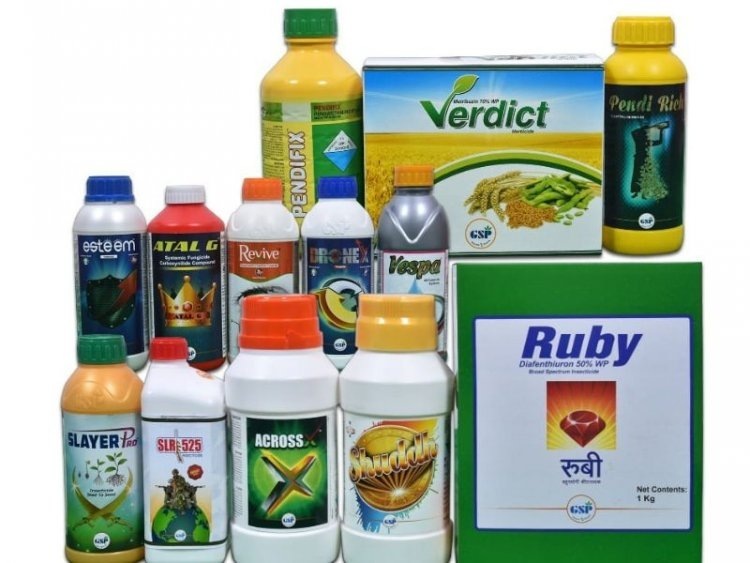
Segment 1: Formulations. Buy active ingredients (mostly imported base chemicals), blend them with additives, package them. Sell to distributors, agricultural retailers, and large-scale farmers directly. Formulations represent the bulk of revenue — compounds like insecticides, herbicides, fungicides, and plant growth regulators. Think of it as the “branded consumer product” version of agrochemicals. Farmers recognize brand names on bottles. GSP owns several such brands, plus sells under OEM agreements with global companies.
Segment 2: Technicals. Manufacture concentrated active ingredients (the pure chemical before formulation). Sell to other agrochemical companies who rebrand and reformulate. This is the B2B, margins-are-lower-but-volume-is-higher play. It’s also the export-heavy segment.
Revenue mix pre-IPO: Formulations ~70-75%, Technicals ~25-30%. International ~30-35% of total, domestic ~65-70%. The business is capital-light on the revenue side (contract manufacturing, outsourced distribution) but capex-heavy on the quality side (R&D, regulatory compliance, manufacturing certifications). GSP has invested heavily in both.
Total Registrations524As of Sept 2025
Patents102Granted
Patent Apps108Under Process
Export Markets37Countries
Manufacturing Reality: Two dedicated facilities in Kathwada and Odhav, Gujarat. The facilities are designed to handle “complex chemistries” — meaning they’ve invested in proper infrastructure. Water treatment, waste management, regulatory compliance — all the boring stuff that separates legitimate manufacturers from backyard chemists. This capex shows. It’s also a moat: setting up an agrochemical facility legally in India takes 2-3 years and ₹50+ crores. Barriers to entry are real, even if the business model is simple.
💬 Quick poll: If you’re a farmer in Bihar and your local retailer stocks GSP, do you specifically ask for it by name, or just grab whatever’s cheapest? This matters more than you think for a company trying to be “branded.”
04 — Financials Overview: The H1 Report Card
First Half of FY26: Steady Eddie, Not Star Player