01 — At a Glance
The Ayurveda Play That Wall Street Wishes It Understood
- 52-Week High / Low₹850 / ₹313
- TTM Revenue₹725 Cr
- TTM PAT₹204 Cr
- TTM EPS₹16.43
- Q3 FY26 EPS₹5.37
- Book Value₹28.4
- Price to Book20.5x
- Dividend Yield0.19%
- Debt / Equity0.30x
- 3-Year Revenue CAGR47.4%
The Auditor’s Verdict: Jeena Sikho closed Q3 FY26 with ₹222 Cr revenue (+92% YoY), ₹67 Cr PAT (+405% YoY), and an operating margin that somehow expanded to 45% despite adding hospitals and clinics like it’s planting trees. The stock went -21.5% in 3 months. Yes. A company growing revenue 92% and profit 405% went down. Indian markets—where logic goes to die and patience becomes a currency.
02 — Introduction
Why Your Ayurveda Doctor Has a Better Business Model Than Your Tech Startup
Jeena Sikho Lifecare is not sexy. It doesn’t make apps. It doesn’t disrupt anything. It runs hospitals where people go when they’re sick, and sells Ayurvedic products for ₹500 that cost ₹50 to make. Gross margin: 89%. If Berkshire Hathaway saw these unit economics, Warren Buffett would weep into his Cherry Coke.
The company started 10 years ago with a founder named Manish Grover who decided that “traditional medicine + professional healthcare + e-commerce” could scale in India. Turns out, when your population is 1.4 billion and your average premium healthcare spend is ₹0 per capita, selling affordable Ayurveda is not a bad play.
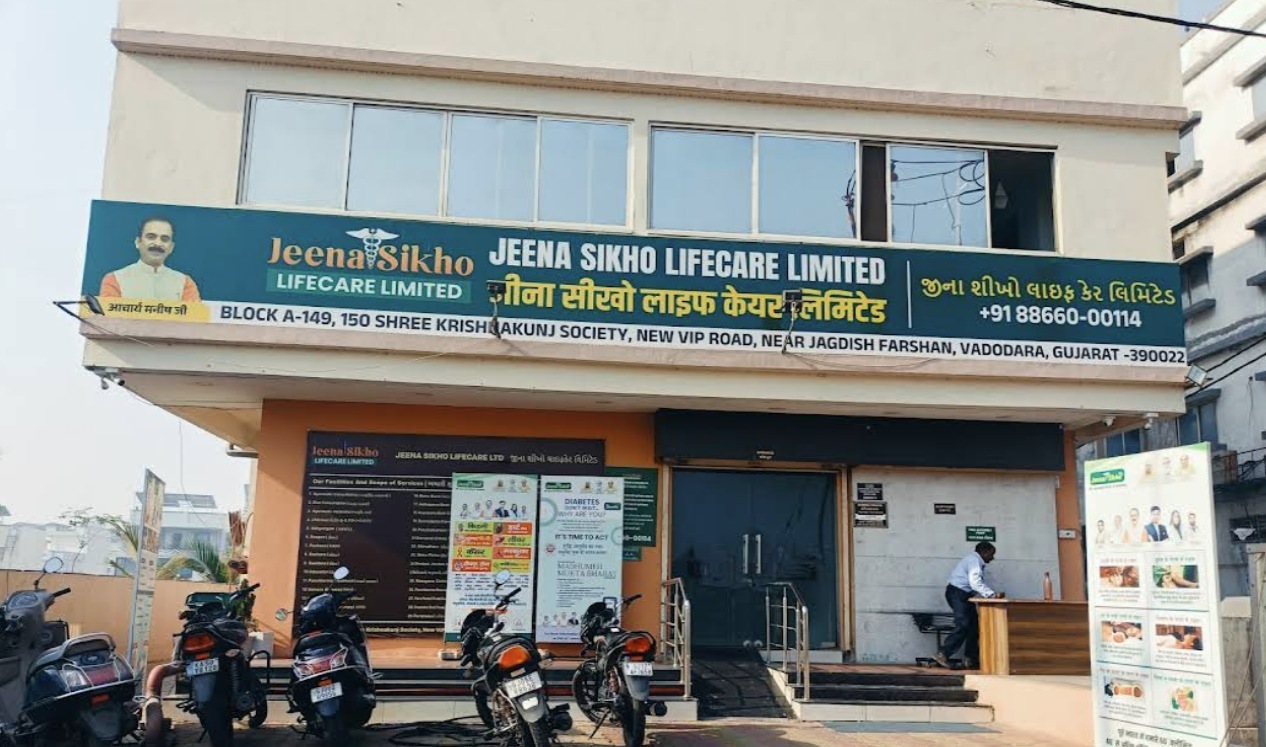
Fast-forward to Q3 FY26: 36 hospitals, 74 clinics, 2,290 operational beds, 50.2% ROCE, and a business model so capital-light that the company’s biggest expense is probably paying managers to stay awake in board meetings. Oh, and they just inked a deal with Entero to distribute Ayurvedic products through 1 lakh chemists. Casually. Like it was nothing.
The stock? Down 21.5% in 3 months. The valuation multiple? 35.4x P/E. The management’s ambition? ₹500 Cr OTC business in 2 years, 7,000–10,000 beds in 5 years, international expansion in 6 countries, and somehow turning diagnostics into a profit centre with zero capex. If this was a Bollywood film, you’d call it unrealistic.
From Concall (Feb 2026): “Despite continuous investment in expansion… operational efficiency has remained strong.” — CFO Jeena Sikho. Translation: We’re growing like weeds but somehow the weeds are making more money.
03 — Business Model: The Ayurveda Ecosystem They Built
Hub-and-Spoke, E-Commerce, Diagnostics, and the Kitchen Sink
Jeena Sikho operates three businesses that feed each other like a perfect ecosystem: hospitals drive patient volumes, patients buy products, products create e-commerce channels, e-commerce volumes drive diagnostics adoption, and diagnostics drive insurance-led hospital admissions. It’s vertical integration for health-conscious millennials who think turmeric latte is medicine.
Hospitals & Clinics (53% of revenue): The company runs a hub-and-spoke model. Big hospitals (100+ beds) sit in cities like Meerut (315 beds), Lucknow (115 beds), Panchkula (50 beds). Small clinics and daycares feed patients into these hubs. About 40% of clinics are franchise-run, but management is “slowly reducing franchises” because they contribute “very little sales” and the company now prefers owning 100% to ensure margin and control. Q3 operational bed count: 2,290 (out of 2,800 total). Bed occupancy: 57–58% running average. ARPB (Average Revenue Per Bed): ₹8,337 for Q3.
Products (47% of revenue): 350+ SKU portfolio with 89% gross margin. Manufactured by third parties, sold through their own call centres, hospitals, clinics, online, and now through Entero (1 lakh pharmacies target). The OTC play is the new bet. They’ve launched “Pet Yakrit Pleeha Shuddhi Kit” to ₹10 Cr monthly sales. Next up: “NutriRoz” (nutritional deficiency play). Management targets 16 products launched by end of CY2026 and ₹500 Cr OTC business within 2 years.
Diagnostics (new, capex-free): Partnership with Chandan (50-50 deal). Already running 34 centers, targeting 64 in 6 months. Zero capex from JSLL. Chandan funds equipment (6 Fibroscan machines, ₹3.5 Cr investment). Current run-rate: ₹3 lakh/day, target ₹5 lakh/day. Management thinks this hits ₹10–15 Cr turnover. The playbook: free first tests, insurance card mechanism, patient-flow acceleration. Brilliant because it’s not their money.
Hospital Beds Operational2,29057–58% occupancy
ARPB (Q3)₹8,337YoY growth focus
Product Gross Margin89%Highest margin pool
Capex Per Bed₹3–4 LakhCapital light by design
The Distribution Play: Entero deal finalised “last week.” Entero has ~10% market share and 1.25 lakh stores. JSLL becomes their “exclusive Ayurveda partner.” Currently selling OTC at ~2,000–2,500 medical stores. Post-Entero, “we will reach 1 lakh stores straightaway.” Management’s own words. This is not ambition—this is the plan.
💬 Here’s the real question: If Ayurveda is scientifically validated, why is the stock down 21.5% while growing 92%? Is it just valuation, or is India still not ready to believe in its own medicine?
04 — Financials Overview
Q3 FY26: The Numbers That Make No Sense In A Good Way