01 — At a Glance
The Broadcast Software Company That Finally Found the Off-Switch on Losses
- Q3 FY26 Revenue₹404 Cr
- Q3 Revenue Growth YoY+22.4%
- Q3 FY26 PAT₹31 Cr
- Q3 FY26 EPS₹1.60
- Annualised Q3 EPS₹6.40
- 9M FY26 Revenue₹1,109 Cr
- 9M Growth YoY+30%
- 9M PAT₹37 Cr
- Debt / Equity0.07x
- IPO ListingJan 21, 2026
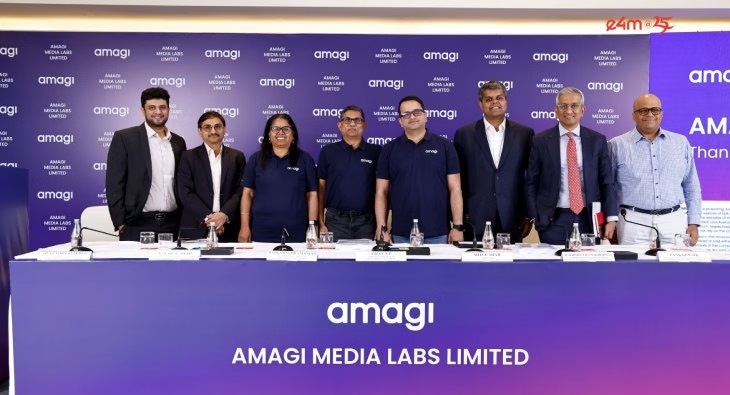
The Auditor’s Opening Note: Amagi just IPO’d at ₹361 on Jan 21, 2026. Raised ₹1,789 crore. Declared Q3 results 3 weeks later with ₹404 crore revenue (+22% YoY) and ₹31 crore PAT (+287% YoY). Full-year FY25 was a ₹69 crore loss. Six weeks later: profitable software company. The stock is up 1.1% to ₹365, meaning the market priced in the profitability before the results. Also meaning: everyone already knows. Also meaning: at 57x forward P/E, what’s left to surprise on?
02 — Introduction
Welcome to Cloud Broadcast: Where Hardware Dinosaurs Go to Die (And SaaS Companies Go to Thrive)
Picture a TV broadcaster in 2008. ₹50 crore of playout servers. Air-conditioned rooms consuming electricity like a Vegas casino. Tapes. Humans. Panic at 11 PM on Sunday when the encoder crashes. That was broadcasting.
Amagi walked in and said: “Cloud. Everything. No hardware. Same uptime. You pay per channel.” Sounds nice, right? Convinced exactly zero broadcasters in 2008 because trust in Bangalore startups managing mission-critical playout was lower than Elon’s attention span.
Fast forward 18 years. Only 10% of global TV channels have moved to the cloud. That means 90% of an estimated $16.9 billion TAM is *still sitting in on-prem hardware*. And Amagi — which IPO’d 6 weeks ago — just proved it can not only migrate that hardware to cloud, but make money doing it. Big money. ₹404 crore quarterly big.
But here’s the kicker: Amagi is priced like it’s already migrated 50% of the TAM. 57x forward P/E on 22% revenue growth is not “emerging software company” valuation. It’s “we believe cloud broadcast is the next Netflix” valuation. Let’s dig into whether that belief is justified or whether you’re buying at the peak of VC enthusiasm.
Concall Insight (Feb 2026): Management emphasized NRR of 127% as central to the growth model and referenced “net retention driven business.” Translation: they’re selling to the same customers, who keep buying more as they scale. That’s good. The problem: top-10 customers are 40% of revenue. That’s not good. Management said they’re “constantly looking at concentration and extending contracts for longer duration to de-risk.” That means they’re willing to lock in lower price-per-year for multi-year durability. Smart. But margin-dilutive in the near term.
03 — Business Model: WTF Do They Even Do?
They Sell Playout Software. That Sits In AWS. And Somehow It Works.
Amagi is a SaaS platform for broadcast and connected TV (“full-stack, cloud-native” in marketing speak). They handle the entire video lifecycle: from production to playout to distribution to ad monetization. It’s Netflix’s backend, but for TV broadcasters, news studios, and streaming platforms.
Three revenue buckets:
Cloud Modernization (19% of FY25): Migrate on-prem broadcast infrastructure to cloud. Amagi Cloudport is the product — channel management, playout, scheduling, 24/7 99.99% uptime. Customers lock in 3–5 year contracts at fixed monthly fees per channel.
Streaming Unification (57% of FY25): Once in the cloud, distribute to everywhere. FAST platforms (Pluto, Roku, Samsung TV Plus), OTT apps, linear streams. 300+ distributors in 40+ countries. Usage-based pricing. Amagi built a three-sided marketplace: content owners ↔ distributors ↔ advertisers.
Monetization & Ad-Tech (24% of FY25): Amagi Thunderstorm is the real money-printer. Server-side ad insertion. Personalised ads for live and on-demand. Customers pay per impression. Q3 delivered 13 billion impressions (+60% YoY). The take rate on billions of impressions is gravy once infrastructure scales.
The Moat: Once you migrate your broadcast workflow to cloud, switching is a six-month, multi-million-dollar project. So Amagi locks customers in. 127% NRR means existing customers expand faster than churn. The network effect comes from ecosystem: 400+ content providers, 350+ distributors, 75+ advertisers all using the same marketplace.
The Risk: AWS price increases hurt margins. Concentration in top-5 (40% of revenue) is a sword of Damocles. And the TAM, while large, is *slow* to adopt because broadcasters hate change.
Content Hours (Q3)800k+Up 64% YoY
Ad Impressions (Q3)13BUp 60% YoY
Channel Deliveries9,000+Global Scale
Top-50 Penetration45%Global Media Cos
From the Concall: Management framed operational KPIs as “leading indicators” that may not map one-to-one to quarterly revenue “due to yield/CPM layers, contract constructs, and customer ramp dynamics.” Translation: record impressions + strong channel deliveries don’t guarantee record revenue in that quarter because of timing lags, repricing on scale, and deal structures. This is why sequential reads are useless for Amagi. Stick to 9-month and full-year.
💬 If cloud broadcast software has a 127% NRR and 45% customer penetration in top-50 global media cos, why is growth only 22–30%? Shouldn’t math suggest 50%+ growth? Drop your theory in the comments.
04 — Financials Overview
Q3 FY26: The Profitability Plot Twist