01 — At a Glance
The Housing Finance Company That Refuses to Stay Small
- 52-Week High / Low₹2,238 / ₹1,145
- FY26 (TTM) Revenue₹2,605 Cr
- FY26 (TTM) PAT₹627 Cr
- FY26 (TTM) EPS₹79.2
- Q3 FY26 Annualised EPS₹85.92
- Book Value₹591
- Price to Book1.98x
- Debt / Equity3.08x
- AUM (Q3 Dec 2025)₹222 Bn
- 1yr Return-37.5%
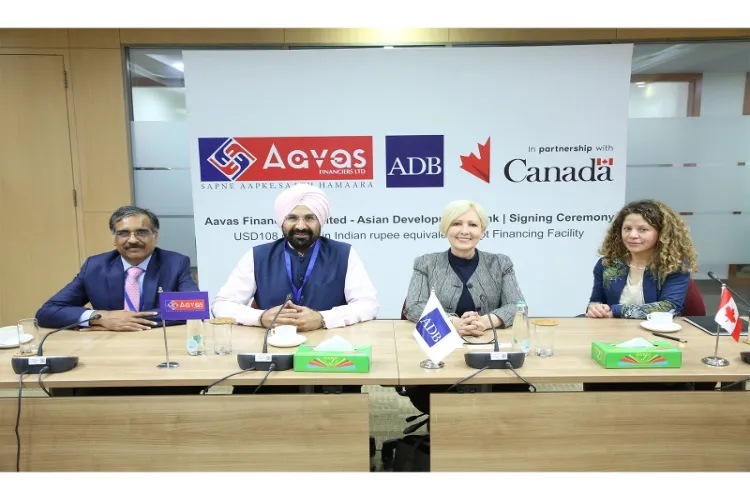
The Auditor’s Coffee Break Commentary: Aavas closed Q3 FY26 with ₹674 crore quarterly revenue (+13% YoY), ₹170 crore PAT (+16.1% YoY), and AUM of ₹222 billion (+15% YoY). The stock has returned -37.5% over the past year while the company has grown profits at 11.3% CAGR over 5 years. This is the equity markets’ way of saying: “Nice fundamentals, buddy. Now find someone else to pump the stock.” Meanwhile, management raised ₹975 crores from a multilateral development bank to fund affordable housing in tier-2 and tier-3 regions. Strategic, boring, and utterly necessary.
02 — Introduction
Affordable Housing Finance. Sexy? No. Sleeping Beauty? Also No. Essential? Absolutely.
Aavas Financiers is not a household name. Your mother won’t mention it at the kitty group. It won’t trend on Twitter. But if you’re a self-employed electrician in Jaipur with ₹12.5 lakhs saved up and you need a home loan, Aavas is the bouncer at the door of your dream house — the one actually willing to let you in.
Incorporated in 2011, the company has spent the last 14 years building what banks call “inconvenient profitability” — lending to people who fall through the cracks of traditional banking’s scoring algorithms. Low-income self-employed customers (61% of the portfolio), secured by moderate-LTV mortgages, generating 14.3% ROE and zero dividend payout year after year because they’re too busy compounding.
Then came the CVC Capital takeover. By June 2025, CVC acquired 48.96% from the previous PE sponsors (Kedaara Capital and Partners Group), triggering the biggest shareholder wealth destruction event of the year: a stock that dropped 37.5% while the company’s fundamentals got materially better. If this isn’t a textbook case of “the market doesn’t always price things correctly,” nothing is.
Fast forward to Q3 FY26, and management just announced the largest NCD placement in company history (₹975 Cr from a multilateral), guided FY27 disbursement growth of 25%+, and opened 410 branches across 15 states. This is not a company biding its time. This is a company in full execution mode while investors panic-sell.
Concall Highlight (Feb 2026): “This is an important inflection point for credit,” management said, citing Union Budget 2026, GST rationalization, trade liberalization, and FDI momentum as structural tailwinds for affordable housing. Translation: the government is finally paying attention to people who actually need houses.
03 — Business Model: WTF Do They Even Do?
They Lend Money to People Banks Reject. And They Get Paid Back.
Aavas takes deposits (via NCDs, bank borrowings, and multilateral funding), converts them into home loans and MSMEs secured by property mortgages, and collects the interest. Simple. Boring. Completely unsexy. Also the highest-ROE path available in Indian finance for lending to underserved markets.
The target customer: a self-employed mason, tailor, shopkeeper, or taxi driver earning ₹30,000–₹50,000 per month in tier-2 or tier-3 cities. Zero digital footprint. Zero formal income documentation. Zero prior banking relationships. Every traditional lender’s nightmare. Aavas’s core demographic. They’ve built an underwriting infrastructure so granular it can predict defaults three months before they happen, using “predictive, prescriptive, and descriptive analytics,” which is fancy speak for: we’ve seen this before, and we know how it ends.
Portfolio breakdown: Home loans (66% of AUM), MSME mortgages (21%), Loans Against Property (13%). Geographic base: Rajasthan still 33%, but expanding aggressively into Maharashtra, MP, UP, and now Tamil Nadu, Andhra Pradesh, Telangana. 404 branches as of Dec 31, with 410 as of January 31, 2026. Plan to add 50 branches in FY27 alone. Expansion model: “deep market” branches run by a Resident Relationship Officer (RRO) with minimal infra and <5 staff. Self-sustaining within 18 months. This is the anti-corporate-bloat playbook.
Home Loans66%AUM Mix
MSME Loans21%AUM Mix
LAP Loans13%AUM Mix
Avg Ticket Size₹12.5LHome Loan
Product Mix Shift: Non-home loan disbursements hit 40%+ (up from historical 35%). Management says this is accounting mechanics, not demand weakness — because home loan disbursements use “check mode” while non-HL uses RTGS, affecting recognition timing. PMAY 2.0 subsidy uptake is fueling home loan momentum anyway.
💬 Have you applied for a housing loan through a traditional bank and gotten rejected? Did you ever think an NBFC with RROs in tier-2 cities would be the one actually helping? Drop your story in the comments.
04 — Financials Overview
Q3 FY26: The Numbers That Actually Tell a Story
Continue reading with a premium membership.