01 — At a Glance
The Conglomerate That Forgot How to Make Profits
- 52-Week High / Low₹527 / ₹328
- Q3 FY25 Revenue₹1,150 Cr
- Q3 FY25 PAT-₹9.87 Cr
- Q3 EPS (₹)-0.31
- Book Value₹236
- Price to Book1.52x
- 12M EPS-₹0.39
- Debt / Equity0.34x
- Interest Coverage1.30x
- Dividend Yield0.03%
The Swan Is In Trouble: Q3 FY25 delivered minus ₹9.87 crore in PAT. The full year is on track for -₹11.4 crore. Revenue collapsed 39.7% YoY and 40% QoQ. The company is a holding vessel for eight different businesses — a shipyard being resurrected, an LNG port bleeding money, petrochemical trading in UAE, real estate, textiles, and tech ventures. Together, they’re accomplishing one thing brilliantly: destroying shareholder value. Yet the stock hasn’t crashed to ₹100. That’s because… well, hope is the most powerful drug in the Indian stock market.
02 — Introduction
Swan Corp: The Conglomerate That Forgot Its Manual
Swan Corp Ltd was born in 1909. We’re talking colonial-era textiles, the kind of legacy most Indian industrialists would spend billions on brand value to acquire. Over 116 years, Swan actually built something: real estate projects, textile mills, refinery storage in the UAE. Good stuff, boring stuff, profitable stuff.
Then, at some point between 2023 and 2025, Swan decided to become a holding company for a shipyard that was literally bankrupt (Reliance Naval), an LNG port that keeps missing deadlines (Swan LNG), and various equity stints in ventures that don’t yet exist. Enter: conglomerate chaos.
The company acquired a majority stake in Veritas India in January 2023 for ₹260 crore — a chemicals distributor operating from UAE. Then in January 2024, it acquired Reliance Naval and Engineering Limited (RNEL) through the NCLT for heavy lifting into defence shipbuilding. Simultaneously, Swan LNG keeps deferring its operational timeline. The textile unit hasn’t posted meaningful revenues in years. Real estate projects are in various states of completion or abandoned.
Q3 FY25 results? Revenue ₹1,150 crore (down 40% QoQ). PAT: -₹9.87 crore. Not a typo. A negative sign. The stock is at ₹346. Book value is ₹236. Market is paying 1.52x book for a company that’s literally losing money and burning cash. Let’s understand why.
The Hope Play: Investors believe SDHI (Swan Defence Heavy Industries, formerly RNEL) will eventually deliver. LNG will eventually operate. These are genuine assets. But “eventually” is a dangerous drug when your balance sheet is bleeding today.
03 — Business Model: WTF Are They Even Doing?
Eight Businesses Colliding in a Holding Company Car Crash
Swan doesn’t have a business model. It has eight, and they’re competing for the same cash reserves.
1. Petrochemical Trading & Storage (Veritas India): This is the crown jewel by revenue (74% in H1 FY25). Veritas operates a 170,000 cubic-meter storage terminal in Hamriyah, UAE, handling specialty chemicals, petrochemicals, bitumen, base oils. It’s automated, BIS-certified, profitable. But Swan acquired it in Jan 2023 for ₹260 Cr. That bet is slowly vindicated.
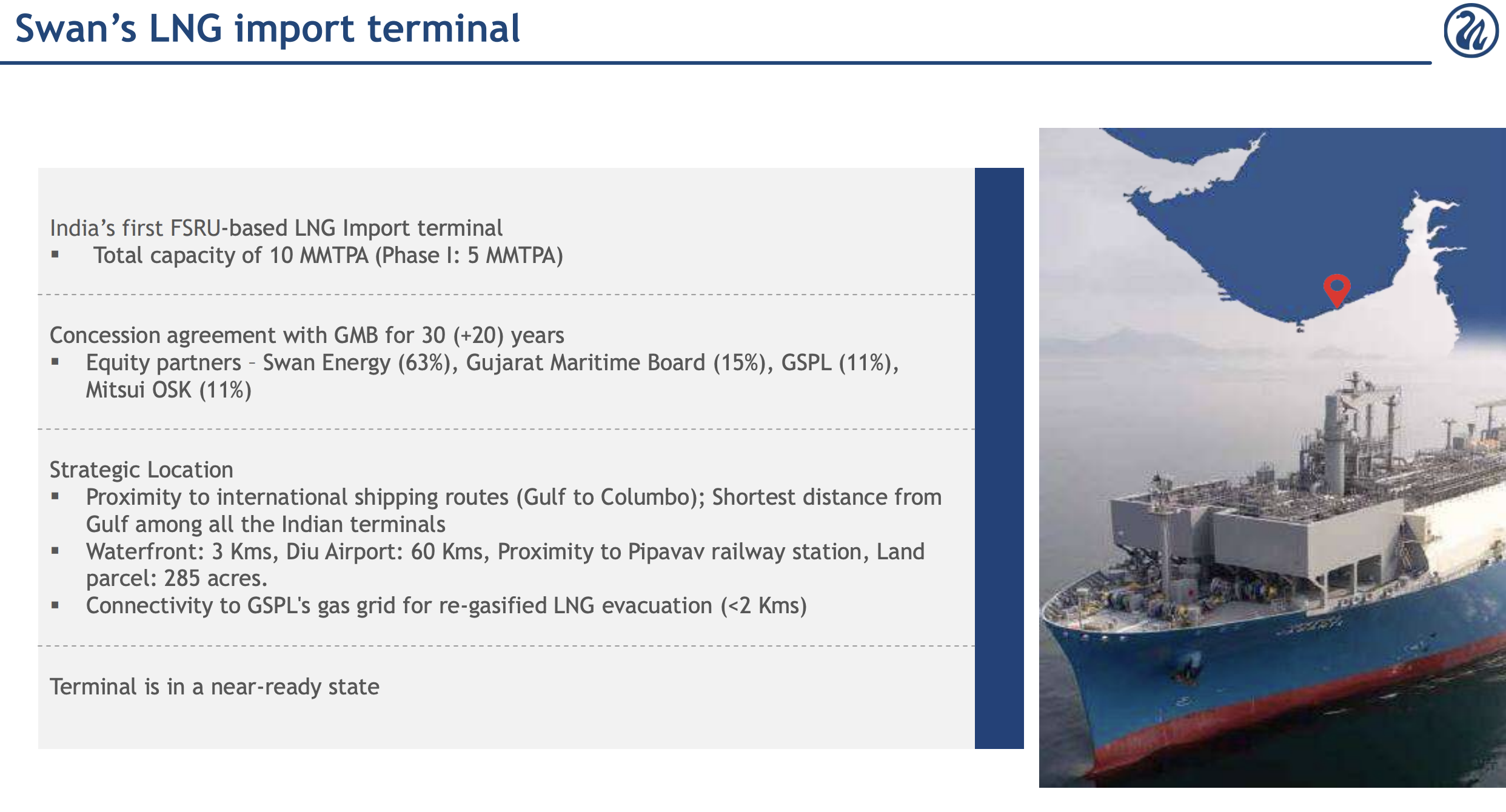
2. LNG Regasification (Swan LNG): India’s first FSRU-based LNG terminal at Jafrabad, Gujarat. Capacity: 10 MMTPA (Phase 1: 5 MMTPA). Booked throughput: 4.5 MMTPA on 20-year “use-or-pay” contracts with GSPCL, IOCL, BPCL, ONGC. It’s supposed to be a cash machine. Except it keeps not opening. Cyclone Vayu, COVID, Cyclone Tauktae, then FSRU sales to Turkey. The terminal is 88% complete (breakwater 85%, jetty 71%, onshore 39%). Swan has infused ₹2,200 crore to keep it afloat. This is a wealth destruction factory disguised as strategic infrastructure.
3. Defence Shipyard (SDHI): Acquired Reliance Naval & Engineering (RNEL) via NCLT in Jan 2024. India’s largest dry dock (662m × 65m). Monthly fabrication capacity: 12,000 MT. Eight vessels in near-completion. The company claims it will capture ₹30–40 billion in cumulative shipbuilding opportunity over 12–15 years. But RNEL was a disaster. Swan is rebuilding. Credible leadership (ex-GRSE CEO), but execution risk is astronomical.
4. Real Estate (Cardinal Infrastructure): Projects in Mumbai, Bangalore, Hyderabad. Completed execution: 27.14 lakh sq ft. Current: mostly completed, inventory lingering. Cardinal One in Bangalore has 14 unsold flats. This segment is neither growing nor generating material returns.
5. Textile Processing (Swan Mills): 100 years of legacy. Current production: 1 lakh meters/day capacity. Output: irrelevant to group financials (~2% of H1 FY25 revenue). Honestly, this unit feels like it’s there for sentimental reasons.
6. Logistics (Veritas Logistics): 600,000 sq ft of warehousing across Mumbai, Bangalore, Delhi. Acquired with Veritas. Profitable but small.
7 & 8. Tech Ventures (SwanSat, Agneyastra): Remote sensing for agriculture/defence/urban planning. Infrastructure security solutions. Both are pre-revenue, venture-stage capital sinks marketed as “strategic adjacencies.”
The Problem: Of these eight businesses, only Veritas Storage is actually printing cash. The rest are draining it. SDHI and Swan LNG are eating equity. Real estate is completed but not sold. Textiles are a legacy artifact. Tech ventures are burning monthly.
💬 If you invested ₹100 in Swan three years ago, where would you expect it to be now? Down 9%. Is that the fault of a conglomerate structure, or management incompetence? Drop your thoughts.
04 — Financials Overview: The Train Wreck in Numbers
Q3 FY25: The Numbers Are… Negative
Continue reading with a premium membership.